
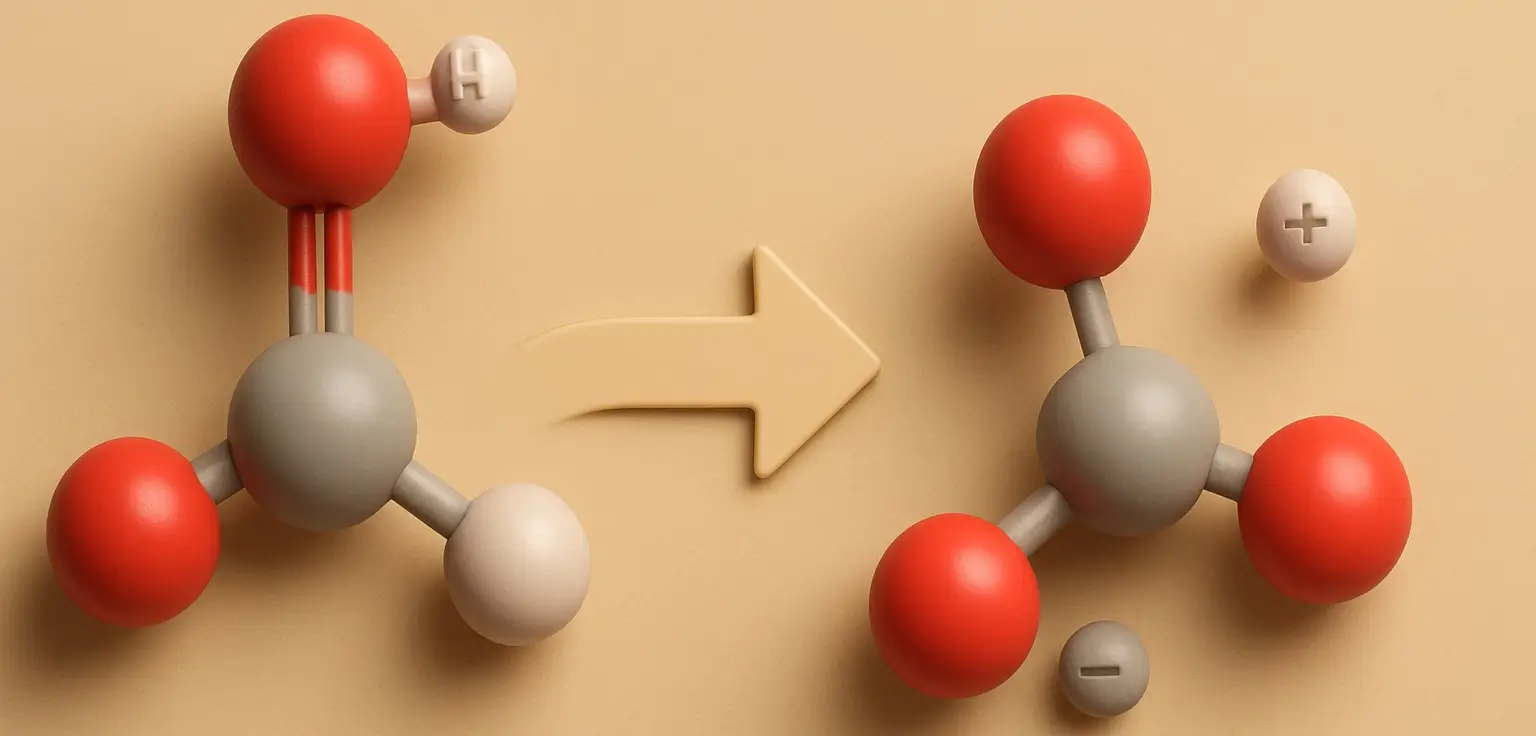
- Carboxylic Acids Acidity are characterized by their carboxyl group (-COOH) and are known for their ability to act as weak acids in solution, only partially ionizing to form a carboxylate anion (RCOO-) and a hydronium ion (H3O+).
- Several key factors contribute to the Carboxylic Acids Acidity:
Resonance Stabilization
- The carboxylate anion (RCOO-) formed upon deprotonation is stabilized by resonance.
- The negative charge is delocalized between the two oxygen atoms, represented by two resonance structures, reducing the energy of the anion and enhancing stability.
- This stabilization encourages the release of a proton from the carboxylic acid, increasing its acidity.
Electronegativity
- The carbonyl group (C=O) within the carboxyl group exhibits significant polarity due to the difference in electronegativity between carbon and oxygen.
- This electronegativity makes the O-H bond more polar and thus more susceptible to releasing a proton, enhancing the acid’s strength.
Advertisements
Inductive Effect
- The acidity of carboxylic acids is influenced by the presence of electron-withdrawing groups (EWGs) or electron-donating groups (EDGs) attached to the molecule.
- EWGs increase acidity by further stabilizing the carboxylate anion through electron withdrawal.
- Conversely, EDGs decrease acidity by destabilizing the anion with electron donation.
Aromaticity
- For aromatic carboxylic acids, the aromatic ring can also stabilize the carboxylate anion through resonance.
- This stabilization is particularly evident in benzoic acid derivatives, where resonance with the aromatic ring enhances the acidity of the carboxylic acid.
Solvation Effects
- The solvent’s nature significantly impacts the acidity of carboxylic acids.
- Polar solvents, like water, stabilize the carboxylate anion and hydronium ion through solvation, promoting the acidic character of carboxylic acids.
Advertisements