
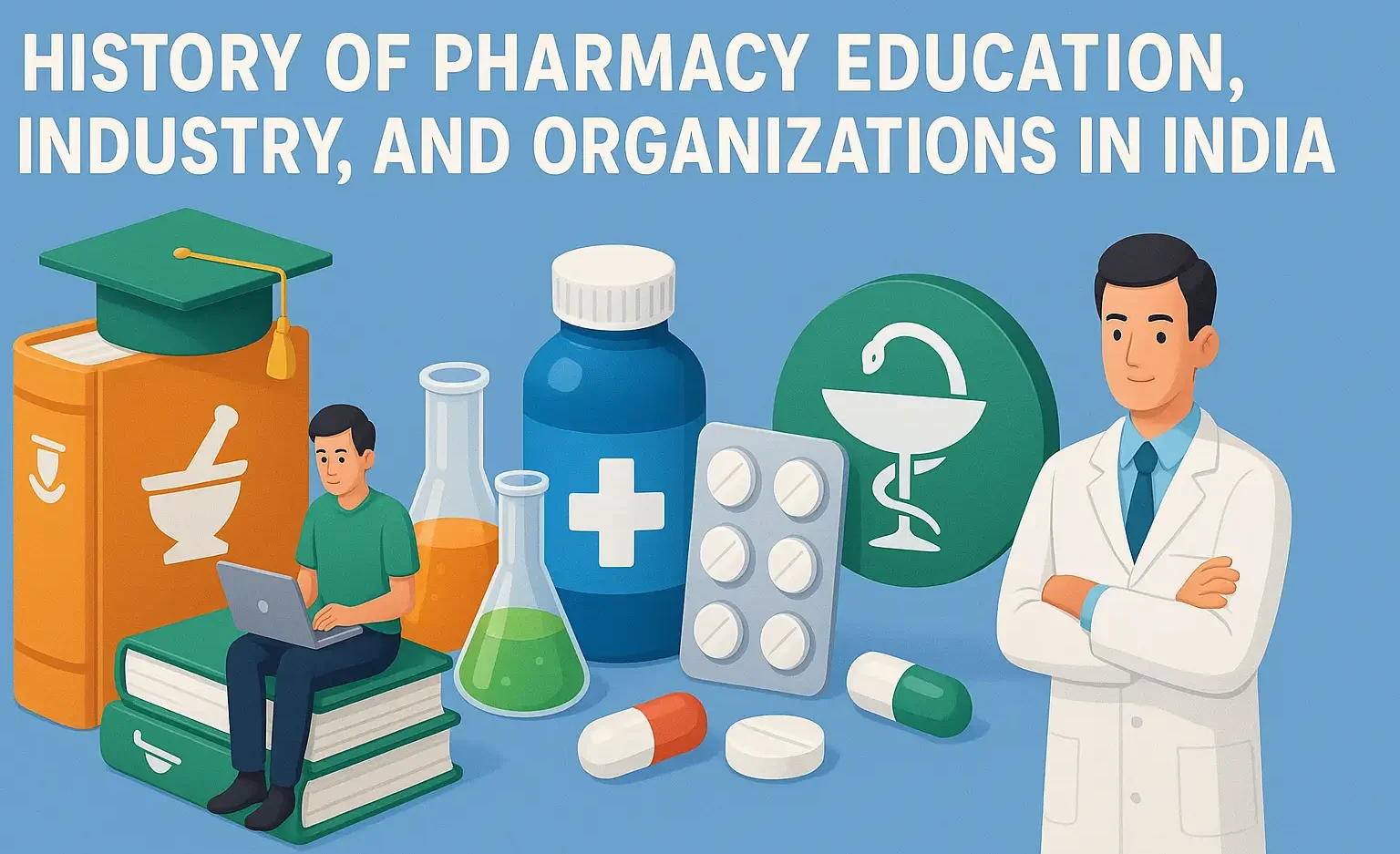
History of Pharmacy Education has evolved from traditional apprenticeships to structured university-based programs emphasizing science, clinical skills, and patient care.
-
History of Pharmacy Education in India:
- Pharmacy education in India began in 1863 with the first pharmacy course at Calcutta Medical College.
- The modern framework was established after the Pharmacy Act of 1948, which set up the Pharmacy Council of India (PCI) to regulate standards in pharmacy education.
- The All India Council for Technical Education (AICTE) later joined in regulating pharmacy programs.
- Pharmacy education has since evolved to include various degrees like Diploma in Pharmacy (D.Pharm), Bachelor of Pharmacy (B.Pharm), Master of Pharmacy (M.Pharm), and Doctor of Pharmacy (Pharm.D).
-
History of the Pharmaceutical Industry in India:
- The pharmaceutical industry began its modern development post-1947, with a focus on self-sufficiency in medicine production.
- In 1970, the Indian Patent Act was amended, enabling Indian companies to produce generic drugs through reverse engineering, which spurred significant growth in the industry.
- Economic liberalization in the 1990s attracted foreign investments and collaborations, further boosting the industry.
- Today, India is one of the largest producers of generic medicines, exporting to over 200 countries and providing affordable medications worldwide.
-
History of Pharmacy Organizations in India:
- Pharmacy Council of India (PCI): Established in 1948 under the Pharmacy Act, the PCI regulates pharmacy education and maintains the Central Register of Pharmacists.
- Indian Pharmaceutical Association (IPA): Founded in 1939, IPA is the professional body of pharmacists, promoting the advancement of the pharmacy profession.
- All India Council for Technical Education (AICTE): Regulates technical and pharmacy education in India, ensuring uniform standards.
- National Institute of Pharmaceutical Education and Research (NIPER): Established in 1991, NIPER leads pharmaceutical education and has been declared an ‘Institute of National Importance.’
- Drug Controller General of India (DCGI): The central authority responsible for regulating drug quality and safety in India.
Click Here to Watch the Best Pharma Videos
Advertisements

Hi I am curious about how india transports medicine to over 200 countries when there are only 197 countries in the world
The statement that India exports medicines to “over 200 countries” should be understood in the context of international trade classification rather than a strict count of sovereign states. Although there are 193 member states of the United Nations (and roughly 197 widely recognized sovereign countries), global trade statistics often classify export destinations more broadly. In customs and trade records, the term “country” may include overseas territories, autonomous regions, and distinct customs jurisdictions that are treated as separate markets. For example, regions such as Hong Kong, Taiwan, Puerto Rico, and Greenland are recorded individually in international trade data despite not all being independent sovereign states.
Thus, the reference to “200+ countries” highlights the extensive global reach of India’s pharmaceutical industry rather than a literal political count of nations. It reflects the sector’s broad export penetration across nearly all regulated and semi-regulated markets worldwide.