
- Catabolism of heme is the process by which the heme molecule is broken down into simpler compounds.
- Catabolism of heme process primarily occurs in the liver and spleen and involves several key steps:
-
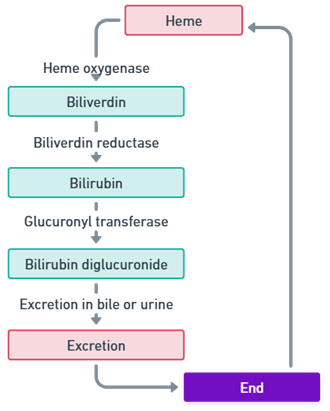
Heme Oxygenase (HO):
- Reaction: Heme is broken down into biliverdin, carbon monoxide (CO), and free ferrous iron (Fe²⁺).
- Enzyme: Heme oxygenase (HO).
- Cofactors: Utilizes molecular oxygen and NADPH.
- Mechanism: HO adds oxygen to the heme, cleaving the heme ring and releasing biliverdin, CO, and Fe²⁺.
-
Biliverdin Reductase (BVR):
- Reaction: Biliverdin is reduced to bilirubin.
- Enzyme: Biliverdin reductase (BVR).
- Cofactors: Uses NADPH.
- Mechanism: BVR reduces biliverdin to bilirubin by adding hydrogen atoms.
-
Conjugation of Bilirubin:
- Process: In the liver, bilirubin is made more water-soluble by conjugation with glucuronic acid.
- Enzyme: Uridine diphosphate-glucuronosyltransferase 1A1 (UGT1A1).
- Product: Bilirubin diglucuronide.
- Mechanism: UGT1A1 attaches glucuronic acid molecules to bilirubin, making it easier to excrete.
-
Excretion and Metabolism of Bilirubin:
- Process: Conjugated bilirubin is excreted into bile and travels to the intestine.
- Intestinal Metabolism: Gut bacteria convert bilirubin into urobilinogens.
- Fate of Urobilinogens: Some are oxidized to stercobilins (excreted in feces), while others are reabsorbed and excreted as urobilins in urine.
Advertisements
- These steps are crucial for recycling and excreting heme components, with any disruptions potentially leading to health issues.