- Isosorbide Dinitrite is an anti-anginal drug that relieves chest pain by dilating blood vessels and lowering heart workload.
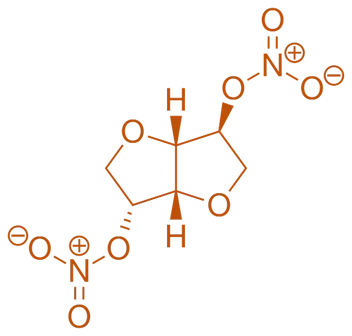
Structure of Isosorbide Dinitrite
- It is an organic nitrate derived from isosorbide, featuring two nitrate groups esterified to the hydroxyl groups of the isosorbide moiety.
- Chemical Formula: C₆H₈N₂O₆
Mode of Action
- Nitric Oxide Release: Metabolizes to release NO, leading to vasodilation.
- Vasodilation: Primarily dilates veins (preload reduction) and arteries (afterload reduction), decreasing cardiac workload.
- Coronary Artery Dilation: Enhances blood flow to the myocardium, alleviating ischemia.
Advertisements
Uses
- Angina Pectoris: Prevents and treats anginal attacks by reducing myocardial oxygen demand.
- Heart Failure: Manages symptoms by decreasing cardiac preload and afterload.
- Hypertension: Utilized in hypertensive emergencies as part of combination therapy.
- Raynaud’s Phenomenon: Off-label use to promote blood flow in affected extremities.
Structure-Activity Relationship (SAR)
- Nitrate Ester Groups: Crucial for NO release; their presence and position determine the potency and duration of action.
- Isosorbide Backbone: Provides rigidity, facilitating proper orientation for enzyme-mediated NO release.
- Hydroxyl Substituents: Influence solubility, bioavailability, and metabolic stability.
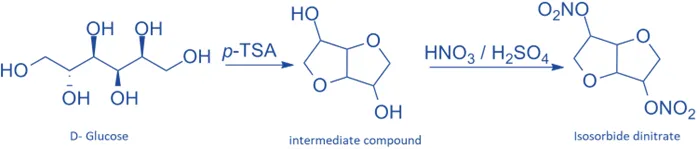
Synthesis of Isosorbide Dinitrite