
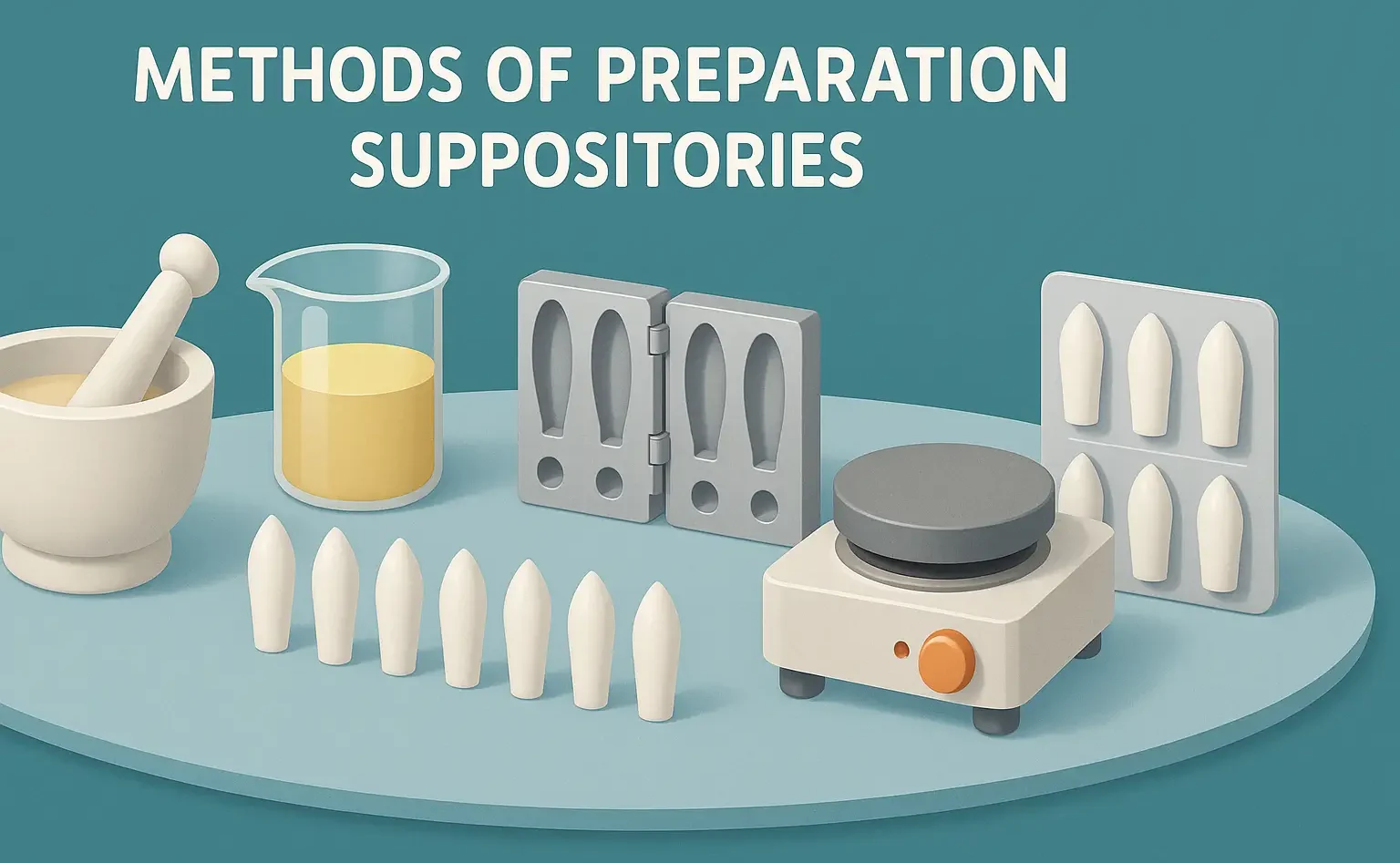
- Several methods exist for preparing suppositories, each with pros and cons.
- The choice of method depends on factors like the base type, drug solubility, stability, and available equipment.
- Below are the main methods:
1. Hand Molding
- Used for small-scale preparation in pharmacy settings.
- Involves manually shaping the suppository.
Steps:
- Melt the suppository base in a water bath.
- Mix in the active ingredient evenly.
- Let the mixture cool to a moldable consistency.
- Shape the suppository manually using a spatula or mold.
- Allow to harden before packaging or use.
Advertisements
2. Compression Molding
- Ideal for large-scale production and works with both lipophilic and hydrophilic bases.
- Involves compressing the mixture into molds using a machine.
Advertisements
Steps:
- Mix the active ingredient with the suppository base in powder or granule form.
- Load the mixture into a compression machine.
- Compress the mixture into molds.
- Remove and package the suppositories.
3. Fusion (Melt) Molding
- The most common method, suitable for lipophilic bases.
- Involves pouring molten mixture into molds.
Advertisements
Steps:
- Melt the suppository base.
- Incorporate the active ingredient evenly.
- Pour the molten mixture into a mold, avoiding air bubbles.
- Allow to cool and harden.
- Remove from the mold and package.