
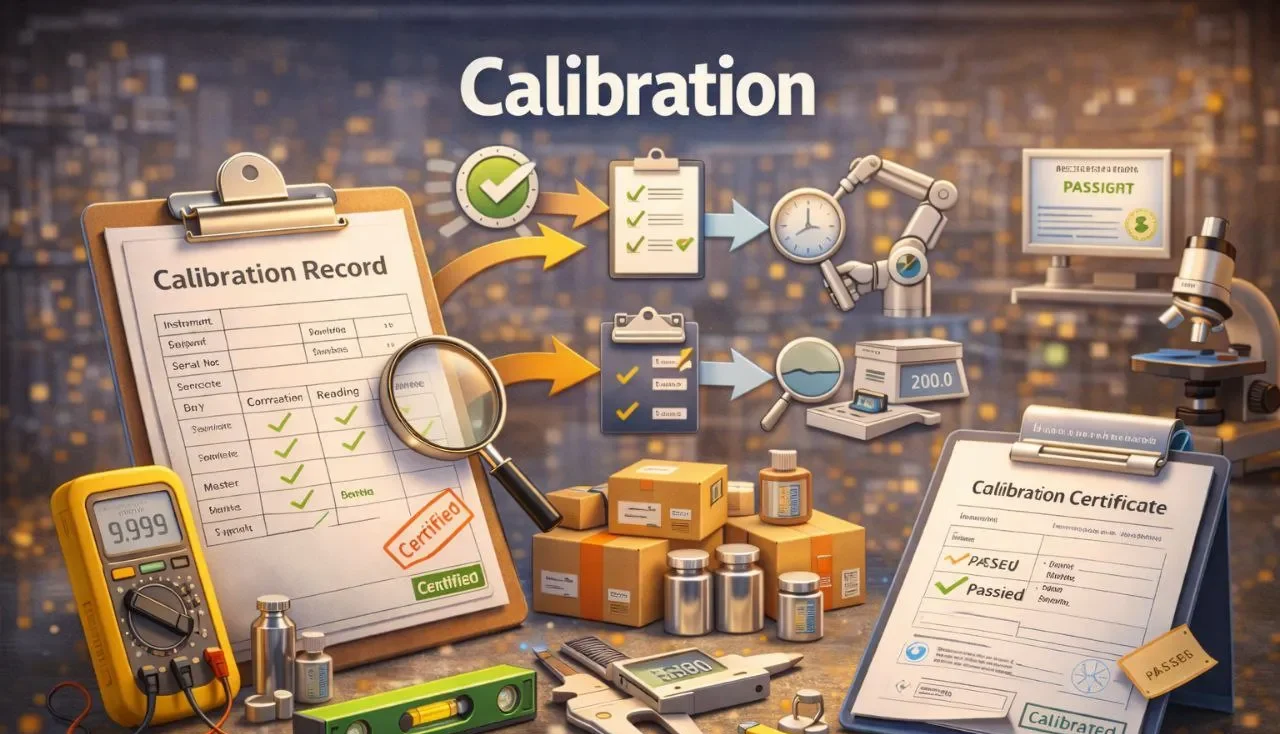
Definition of Calibration
- Calibration is the process of configuring an instrument to provide accurate results by comparing it with a known standard.
General Principles of Calibration
- Traceability: Calibration should be performed using standard references that are traceable to national or international standards.
- Accuracy and Precision: The instrument should give measurements that are both accurate (close to the true value) and precise (repeatable).
- Frequency of Calibration: Instruments should be calibrated at regular intervals depending on their usage and stability.
- Environmental Factors: Conditions such as temperature, humidity, and pressure can affect calibration and must be controlled.
- Documentation: Calibration records must be maintained for regulatory compliance and quality assurance.
Types of Calibration

Advertisements
- Equipment Calibration – Ensures instruments (e.g., pH meters, balances, pipettes) provide accurate readings.
- Temperature Calibration – Verifies accuracy of temperature measurement devices for storage and sterile processes.
- Process Calibration – Ensures entire processes function correctly through statistical and measurement techniques.
- Standardization Calibration – Maintains consistency across procedures, locations, and staff using SOPs and quality control.
Scope of Calibration
- Calibration applies to various instruments, including balances, thermometers, pressure gauges, pH meters, and flowmeters.
- It extends to complex systems such as manufacturing lines, medical diagnostics, and environmental monitoring.
Purpose
- To ensure instruments provide accurate and reliable measurements within an acceptable range of error or uncertainty.
Advertisements
Objectives
- Verify accuracy of instruments.
- Ensure consistency and repeatability of measurements.
- Maintain traceability to national or international standards.
- Identify and correct deviations.
- Ensure compliance with regulatory standards.
Calibration Methods & Procedures
- Comparison to a Reference Standard – Compare instrument readings with a known reference standard.
- Adjustment – Align the instrument based on deviations observed.
- Uncertainty Evaluation – Analyze factors affecting measurement confidence, like environmental conditions and drift.
- Documentation – Record calibration steps, results, and adjustments.
- Regular Calibration – Conduct calibration at defined intervals based on industry requirements.
- Traceability Verification – Ensure measurements link back to a certified reference standard.
Importance of Calibration
- Ensures Accuracy – Prevents measurement errors, crucial in pharmaceutical and scientific fields.
- Maintains Reliability – Detects and corrects instrument issues, extending equipment lifespan.
- Ensures Regulatory Compliance – Meets industry and legal calibration standards.
- Improves Quality – Ensures product consistency and adherence to required specifications.
- Saves Time & Cost – Prevents major errors, reduces downtime, and minimizes financial losses.
Advertisements