
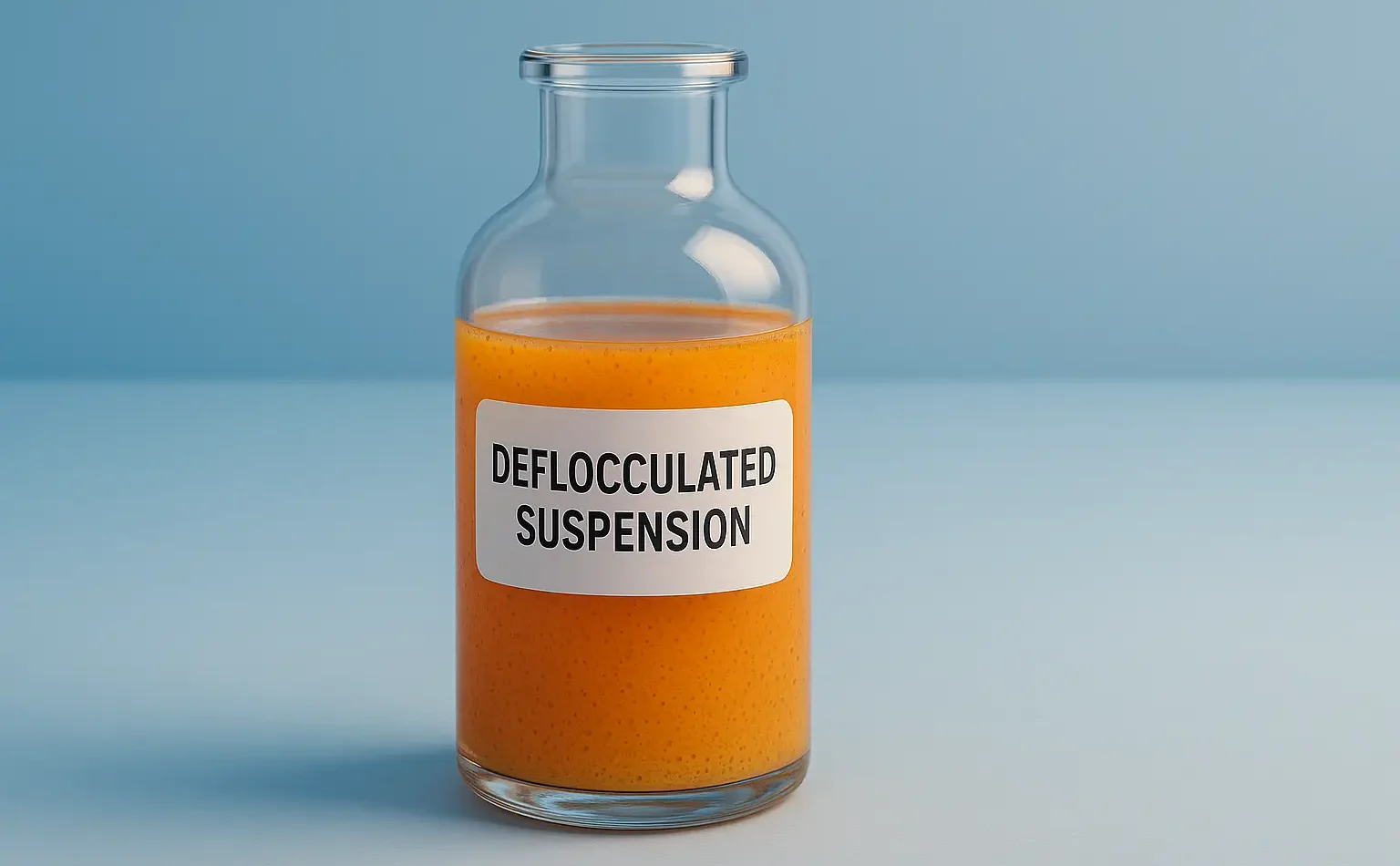
Definition of Deflocculated suspension
- In a deflocculated suspension, solid particles remain discrete and uniformly dispersed throughout the liquid medium.
- While initially more uniform, these suspensions are prone to sedimentation and caking, making redispersion difficult.
Preparation of Deflocculated Suspensions
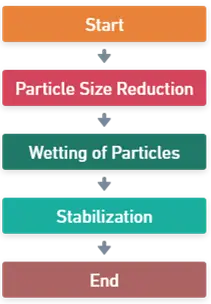
-
Particle size reduction:
- The solid drug is milled or micronized for proper dispersion, similar to flocculated suspensions.
-
Wetting of particles:
- A wetting agent is used to reduce interfacial tension between the particles and the liquid medium.
-
Stabilization:
- A stabilizing agent (e.g., non-ionic surfactant or hydrophilic polymer) is added to prevent
- This forms a protective layer around particles, promoting repulsion and maintaining uniform dispersion.
Stability Problems & Solutions
-
Sedimentation and caking:
- Problem: Particles may settle and form a hard cake, making redispersion difficult.
- Solution: Increase the viscosity of the medium with thickening agents and use stabilizing agents like surfactants to prevent caking.
-
Particle aggregation:
- Problem: Deflocculated particles may aggregate, leading to non-uniform dispersion.
- Solution: Use stabilizing agents (e.g., surfactants or hydrophilic polymers) to maintain particle repulsion and uniform dispersion.
Advertisements