
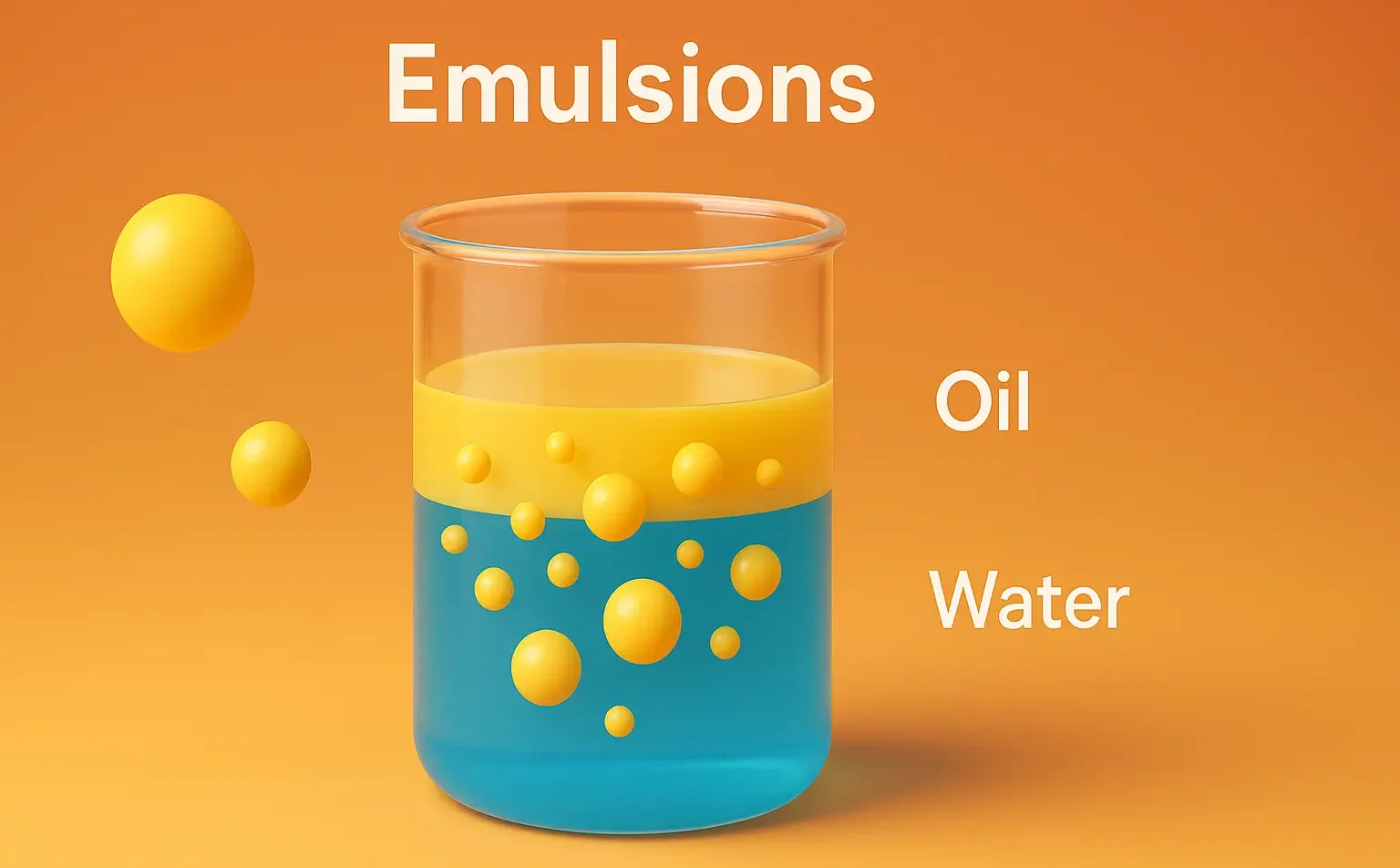
Definition of Emulsions
- Emulsions in pharmaceutics is a heterogeneous system consisting of two immiscible liquids (often oil and water), where one liquid is dispersed in the other as small droplets.
- Emulsion is typically unstable and require stabilizing agents (emulsifiers) to maintain the dispersion.
Classification of Emulsions
-
Oil-in-Water (O/W) Emulsion:
- Oil droplets are dispersed in a water phase.
- Commonly used in oral, intravenous, or topical pharmaceutical formulations as they are more compatible with the body’s aqueous environment.
-
Water-in-Oil (W/O) Emulsion:
- Water droplets are dispersed in an oil phase.
- Often used in topical formulations like moisturizing creams or ointments to create a water-resistant barrier.
-
Multiple Emulsion:
- These can be water-in-oil-in-water (W/O/W) or oil-in-water-in-oil (O/W/O)
- Used in specialized drug delivery applications to control the release of active ingredients.
Advertisements