
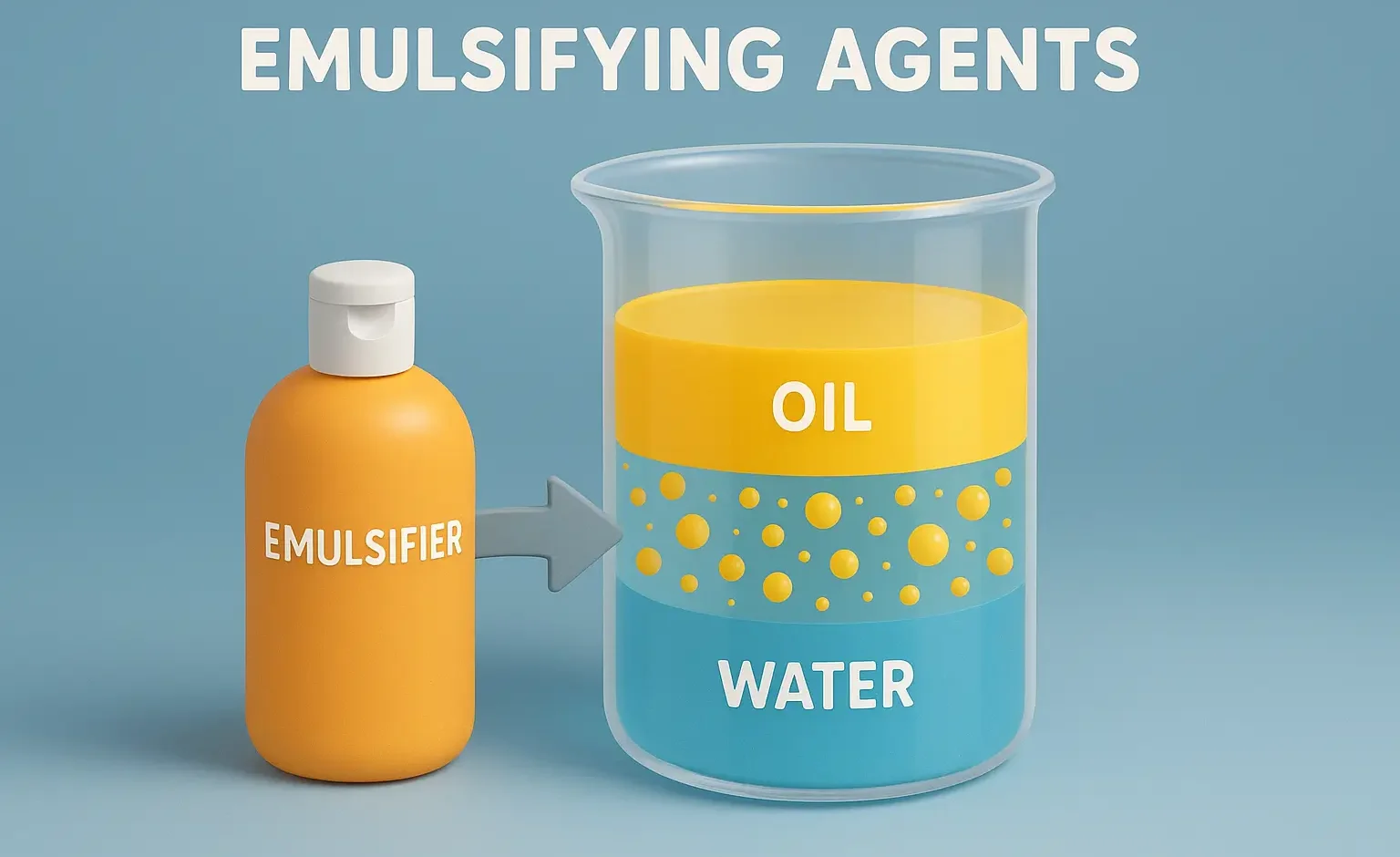
Definition of Emulsifying Agents
- An emulsifying agent (or emulsifier) is a substance that stabilizes an emulsion by improving its kinetic stability.
- Emulsifiers work by reducing surface tension at the interface between the oil and water phases, making it easier to mix and stabilize the two phases.
- In pharmaceuticals, emulsifiers can also affect the bioavailability and release profile of the drug.
Types of Emulsifying Agents

-
Surfactants:
- The most common emulsifiers, which include anionic, cationic, nonionic, and amphoteric
- They possess both hydrophilic (water-attracting) and lipophilic (oil-attracting) properties, enabling them to reduce surface tension between the two phases.
-
Hydrocolloids:
- High molecular weight compounds, often polymers, that stabilize emulsions by increasing viscosity and forming a protective layer around the droplets.
- They help maintain the stability of the emulsion by preventing the droplets from coalescing.
Selection Criteria for Emulsifying Agent
- Compatibility with the drug and other formulation components
- Ability to form a stable emulsion
- Safety and non-toxicity
- Influence on drug release and bioavailability
Advertisements