
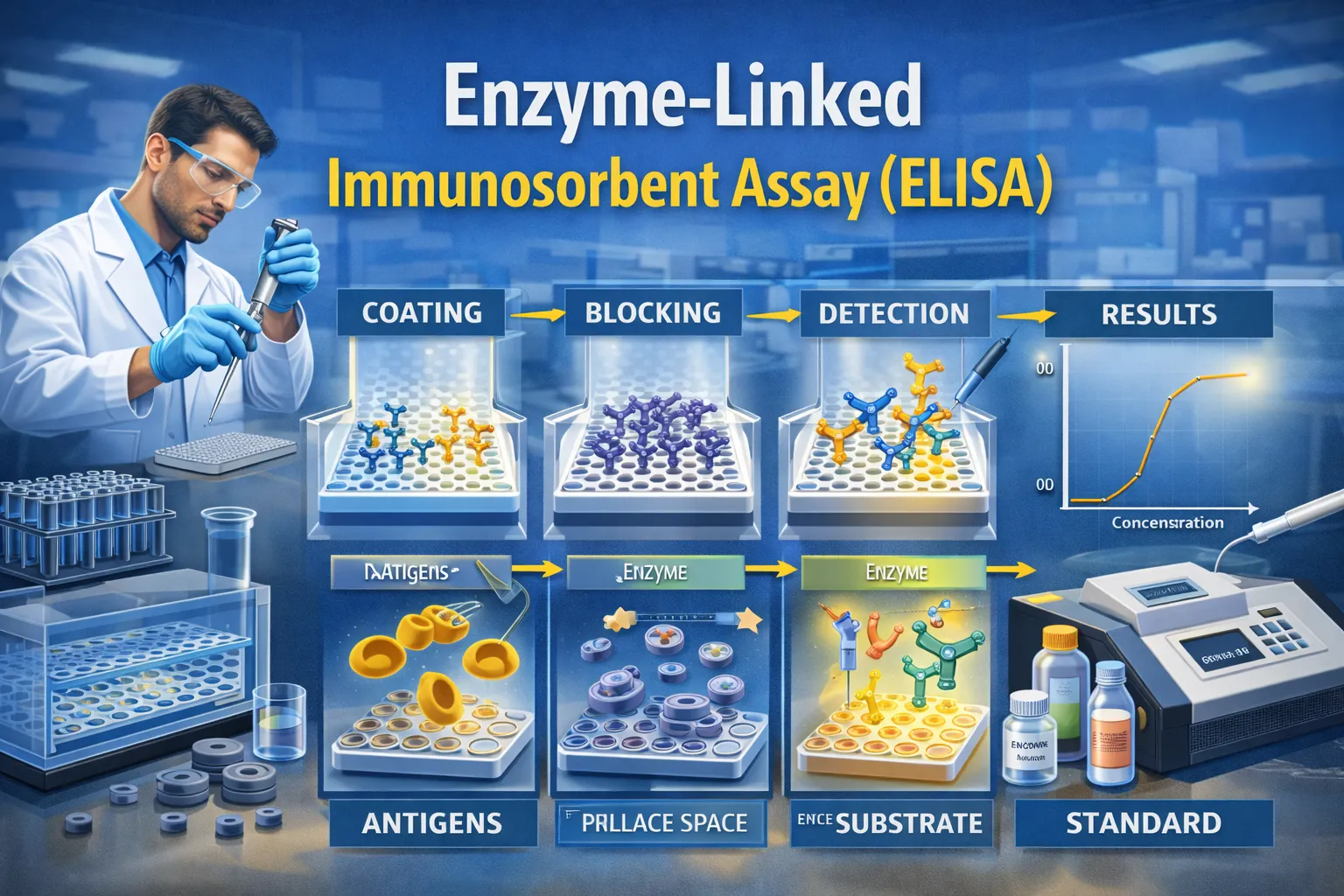
Definition of Enzyme-Linked Immunosorbent Assay (ELISA):
- ELISA is a widely used immunological technique that detects and quantifies specific molecules, such as proteins, peptides, antibodies, and hormones, in biological samples.
Principle:
- ELISA relies on antigen-antibody interactions.
- A specific antigen or antibody is immobilized onto a solid support and subsequently detected using a labeled antibody or enzyme.
Types of ELISA:
- Direct ELISA: Uses a single, enzyme-labeled antibody.
- Indirect ELISA: Uses a primary antibody and an enzyme-labeled secondary antibody.
- Sandwich ELISA: Uses two antibodies, one for capturing and the other for detection.
- Competitive ELISA: Measures antigen concentration by competing with a labeled antigen for antibody binding.
Advertisements
Steps of ELISA:
- Coating: The antigen or antibody is immobilized on a solid surface (typically a 96-well plate).
- Blocking: Unoccupied sites are blocked with a non-specific protein to prevent non-specific binding.
- Incubation with Primary Antibody: A specific antibody binds to the target antigen.
- Secondary Antibody Addition: A secondary antibody conjugated with an enzyme (e.g., HRP or alkaline phosphatase) binds to the primary antibody.
- Substrate Addition: A substrate is added, which reacts with the enzyme to produce a detectable signal (colorimetric or fluorescent).
- Measurement: The intensity of the color change is measured using a spectrophotometer.
Applications of ELISA:
- Detection of viral and bacterial infections.
- Detection of autoimmune diseases.
- Drug discovery and development.
- Environmental monitoring.
Click Here to Watch the Best Pharma Videos
Advertisements