
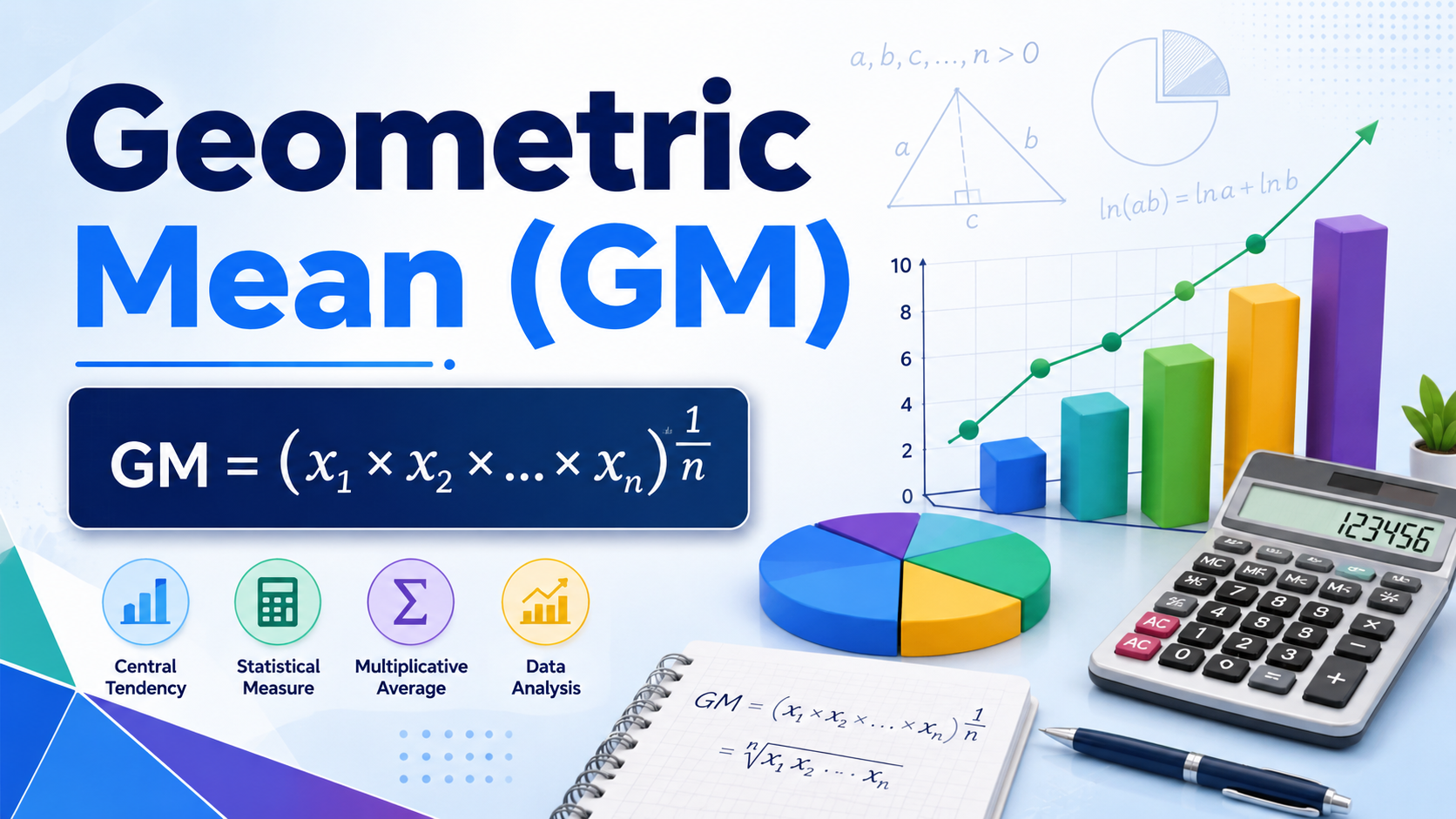
Geometric Mean (GM)
Definition
- The Geometric Mean is used to find the average rate of change or growth across a dataset with multiplicative relationships.
- It is especially useful in fields like finance, biology, and pharmacology, where compounding effects are observed.
Formula
GM=x1⋅x2⋅⋯⋅xn−−−−−−−−−−−−−√n𝑮𝑴=𝒙𝟏⋅𝒙𝟐⋅⋯⋅𝒙𝒏𝒏
Key Features
- Reflects the central tendency of ratios or percentage changes.
- Less affected by extreme values compared to the arithmetic mean.
- Suitable for data involving proportional or exponential growth.
Example: Rate of Drug Absorption
- Scenario: A clinical trial tracks the rate of drug concentration increase in the bloodstream at four time points.
- Observed Rates: 120%, 125%, 130%, 135%
- Convert percentages to growth factors:
1.20, 1.25, 1.30, 1.35
Calculation:
GM=1.20×1.25×1.30×1.35−−−−−−−−−−−−−−−−−−−−−−−√4=2.637−−−−−√4≈1.286𝑮𝑴=𝟏.𝟐𝟎×𝟏.𝟐𝟓×𝟏.𝟑𝟎×𝟏.𝟑𝟓𝟒=𝟐.𝟔𝟑𝟕𝟒≈𝟏.𝟐𝟖𝟔
Result:
Geometric Mean Rate=1.286×100=128.6%Geometric Mean Rate=𝟏.𝟐𝟖𝟔×𝟏𝟎𝟎=𝟏𝟐𝟖.𝟔%
Interpretation:
- On average, the drug concentration increased by 128.6% per time point, accounting for compounding effects.