
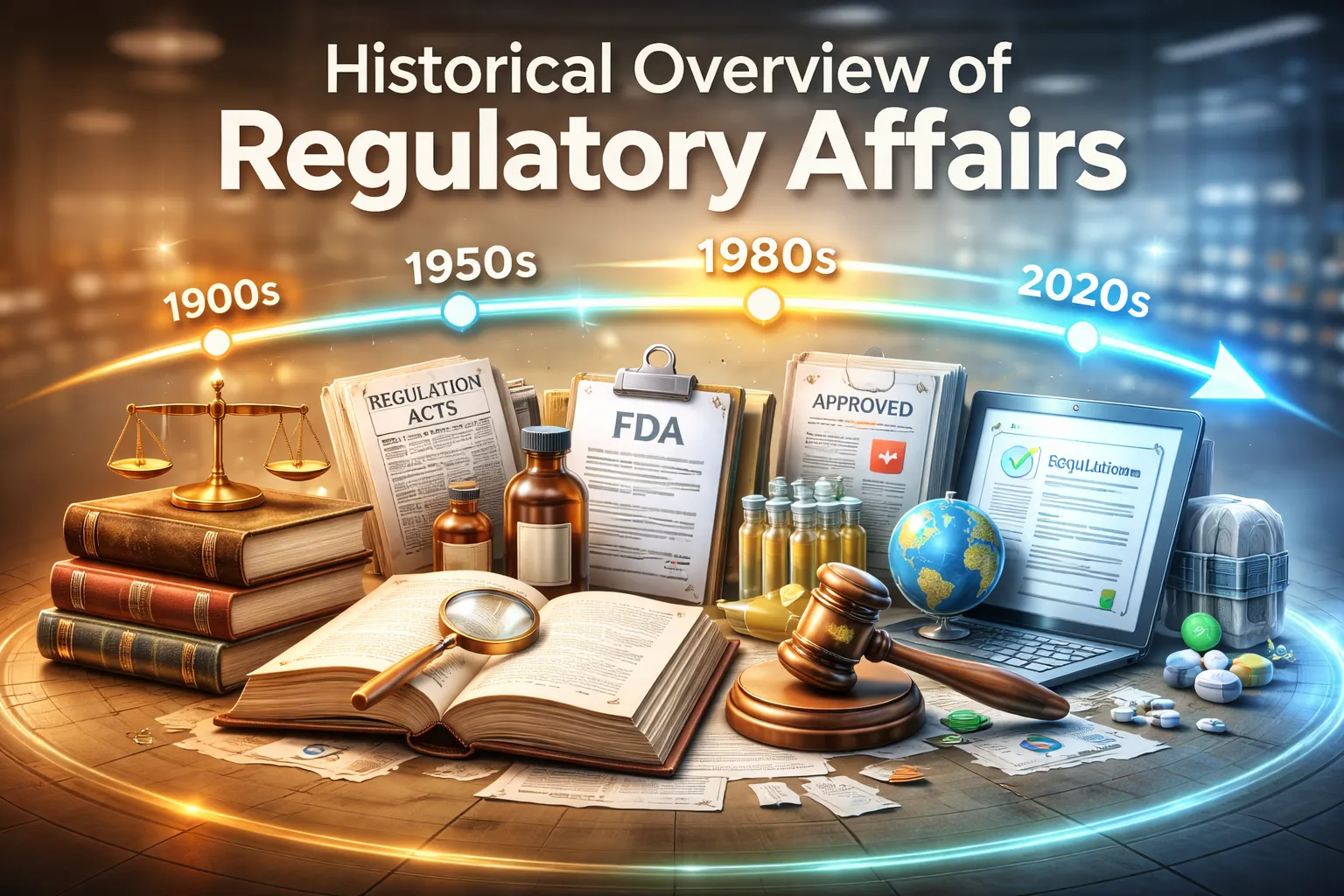
Historical Overview of Regulatory Affairs
Historical Overview of Regulatory Affairs explains evolution of drug laws and systems ensuring safety and quality.
Early Beginnings
- 19th Century: The industrial revolution led to mass production of goods, including pharmaceuticals and food products, necessitating regulation to protect public health.
- Pure Food and Drug Act of 1906 (USA): One of the first significant regulatory laws, prohibiting interstate commerce of misbranded and adulterated foods, drinks, and drugs.
Key Milestones
-
1938 – Federal Food, Drug, and Cosmetic Act (FD&C Act):
- Enacted in response to the sulfanilamide disaster, where a toxic solvent led to over 100 deaths.
- Required proof of safety for new drugs before marketing.
-
1962 – Kefauver-Harris Amendments:
- Triggered by the thalidomide tragedy causing birth defects.
- Mandated proof of efficacy as well as safety.
- Introduced Good Manufacturing Practices (GMP) and greater oversight of clinical trials.
Advertisements
Global Expansion
-
Formation of Regulatory Agencies:
- FDA (Food and Drug Administration, USA): Evolved to oversee food, drugs, medical devices, and cosmetics.
- EMA (European Medicines Agency): Established to harmonize regulations across the European Union.
- MHRA (Medicines and Healthcare products Regulatory Agency, UK).
-
International Harmonization Efforts:
- International Council for Harmonisation of Technical Requirements for Pharmaceuticals for Human Use (ICH):
- Established in 1990.
- Aims to harmonize regulatory requirements globally.
- International Council for Harmonisation of Technical Requirements for Pharmaceuticals for Human Use (ICH):
-
Modern Era:
- Digitalization: Electronic submissions (e.g., eCTD – electronic Common Technical Document) became standard.
- Patient-Centric Approaches: Increased emphasis on patient safety and involvement in regulatory processes.
- Emergence of New Technologies: Biotechnology, gene therapies, and personalized medicine presented new regulatory challenges.
Impact of Historical Events
- Public Health Crises: Each major health crisis led to more stringent regulations and oversight.
- Technological Advancements: Innovations required adaptation and evolution of regulatory frameworks.
- Globalization: International trade necessitated harmonization and cooperation between regulatory bodies.
Click Here to Watch the Best Pharma Videos
Advertisements