
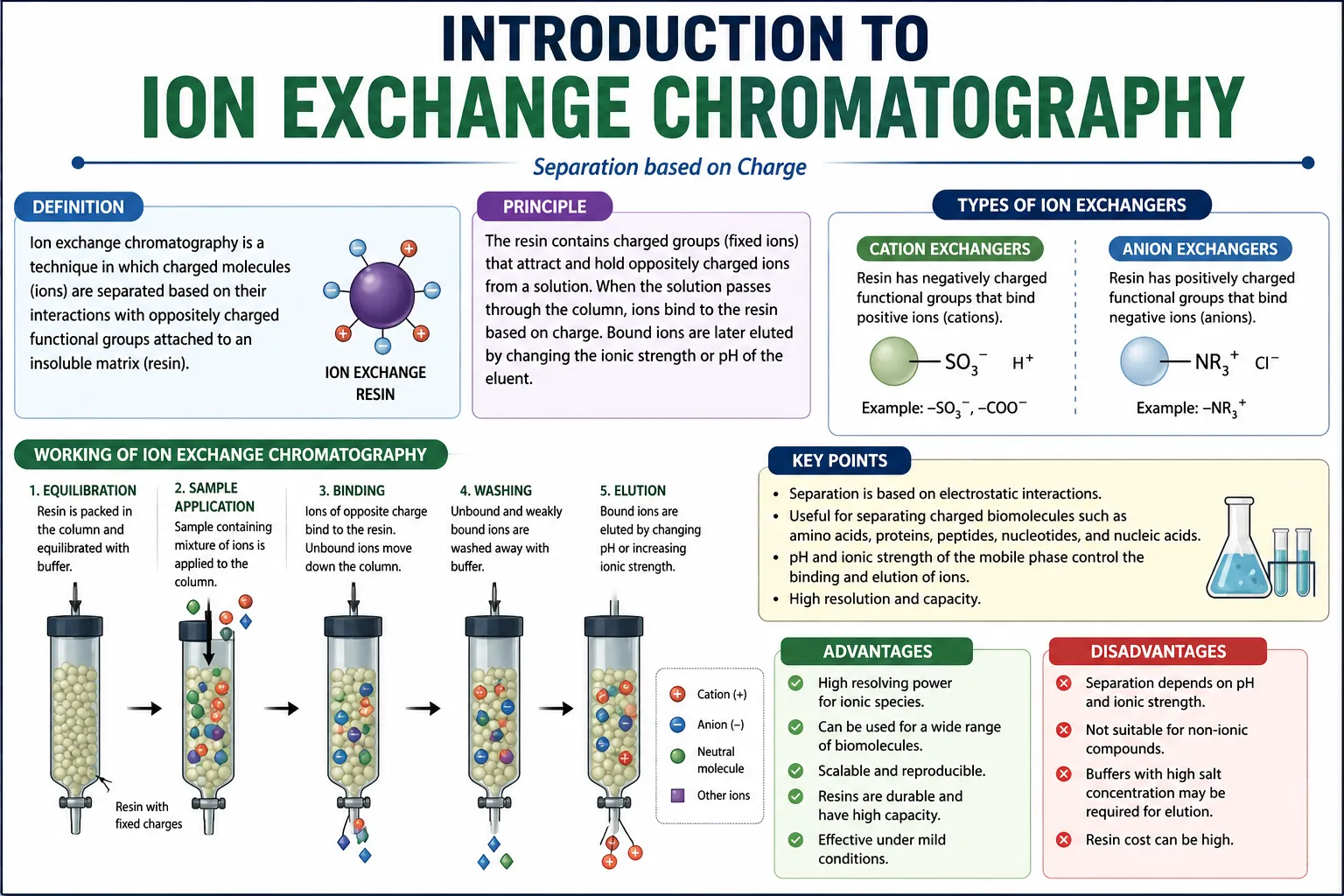
Introduction to Ion Exchange Chromatography explains separation of ions based on charge interaction with a stationary phase.
Introduction to Ion Exchange Chromatography
- Ion Exchange Chromatography (IEC) is a type of chromatography that separates ions and polar molecules based on their charge.
- It is widely employed in various fields, including protein purification, water analysis, and diverse ion analyses.
- Chromatography, as a technique, separates components of a mixture by passing them through a medium where they migrate at different rates due to differences in their interactions with the medium.
Advertisements
Principle
- The fundamental principle of IEC involves the use of a charged stationary phase to separate ions present in the mobile phase.
- Depending on the charge of the stationary phase:
- Cation Exchange Chromatography: Utilizes a negatively charged stationary phase to attract and retain positively charged ions (cations).
- Anion Exchange Chromatography: Utilizes a positively charged stationary phase to attract and retain negatively charged ions (anions).
Components of Ion Exchange Chromatography
-
Stationary Phase
- Composition: Typically consists of a resin made from organic polymers with ionic functional groups.
- Types:
- Cation Exchangers: Contain negatively charged groups.
- Anion Exchangers: Contain positively charged groups.
- Function: Provides the charged sites for ion exchange.
-
Mobile Phase
- Composition: Usually a water-based solution that transports the sample through the stationary phase.
- Adjustability: The composition and pH can be modified to influence the separation process.
Click Here to Watch the Best Pharma Videos
Advertisements