
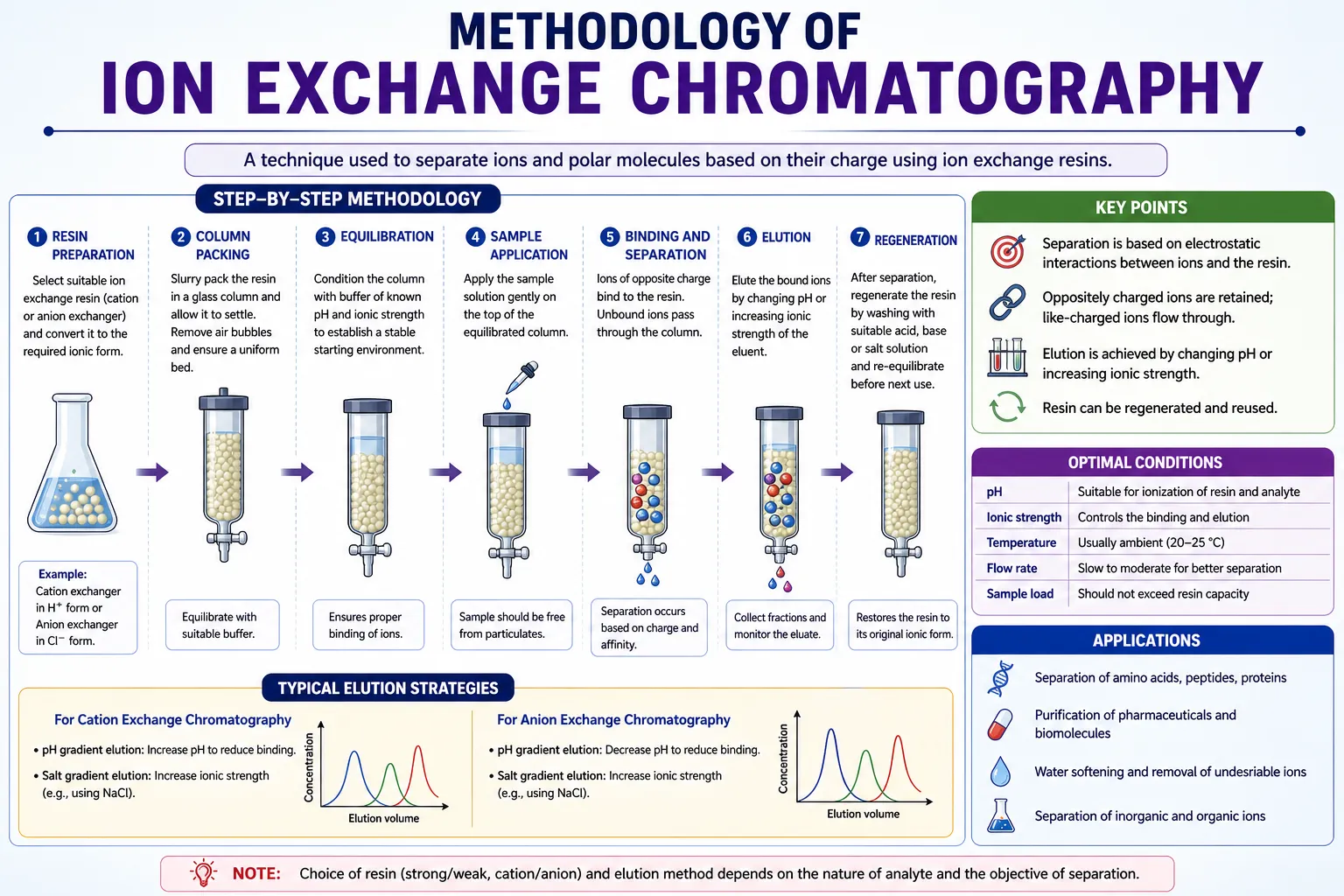
Methodology of Ion Exchange Chromatography involves sample loading, ion exchange, washing, and elution for separation.
Methodology of Ion Exchange Chromatography
- Ion Exchange Chromatography (IEC) is a widely used separation technique that exploits the charge properties of molecules to separate and purify them based on their affinity to charged resin particles.
- Below is a breakdown of the methodology:

Advertisements
-
Selection of Ion Exchange Resin:
- Cation Exchangers: Contain negatively charged functional groups (e.g., sulfonic acid) that bind positively charged ions.
- Anion Exchangers: Contain positively charged functional groups (e.g., quaternary ammonium) that bind negatively charged ions.
- The choice of resin depends on the target molecule’s charge at a given pH.
-
Equilibration:
- The column is equilibrated with a buffer that establishes the desired ionic environment and pH, ensuring optimal binding of the target molecules to the resin.
- Sample Application:
- The sample is introduced into the column, where oppositely charged molecules interact with the resin and bind, while others are washed through.
-
Washing:
- A buffer is passed through the column to remove unbound or weakly bound contaminants.
-
Elution:
- The bound molecules are eluted using a gradient of increasing ionic strength (e.g., using NaCl) or by altering the pH. This disrupts the interaction between the target molecules and the resin.
-
Detection and Collection:
- Eluted fractions are detected using UV spectroscopy or other methods, and the target molecules are collected.
-
Regeneration:
- After use, the resin is regenerated by washing with high salt solutions or specific buffers to restore its binding capacity.