
Nepheloturbidometry
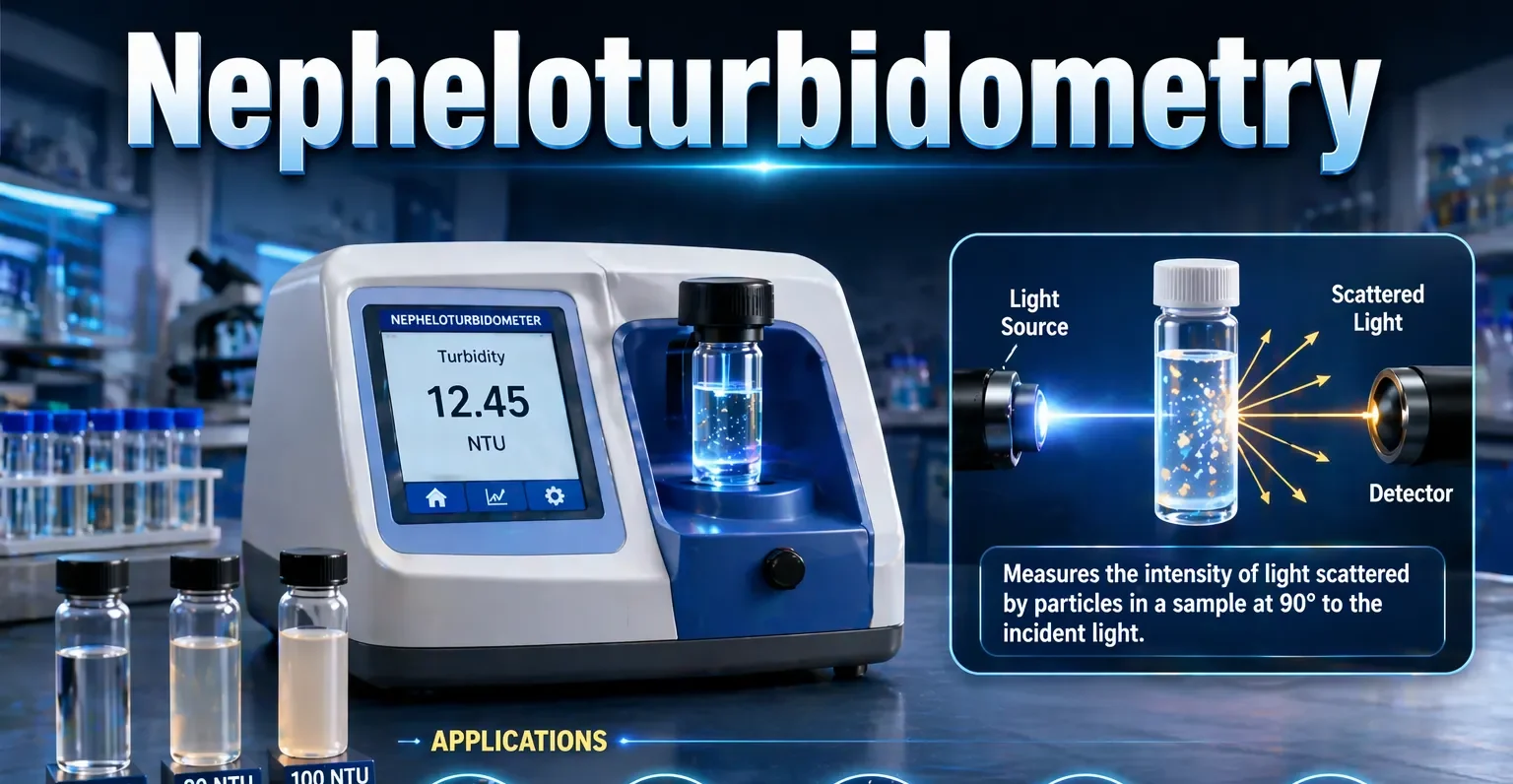
- Nepheloturbidometry is an instrumental technique used to quantitatively analyze substances in solution by measuring their light-scattering properties.
Principle of Nepheloturbidometry:
- When a light beam passes through a sample containing suspended particles (larger than the wavelength of light), the particles scatter light in all directions.
- Nephelometry: Measures light scattered at an angle (typically 90°) to the incident beam.
- Turbidimetry: Measures the decrease in transmitted light intensity due to scattering and absorption.
- The intensity of scattered light is directly proportional to the concentration of suspended particles in the sample.
Procedure:
- A light source emits a beam through the sample.
- Suspended particles in the sample scatter the light.
- A detector, placed at an angle (commonly 90°) to the incident light, measures the scattered light intensity.
- The measured intensity is compared with standard solutions of known concentrations to determine the concentration of particles in the sample.
Advertisements
Applications:
- Quantifying macromolecules such as proteins in solution.
- Measuring turbidity in water samples for quality analysis.
Advertisements
Nepheloturbidometry is valuable for applications requiring precise quantification of suspended particles in various solutions.
Click Here to Watch the Best Pharma Videos
Advertisements