
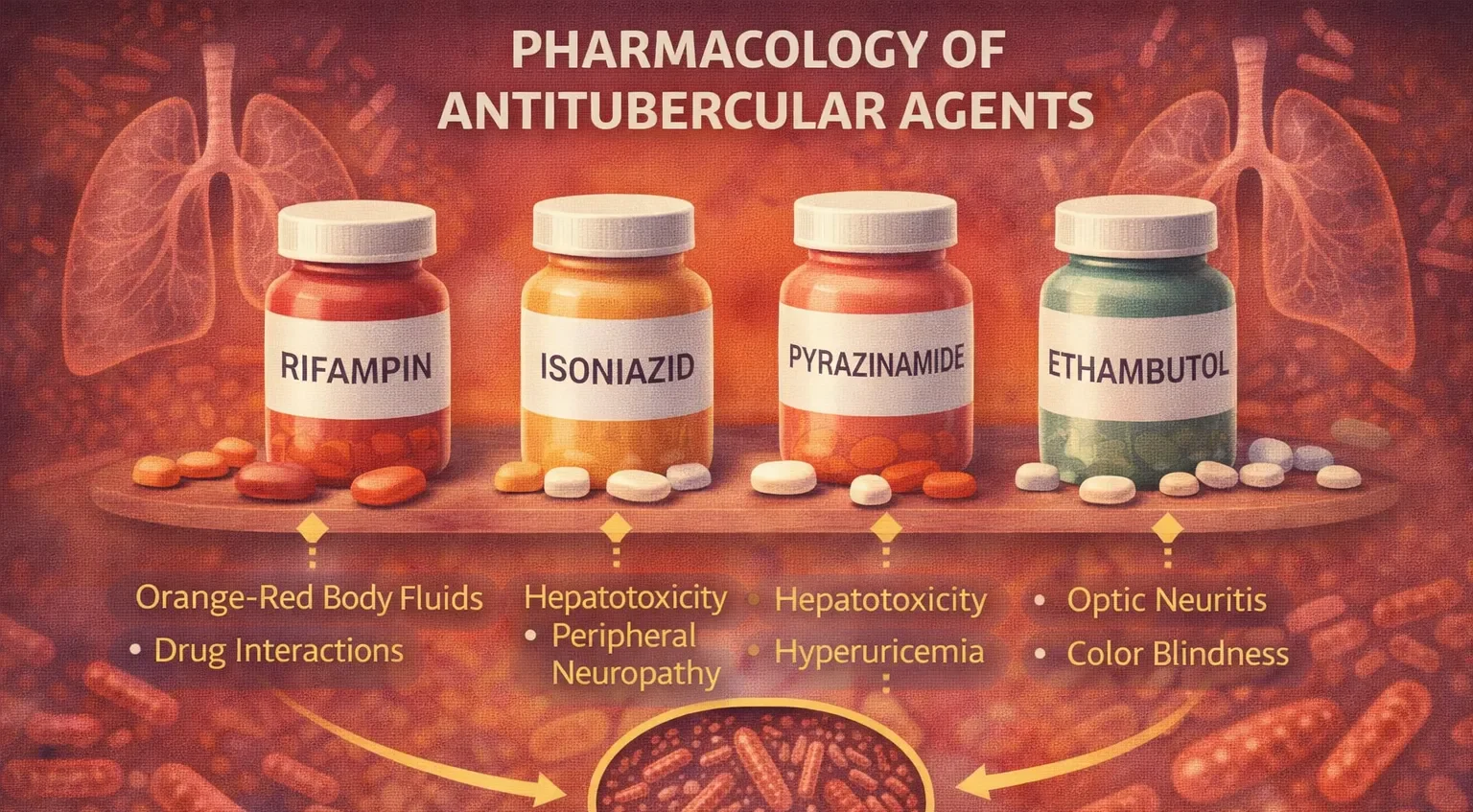
Pharmacology of Antitubercular Agents explains mechanisms and actions of drugs used to kill or inhibit Mycobacterium tuberculosis.
Pharmacology of Antitubercular Agents
- Tuberculosis (TB) is a chronic infectious disease caused by Mycobacterium tuberculosis.
- Effective treatment requires a prolonged, multi-drug regimen to achieve the following goals:
- Prevent resistance
- Ensure complete eradication of the bacteria
- Treat both active and latent bacilli (intracellular and extracellular)
First-Line Antitubercular Drugs (HRZE)
- These are the standard drugs used for the treatment of tuberculosis and form the cornerstone of therapy.
- They are effective against both active and latent tuberculosis.
Advertisements
-
Isoniazid (INH)
- Mechanism of Action: Inhibits mycolic acid synthesis in the bacterial cell wall.
- Adverse Effects: Hepatotoxicity, peripheral neuropathy, hemolysis in G6PD deficiency.
-
Rifampicin
- Mechanism of Action: Inhibits DNA-dependent RNA polymerase, blocking RNA synthesis.
- Adverse Effects: Hepatotoxicity, orange discoloration of body fluids, enzyme induction.
-
Pyrazinamide
- Mechanism of Action: Disrupts mycobacterial membrane metabolism (exact mechanism unclear).
- Adverse Effects: Hepatotoxicity, hyperuricemia (may cause gout).
-
Ethambutol
- Mechanism of Action: Inhibits arabinosyl transferase, reducing cell wall synthesis.
- Adverse Effects: Optic neuritis, reduced visual acuity, red-green color blindness.
Second-Line Antitubercular Drugs
- These drugs are typically used when first-line drugs are ineffective, such as in multidrug-resistant (MDR-TB) or extensively drug-resistant tuberculosis (XDR-TB).
-
Streptomycin
- Mechanism of Action: Aminoglycoside antibiotic that inhibits protein synthesis by binding to bacterial ribosomes.
-
Ethionamide
- Mechanism of Action: Inhibits mycolic acid synthesis by interfering with the fatty acid synthase II complex.
-
Cycloserine
- Mechanism of Action: Inhibits cell wall synthesis by blocking the incorporation of D-alanine into peptidoglycan.
-
Para-aminosalicylic acid (PAS)
- Mechanism of Action: Interferes with folic acid metabolism, inhibiting bacterial growth.
-
Fluoroquinolones (e.g., levofloxacin)
- Mechanism of Action: Inhibits bacterial DNA gyrase and topoisomerase IV, interfering with DNA replication and transcription.
Advertisements
Fixed-Dose Combination (FDC) Therapy
- Purpose: FDC therapy is used to improve patient adherence to treatment and reduce the risk of drug resistance
- Example: HRZE in a single tablet (commonly used in the DOTS – Directly Observed Treatment, Short-course program)