
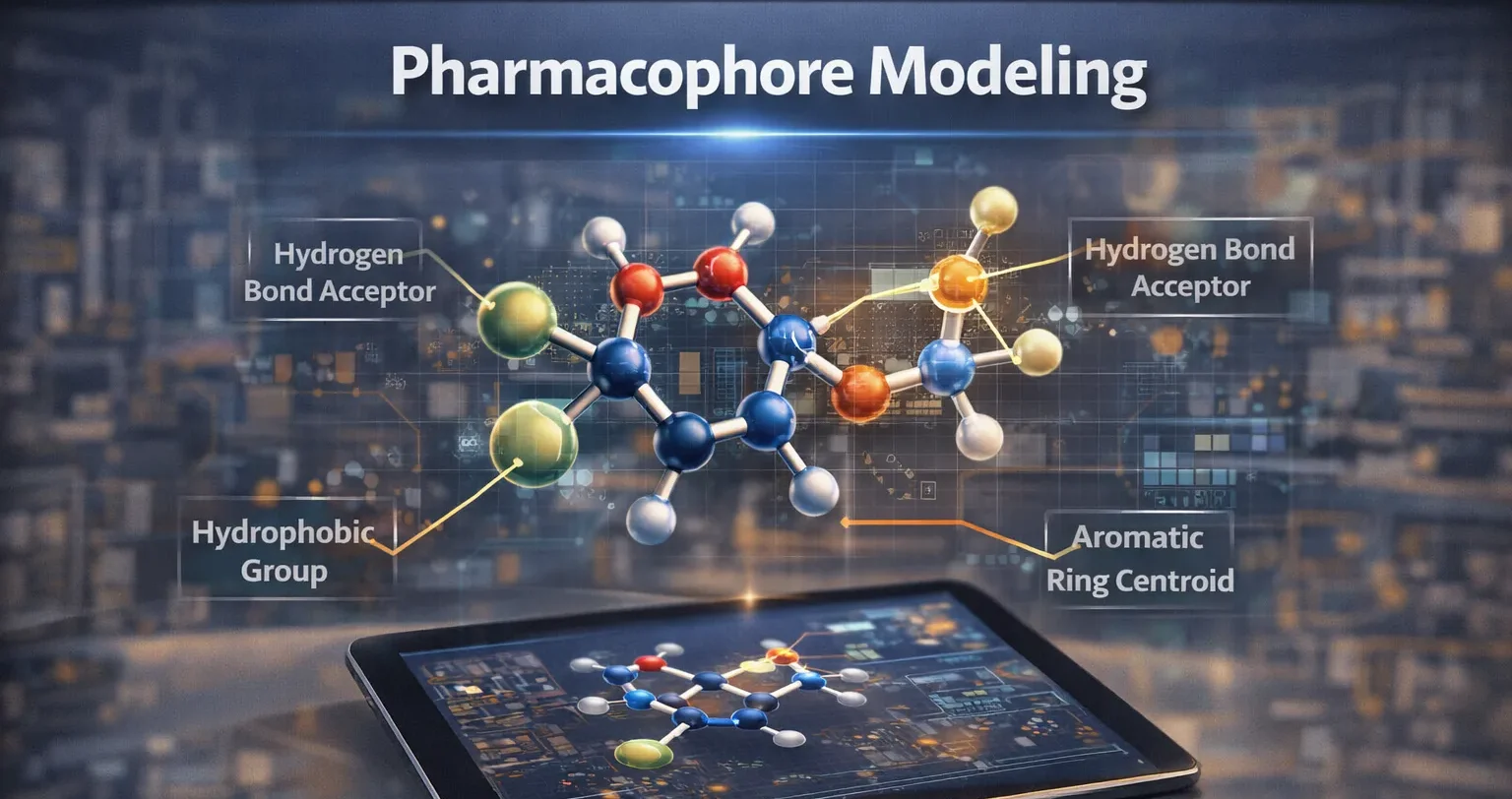
- Pharmacophore Modeling identifies essential features required for drug–target interaction and helps design new active compounds.
- A pharmacophore is the essential molecular features required for a drug to interact with a biological target.
Types of Pharmacophores:
- Ligand-Based Pharmacophore: Derived from known active molecules.
- Structure-Based Pharmacophore: Derived from the 3D structure of the target protein.
Key Features in Pharmacophore Models:
- Hydrogen bond donors (HBD)
- Hydrogen bond acceptors (HBA)
- Hydrophobic regions
- Aromatic rings
- Charged groups
Advertisements
Steps in Pharmacophore Modeling
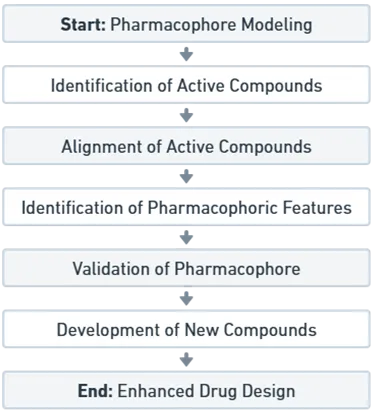
- Identification of Active Compounds: Select compounds that bind to the target.
- Alignment of Active Compounds: Align them to identify common pharmacophoric features.
- Identification of Pharmacophoric Features: Determine key elements like aromatic rings, hydrogen bond donors/acceptors, and charged groups.
- Validation of Pharmacophore: Confirm specificity using inactive compounds.
- Development of New Compounds: Design new molecules with enhanced activity and properties.
Applications of Pharmacophore Modeling
- Identifying new lead compounds.
- Optimizing the activity of existing drugs.
- Designing drug candidates with improved selectivity and pharmacokinetics.
- Predicting the activity of novel compounds.
Advertisements
Limitations of Pharmacophore Modeling
- Over-reliance on Active Compounds: Requires known active molecules.
- Limited Applicability: May not work for all targets.
- Simplified Molecular Interactions: May not capture all complexities.
- Dependence on Computational Methods: Accuracy relies on algorithms and available data.