
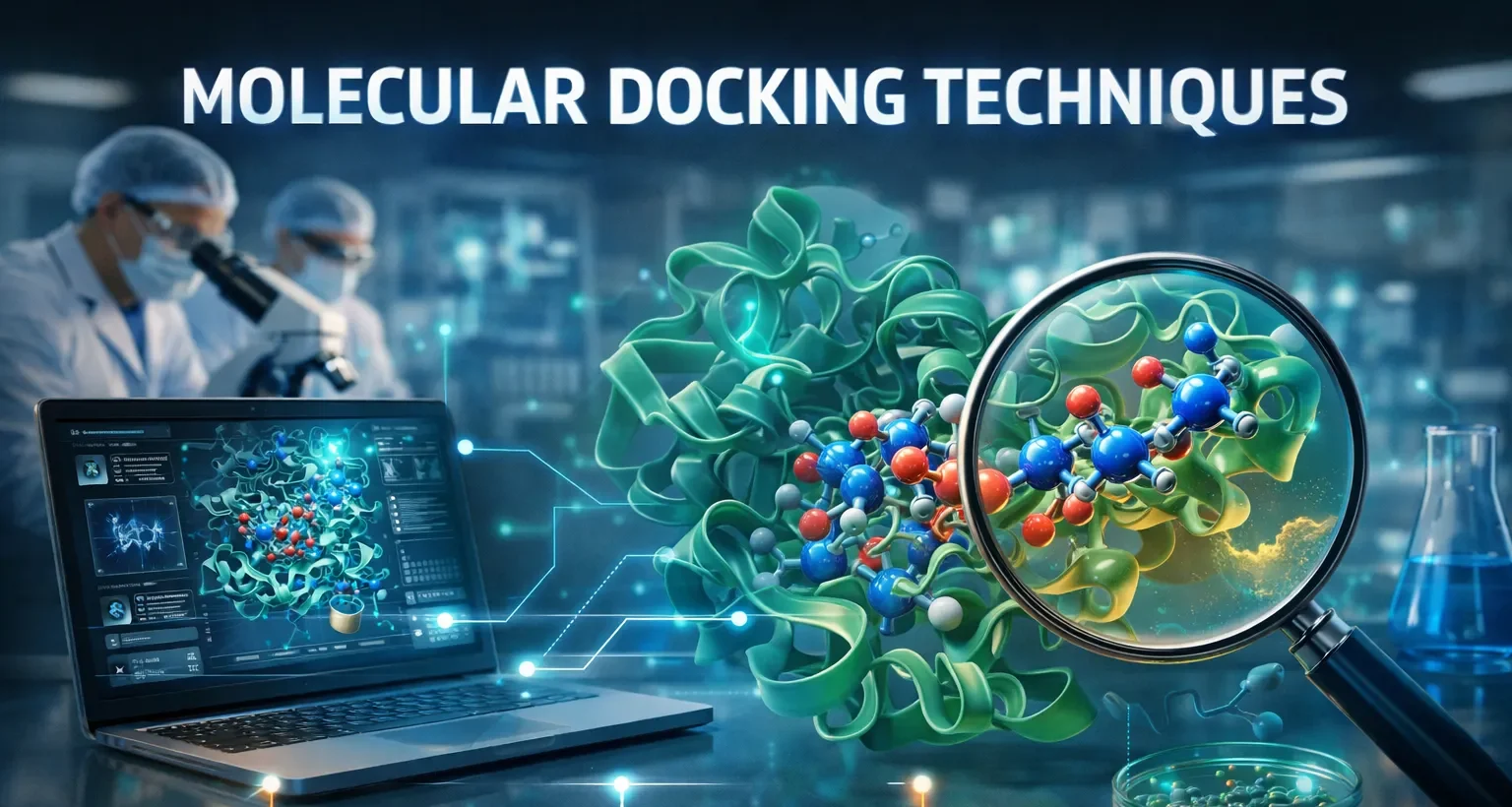
- Molecular docking is a computational technique that predicts the binding orientation and affinity of a small molecule (ligand) to a biological target (receptor).

Types of Docking:
- Structure-Based Docking: Uses the 3D structure of the target receptor to guide ligand placement.
- Ligand-Based Docking: Estimates binding mechanisms based on the similarity between the ligand and known active molecules.
Advertisements
Steps in Docking
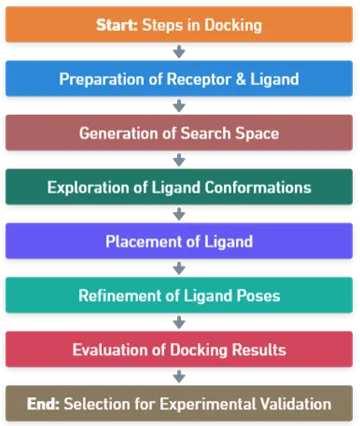
- Preparation of Receptor & Ligand: Optimizing geometries, adding missing atoms/charges, and minimizing energy.
- Generation of Search Space: Defining a docking box around the binding site.
- Exploration of Ligand Conformations: Using molecular dynamics, Monte Carlo, or quantum mechanical methods.
- Placement of Ligand: Docking ligands into the search space based on scoring functions evaluating complementarity and energy.
- Refinement of Ligand Poses: Optimizing docked poses to improve binding accuracy.
- Evaluation of Docking Results: Selecting the best ligand-receptor interactions for experimental validation.
Applications of Docking Techniques
- Drug Discovery: Identifying and optimizing drug candidates.
- Protein-Protein Interactions: Studying molecular binding mechanisms.
- Virtual Screening: Screening large compound libraries.
- Materials Design: Designing functional materials at the molecular level.
- Structure Prediction: Modeling molecular interactions.
Advertisements
Limitations of Docking Techniques
- Accuracy: Computational approximations may not fully capture real interactions.
- Speed: High computational cost for large datasets.
- Solvent Effects: Often ignores water and other solvent influences.
- False Positives/Negatives: Some predicted interactions may not occur experimentally.
- Validation Requirement: Needs experimental confirmation for reliability.