
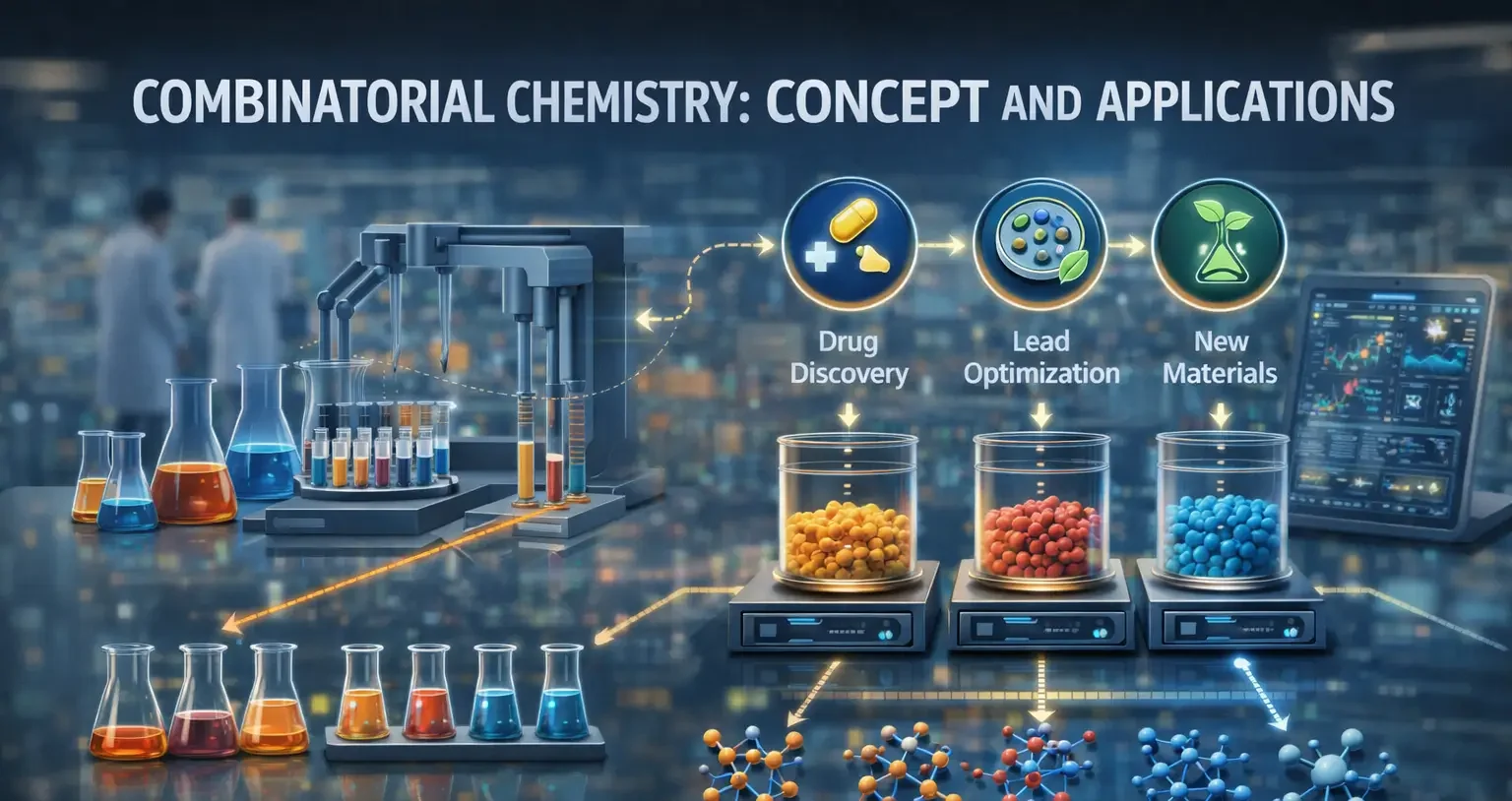
Concept of Combinatorial Chemistry
- Combinatorial chemistry is a high-throughput technique used in drug discovery and materials science to efficiently generate large chemical libraries.
- Instead of synthesizing compounds individually, it allows the simultaneous creation of thousands to millions of molecules.
Key principles:
- Parallel Synthesis: Multiple compounds are synthesized in separate reactions simultaneously.
- Mix-and-Split Synthesis: A systematic approach where compounds are combined, split, and recombined to create a diverse chemical library.
- Automation: High-throughput methods use robotic systems and computational tools to speed up the process.
Applications of Combinatorial Chemistry
Combinatorial chemistry is applied in various scientific and industrial fields:
Advertisements
-
Drug Discovery:
- Rapid generation of large libraries of potential drug molecules.
- Screening for active compounds (hits) against biological targets.
- Optimization of lead compounds for potency, selectivity, and pharmacokinetic properties.
- Used in designing inhibitors for enzymes, receptors, and other biological macromolecules.
-
Material Science:
- Development of new polymers and catalysts.
- Discovery of novel nanomaterials with unique properties.
- Synthesis of coatings and functional materials for industrial applications.
-
Agrochemicals:
- Development of new pesticides and herbicides.
- Synthesis of compounds with enhanced selectivity and environmental safety.
-
Chemical Biology:
- Identification of biochemical probes for studying biological pathways.
- Discovery of protein-ligand interactions for therapeutic research.
-
Peptide and Protein Research:
- Rapid synthesis of peptide libraries for enzyme inhibitors and vaccines.
- Generation of peptide-based drugs with improved stability and bioactivity.
Combinatorial Chemistry: Synthesis Methods
Two major approaches are used in combinatorial synthesis:
- Solid-Phase Synthesis (SPS)
- Solution-Phase Synthesis (SPS)
Advertisements