
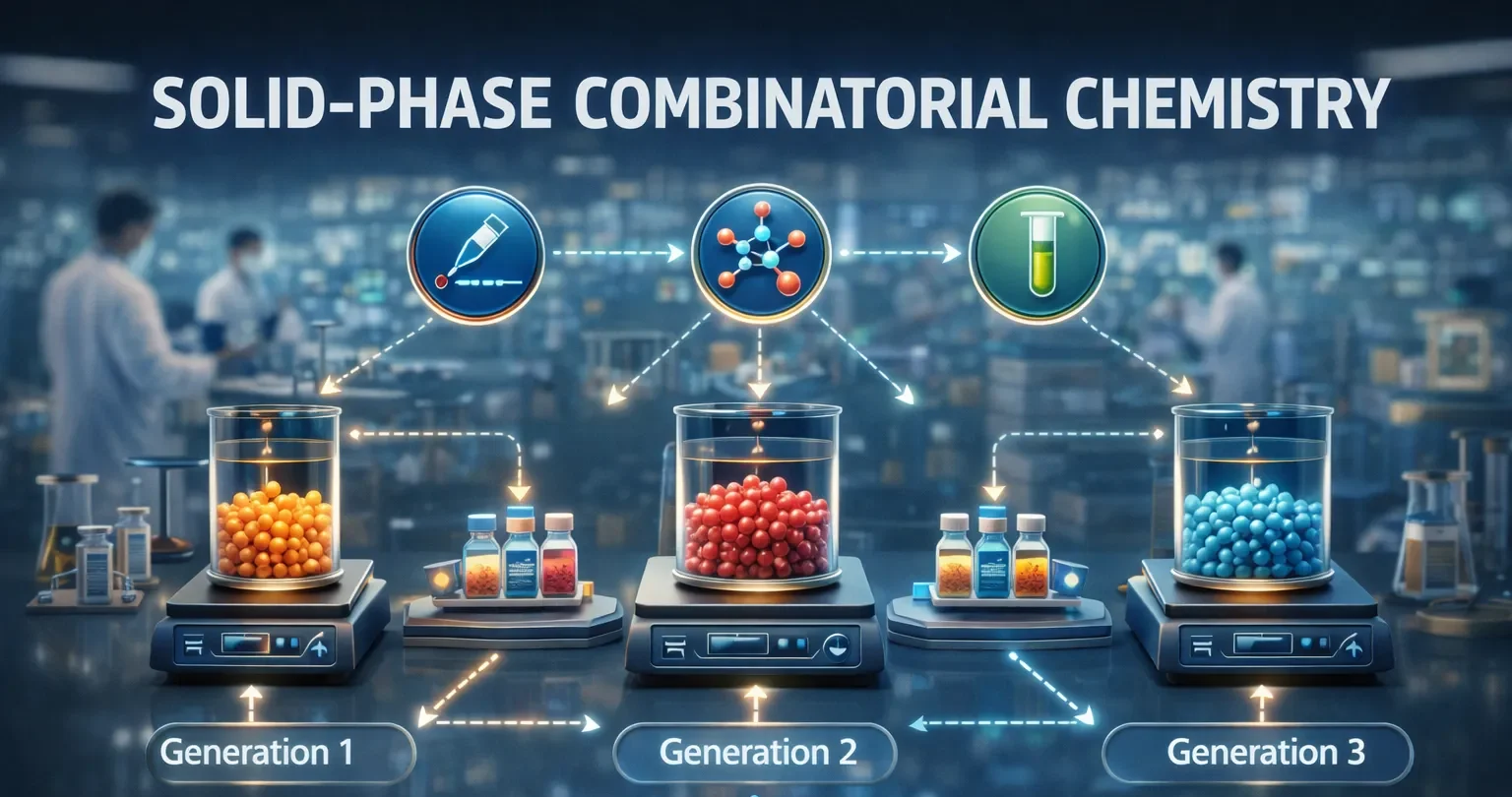
Solid-Phase Combinatorial Chemistry involves synthesis of compounds on solid supports for easy separation and high-throughput screening.
- A method where compounds are synthesized on a solid support, making synthesis, purification, and screening more efficient.
- This approach is automation-friendly and ideal for drug discovery and materials science.
Applications of Solid-Phase Combinatorial Chemistry
- Drug Discovery: Identifying new drug candidates.
- Peptide Synthesis: Producing peptide-based drugs.
- Materials Science: Developing new materials with specific properties.
- Chemical Biology: Studying biomolecular interactions.
Advantages
- High Efficiency: Faster synthesis compared to solution-phase methods.
- Automation: Easily integrated into robotic systems.
- Cost-Effective: Reduces reagent use and waste.
- Easy Purification: Simplified separation of final products.
- Reduced Reaction Times: Faster chemical transformations.
- Parallel Synthesis: Multiple compounds synthesized simultaneously.
- Increased Diversity: Enables rapid generation of structurally varied compounds.
Advertisements
Example: Peptide Synthesis (Merrifield Method)
- The Merrifield method, developed by Robert Merrifield, is widely used for automated peptide synthesis. It employs a solid support resin to build peptides step by step, adding one amino acid at a time.