
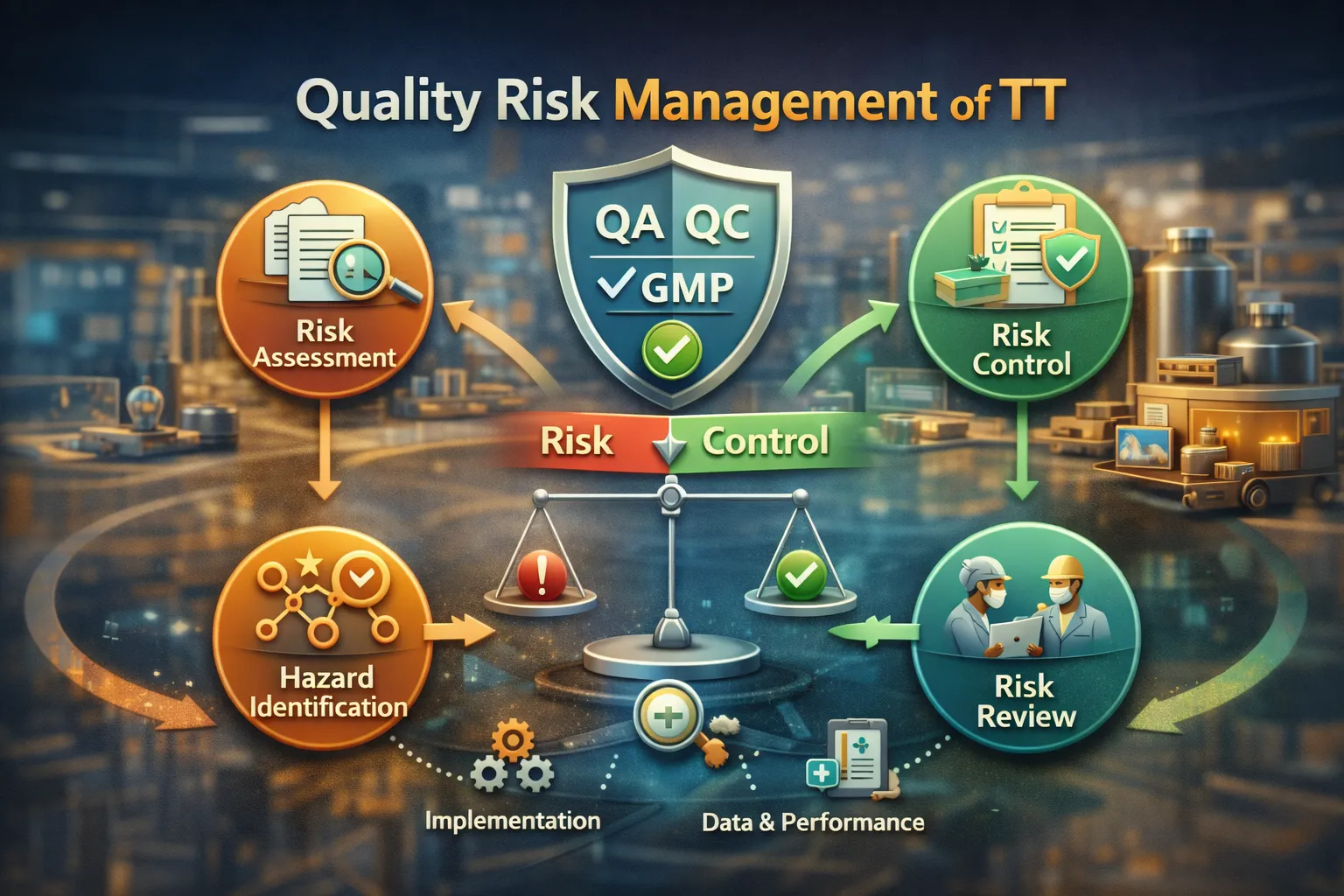
Definition and Importance of Quality risk management of TT
- Quality Risk Management (QRM) is a systematic process for the assessment, control, communication, and review of risks to the quality of the drug product across the product lifecycle.
- It ensures that high-quality products are delivered to patients.
Principles of Quality risk management of TT
- Scientific Knowledge: Decisions are based on scientific understanding.
- Risk-Based Approach: Focus on critical areas that impact product quality.
- Lifecycle Management: Continuous process throughout the product’s life.
QRM Process Steps
- Risk Identification: Determining what could go wrong.
- Risk Analysis: Understanding the nature of the risk and its potential impact.
- Risk Evaluation: Comparing the estimated risk against given risk criteria.
- Risk Control:
- Risk Reduction: Implementing actions to mitigate risk.
- Risk Acceptance: Deciding whether residual risk is acceptable.
- Risk Communication: Sharing information about risks and risk management between stakeholders.
- Risk Review: Monitoring and reviewing risk over time.
Advertisements
Tools Used in QRM
- Failure Mode and Effects Analysis (FMEA)
- Hazard Analysis and Critical Control Points (HACCP)
- Fault Tree Analysis (FTA)
- Risk Ranking and Filtering
Application of QRM in Technology Transfer
- Process Understanding: Identifying critical process parameters.
- Equipment Qualification: Assessing equipment suitability and risks.
- Analytical Method Transfer: Ensuring methods are robust and reliable.
- Regulatory Compliance: Demonstrating control over risks to regulatory bodies.
Click Here to Watch the Best Pharma Videos
Advertisements