
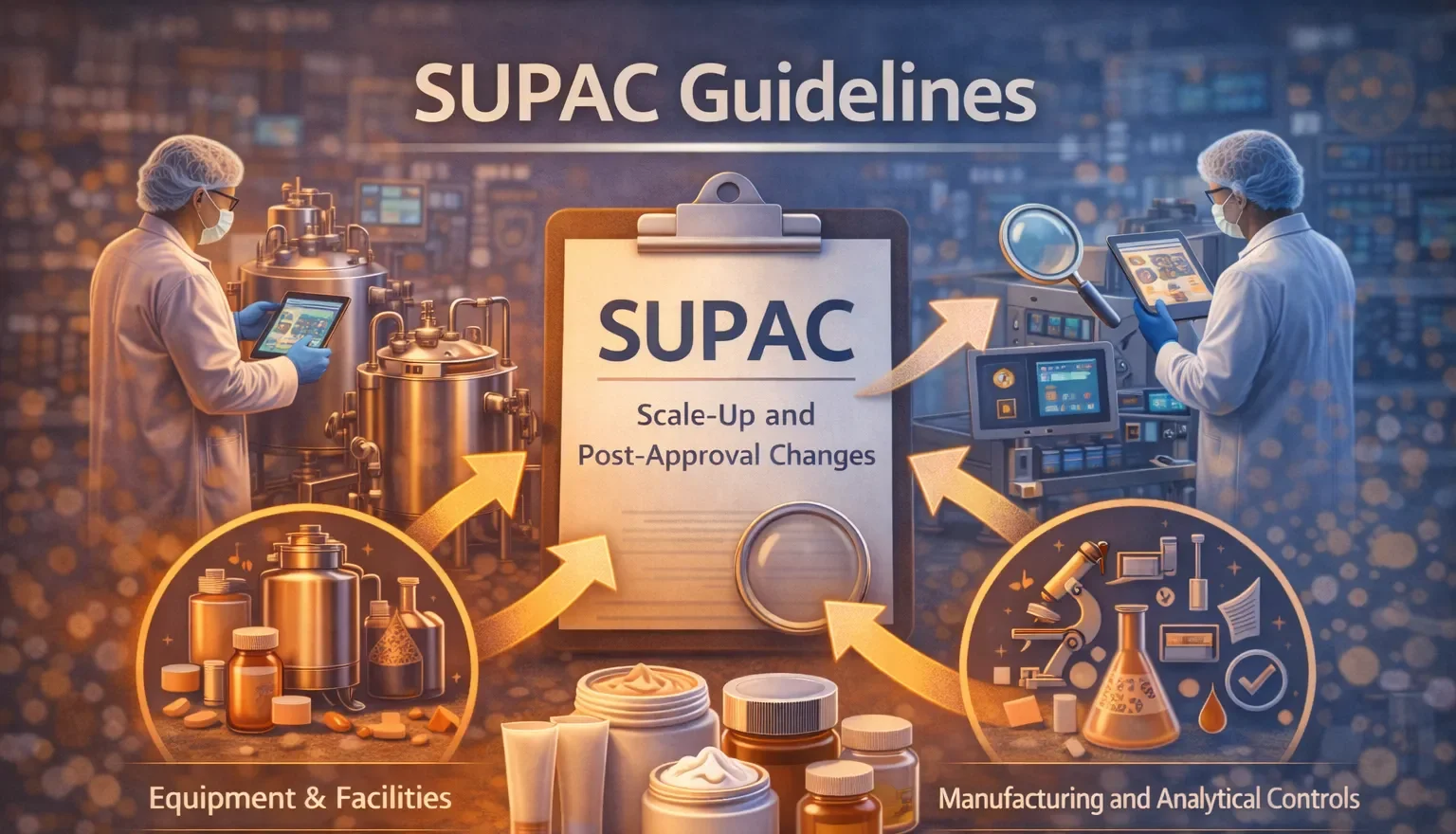
- The Scale-Up and Post-Approval Changes (SUPAC) guidelines are provided by the U.S.
- Food and Drug Administration (FDA) to assist pharmaceutical manufacturers in managing changes to approved drug products.
- These guidelines help ensure that post-approval changes do not adversely affect the identity, strength, quality, purity, or potency of the drug product.
Key Components of SUPAC
-
Change Levels:

Advertisements
-
- Level 1 (Minor Changes): Changes that are unlikely to have any detectable impact on formulation quality and performance (e.g., minor equipment changes within the same class).
- Level 2 (Moderate Changes): Changes that could have a significant impact and may require additional in vitro dissolution testing (e.g., changes in batch size beyond a certain scale).
- Level 3 (Major Changes): Changes that are likely to have a significant impact on the formulation’s quality and performance, possibly requiring bioequivalence studies (e.g., changes in manufacturing site or significant process alterations).
Categories of SUPAC Guidelines
- SUPAC-IR: For immediate-release solid oral dosage forms.
- SUPAC-MR: For modified-release solid oral dosage forms.
- SUPAC-SS: For non-sterile semi-solid dosage forms.
- SUPAC-SS Nonsterile Semisolid Dosage Forms: Specifically addresses creams, ointments, and gels.
Implementation
- Documentation and Reporting: Depending on the level of change, manufacturers may need to submit different types of documentation to the FDA, ranging from annual reports to prior approval supplements.
- Testing Requirements: Additional testing, such as dissolution profiles, stability studies, or bioequivalence studies, may be required to demonstrate that the product remains equivalent to the approved version.
- Regulatory Compliance: Adherence to SUPAC guidelines helps ensure that changes are made in compliance with regulatory expectations, minimizing the risk of product recalls or compliance actions.
Advertisements