
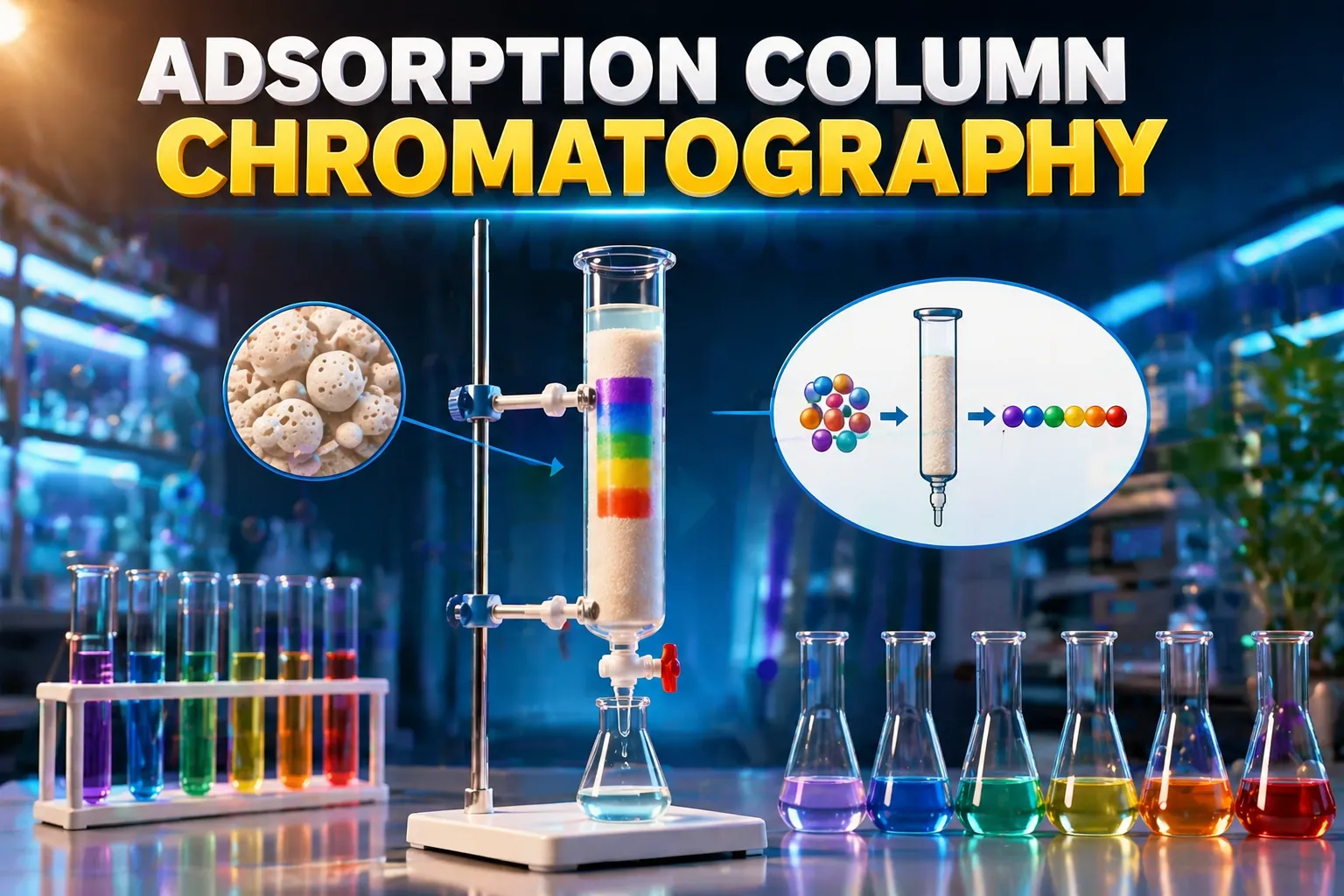
Introduction to Adsorption Column Chromatography
- Adsorption column chromatography is one of the earliest and most fundamental forms of column chromatography.
- It relies on the differential adsorption of components in a mixture onto the surface of a solid stationary phase.
Principle
- The separation is based on the varying affinities of different components for the stationary phase.
- Components that strongly adsorb to the stationary phase move more slowly through the column, while those with weaker interactions elute faster.
Advertisements
Methodology of Adsorption Column Chromatography
-
Preparation of the Column:
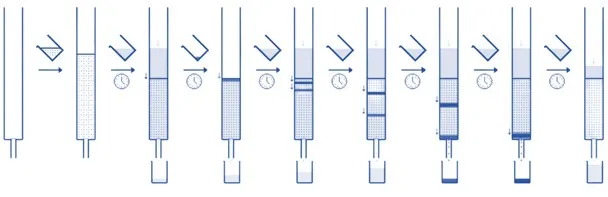
- A glass column is packed with a stationary phase (e.g., silica gel or alumina).
- A cotton plug is placed at the bottom to retain the stationary phase.
- The adsorbent is slurried with a solvent and poured into the column, avoiding air bubbles.
- A layer of sand is added on top to protect the stationary phase.
-
Sample Loading:
- The mixture is dissolved in a minimal solvent and carefully added to the top of the column or applied as a dried sample pre-adsorbed on the stationary phase.
-
Elution:
- The mobile phase (solvent) flows through the column, carrying the sample.
- Components separate based on their affinity for the stationary phase; lower-affinity compounds elute first, higher-affinity compounds elute later.
-
Detection & Collection:
- Fractions are collected at the column’s outlet in test tubes or vials.
- Visual indicators (e.g., colored bands) or instruments like UV-Vis detectors monitor elution.
-
Analysis:
- Collected fractions are analyzed, often using thin-layer chromatography (TLC), to identify the separated components.
Advantages
- Simplicity: Easy to set up and operate with minimal equipment.
- Versatility: Applicable to a wide range of compounds, both polar and non-polar.
- Scalability: Suitable for both analytical and preparative purposes.
- Cost-Effective: Utilizes inexpensive materials like silica gel and common solvents.
- Robustness: Can handle samples with a wide range of concentrations and complexities.
Disadvantages
- Resolution: May offer lower resolution compared to more advanced techniques like HPLC.
- Time-Consuming: Can be slower, especially for large-scale separations.
- Reproducibility: Less reproducible due to potential variations in column packing and flow rates.
- Sample Load Limitations: Overloading the column can lead to poor separation and overlapping of components.
- Limited Detection: Typically requires additional steps for detection and identification of separated components.
Advertisements
Applications
- Purification of Organic Compounds: Isolation of individual components from plant extracts or synthetic mixtures.
- Pharmaceuticals: Separation and purification of active ingredients.
- Environmental Analysis: Removal of contaminants from water or soil samples.
- Food Industry: Extraction and purification of food additives and natural colorants.
- Natural Product Isolation: Separation of complex mixtures derived from biological sources.