
Introduction to Partition Column Chromatography
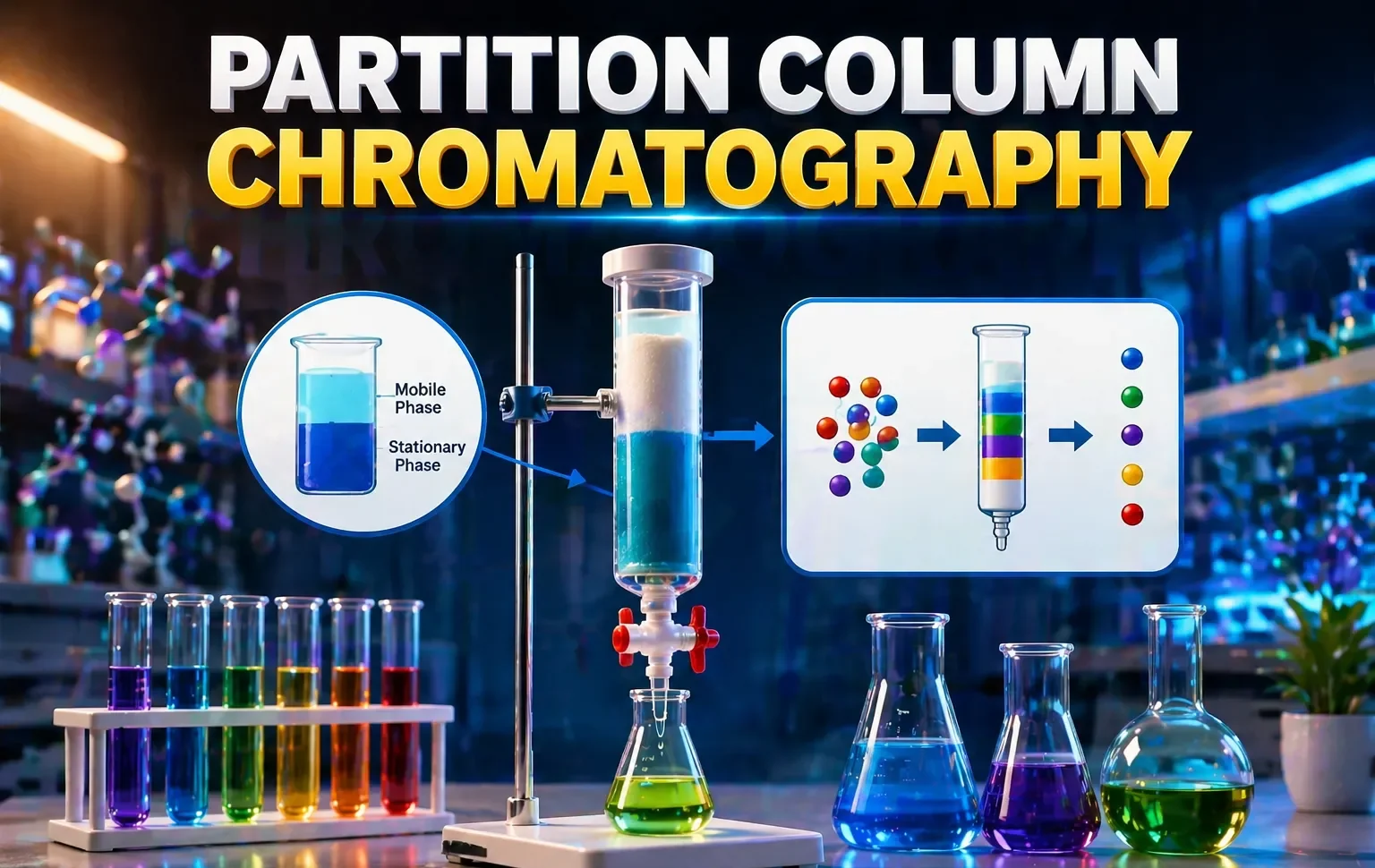
- Partition column chromatography utilizes a liquid stationary phase supported on an inert solid, relying on the partitioning of solutes between the mobile and stationary phases for separation.
Principle of Partition Column Chromatography
- Separation occurs based on the solubility of components in the mobile phase relative to the stationary phase.
- Components distribute themselves between the two phases until equilibrium is reached, with differing affinities leading to separation.
Advertisements
Methodology
-
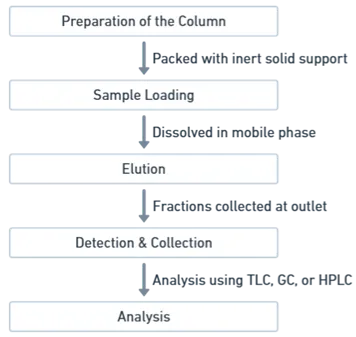
Preparation of the Column:
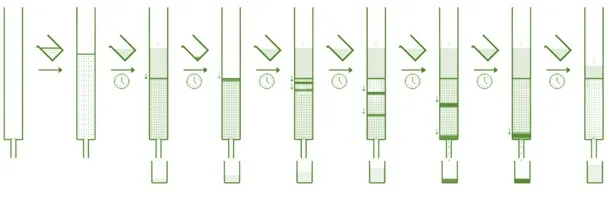
- A glass column is packed with an inert solid support (e.g., diatomaceous earth, Celite, or silica) soaked or coated with one immiscible liquid phase, serving as the stationary phase.
- The stationary phase liquid can be water, oil, or another suitable liquid.
-
Sample Loading:
- The sample is dissolved in the mobile phase or a compatible solvent and carefully added to the top of the column.
-
Elution:
- The mobile phase, immiscible with the stationary phase, is poured or pumped through the column.
- Compounds partition between the two liquid phases based on their partition coefficients:
- Those favoring the mobile phase elute faster.
- Those favoring the stationary phase elute slower.
-
Detection & Collection:
- Fractions are collected at the column outlet in test tubes or vials.
- Detection can be visual (for colored compounds) or performed using instruments like UV-Vis or refractive index detectors.
-
Analysis:
- The collected fractions are analyzed using techniques such as TLC, GC, or HPLC to identify their constituents.
Advantages
- High Resolution: Better separation efficiency compared to simple adsorption chromatography.
- Flexibility: Ability to fine-tune the mobile phase for optimal separation.
- Compatibility: Suitable for a wide range of chemical compounds, including those with similar structures.
- Enhanced Selectivity: Can achieve selective separation based on solubility differences.
- Scalable: Can be adapted for both small-scale analytical and large-scale preparative processes.
Advertisements
Disadvantages
- Complexity: More parameters to optimize, such as solvent composition and flow rate.
- Stability Issues: The liquid stationary phase can sometimes be unstable or prone to leaching.
- Cost: Potentially higher costs due to the need for specific solvents and supports.
- Maintenance: Requires careful maintenance to prevent phase separation and ensure consistent performance.
- Limited Reusability: The liquid stationary phase may degrade or become contaminated, limiting column reuse.
Applications
- Natural Product Isolation: Separation of complex mixtures from plant or microbial sources.
- Synthetic Chemistry: Purification of reaction products in organic synthesis.
- Biochemistry: Isolation of biomolecules like amino acids and peptides.
- Petroleum Industry: Separation of hydrocarbon mixtures.
Pharmaceuticals: Purification of drug intermediates and active pharmaceutical ingredients (APIs).
Advertisements