
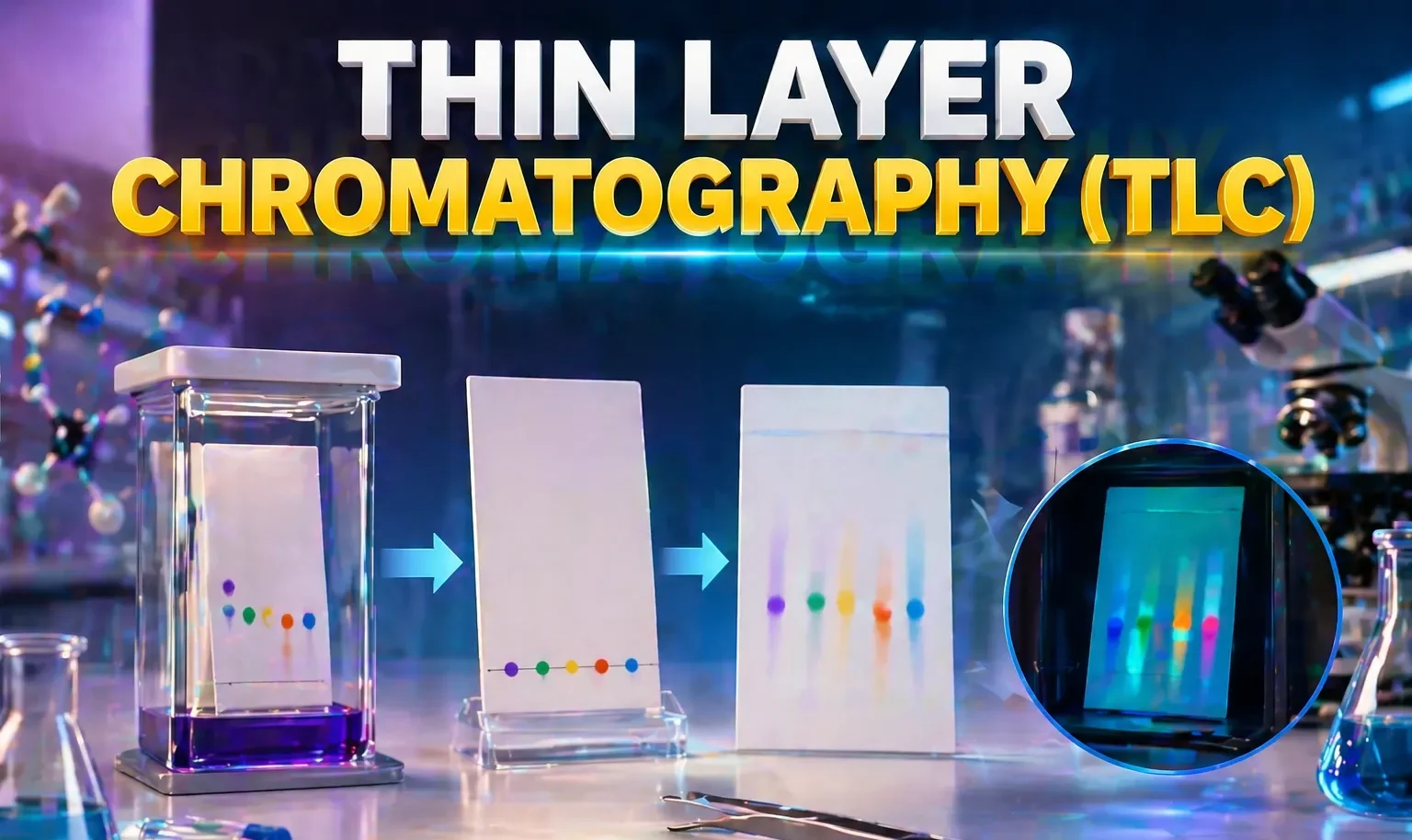
Introduction to Thin Layer Chromatography (TLC)
- Thin Layer Chromatography (TLC) is a simple, rapid, and versatile analytical technique used to separate and identify compounds within a mixture.
- It is widely used in laboratories for qualitative analysis and monitoring reactions.
Principle of Thin Layer Chromatography (TLC)
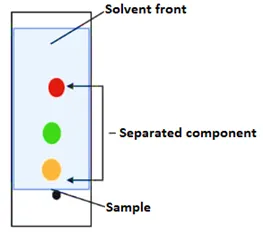
- TLC operates on the principle of differential migration of components between a stationary phase and a mobile phase.
- The stationary phase is a thin layer of adsorbent material, typically silica gel or alumina, coated on a flat substrate.
- The mobile phase moves up the plate by capillary action, carrying the sample components with it at different rates based on their affinities.
Advertisements
Methodology of Thin Layer Chromatography (TLC)
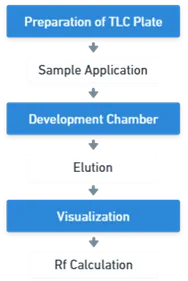
- Preparation of TLC Plate: A thin layer of adsorbent (e.g., silica gel) is spread uniformly on a glass, plastic, or aluminum plate.
- Sample Application: Small spots of the sample mixture are applied near the bottom of the plate using a capillary tube.
- Development Chamber: The plate is placed in a chamber containing a shallow pool of the mobile phase solvent.
- Elution: The solvent ascends the plate by capillary action, carrying the sample components with it.
- Visualization: After development, separated spots are visualized under UV light or by applying a suitable reagent.
- Rf Calculation: The Retention factor (Rf) values are calculated for each component to aid in identification.
$R_f = \frac{\text{Distance traveled by compound}}{\text{Distance travelled by solvent front}}$
Advertisements
Rf Values
- Definition: Rf is the ratio of the distance traveled by the compound to the distance traveled by the solvent front.
- Calculation:
$Rf = \frac{\text{Distance traveled by the compound}}{\text{Distance travelled by the solvent front}}$
-
- Significance: Rf values are characteristic for specific compounds under given conditions and aid in their identification.
Advertisements
Advantages
- Simplicity: Requires minimal equipment and is easy to perform.
- Speed: Rapid separation process, often completed within minutes.
- Cost-Effective: Inexpensive reagents and materials.
- Versatility: Applicable to a wide range of substances, including organic and inorganic compounds.
- Visualization: Easy to detect separated components using various visualization techniques.
Disadvantages
- Quantitative Limitations: Primarily qualitative, with limited accuracy for quantitative analysis.
- Resolution: Lower resolution compared to more advanced techniques like HPLC.
- Reproducibility: Can suffer from variability between runs due to manual handling.
- Scalability: Not suitable for preparative purposes involving large sample quantities.
- Sensitivity: Limited sensitivity, making it difficult to detect components present in very low concentrations.
Applications
- Qualitative Analysis: Identification of compounds in mixtures based on Rf values and comparison with standards.
- Monitoring Reactions: Tracking the progress of chemical reactions by observing the disappearance of reactants or formation of products.
- Purity Testing: Assessing the purity of compounds by detecting the presence of impurities.
- Forensic Science: Analyzing substances like drugs, inks, and pigments.
- Pharmaceuticals: Checking the consistency and quality of pharmaceutical preparations.
Advertisements