
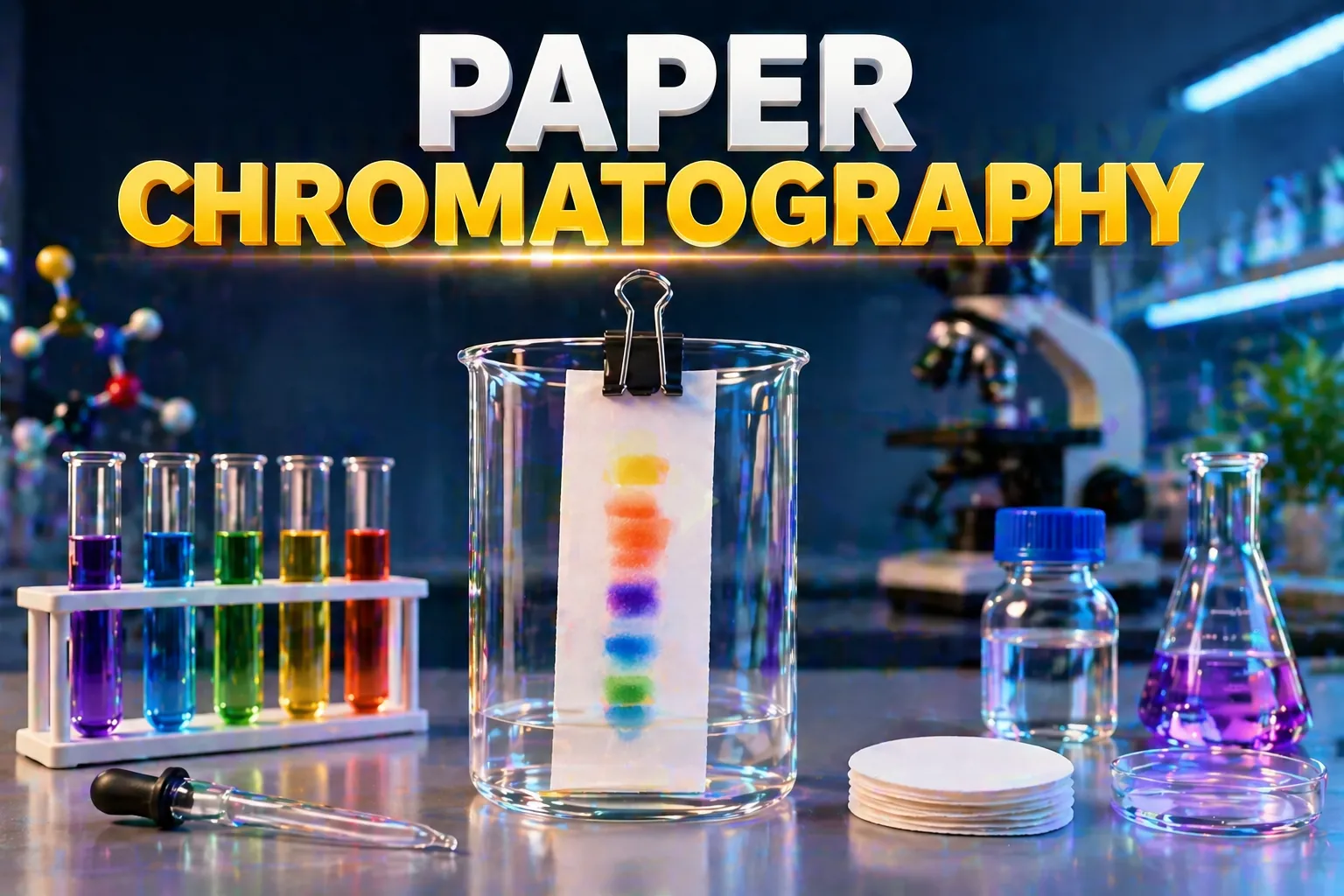
Introduction to Paper Chromatography
- Paper chromatography is an analytical technique used to separate and identify mixtures of soluble substances.
- It is one of the simplest forms of chromatography, utilizing paper as the stationary phase and a solvent as the mobile phase.
Principle of Paper Chromatography
- The separation in paper chromatography is based on differential solubility and partitioning of components between the stationary phase (paper) and the mobile phase (solvent).
- Components move at different rates depending on their affinity for the solvent versus the paper.
Advertisements
Methodology of Paper Chromatography
-
Paper Selection:
- Chromatographic paper (usually cellulose-based) serves as the stationary phase.
-
Sample Preparation:
- The sample is dissolved in a suitable solvent for easy application.
-
Spotting the Sample:
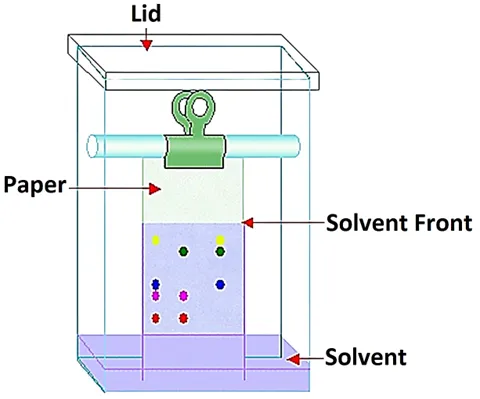
- A small, concentrated spot of the sample is applied near the paper’s bottom edge (origin) using a capillary tube or micro-pipette.
-
Choice of Solvent (Mobile Phase):
- The solvent (developing solution) is chosen based on the sample and desired separation.
-
Chamber Saturation:
- The developing chamber is saturated with solvent vapor for consistency.
-
Development:
- The paper is placed in the chamber with the solvent below the sample spot.
- The solvent rises via capillary action, separating the sample components based on their affinities for the mobile and stationary phases.
-
Termination:
- The paper is removed once the solvent has traveled a set distance. The solvent front is marked immediately.
-
Visualization:
- For colorless compounds, methods include:
- UV Light: Visualizes fluorescent compounds.
- Staining: Reacts with compounds to produce color.
- Iodine Vapors: Useful for certain organic compounds.
- For colorless compounds, methods include:
-
Analysis:
- Separation is analyzed by calculating Rf values:
-
- $Rf = \frac{\text{Distance traveled by the compound}}{\text{Distance travelled by the solvent front}}$
- Rf values are compared for compound identification.
-
- Separation is analyzed by calculating Rf values:
Development Techniques
- Ascending (Vertical) Development: The solvent moves upwards from the bottom of the paper.
- Descending (Horizontal) Development: The solvent moves downward from the top, though less common.
- Two-Dimensional Development: The paper is developed first in one solvent direction and then rotated 90 degrees for a second development, enhancing separation.
- Isocratic Development: Using a single solvent system throughout the development process.
- Gradient Development: Gradually changing the solvent composition during development to improve separation.
Advantages
- Simplicity: Requires minimal equipment and is easy to perform.
- Cost-Effective: Low-cost materials and solvents.
- Portability: Can be performed without sophisticated instruments.
- Visualization: Easily visualized with common reagents or UV light.
- Educational Use: Ideal for teaching fundamental chromatographic principles.
Advertisements
Disadvantages
- Low Resolution: Limited ability to separate complex mixtures compared to advanced techniques.
- Quantitative Analysis: Primarily qualitative with limited quantitative capabilities.
- Reproducibility: Variability due to manual handling and environmental factors.
- Scalability: Not suitable for preparative purposes or large sample sizes.
- Sensitivity: Lower sensitivity compared to methods like TLC or HPLC, making it difficult to detect trace components.
Applications
- Amino Acid Separation: Differentiating amino acids based on their charge and solubility.
- Pigment Analysis: Separating pigments in plants, inks, or dyes.
- Food Industry: Detecting additives, contaminants, or verifying the composition of food products.
- Forensic Science: Analyzing substances such as drugs, inks, and toxins.
- Pharmaceuticals: Monitoring the purity and composition of pharmaceutical compounds.
Click Here to Watch the Best Pharma Videos
Advertisements