
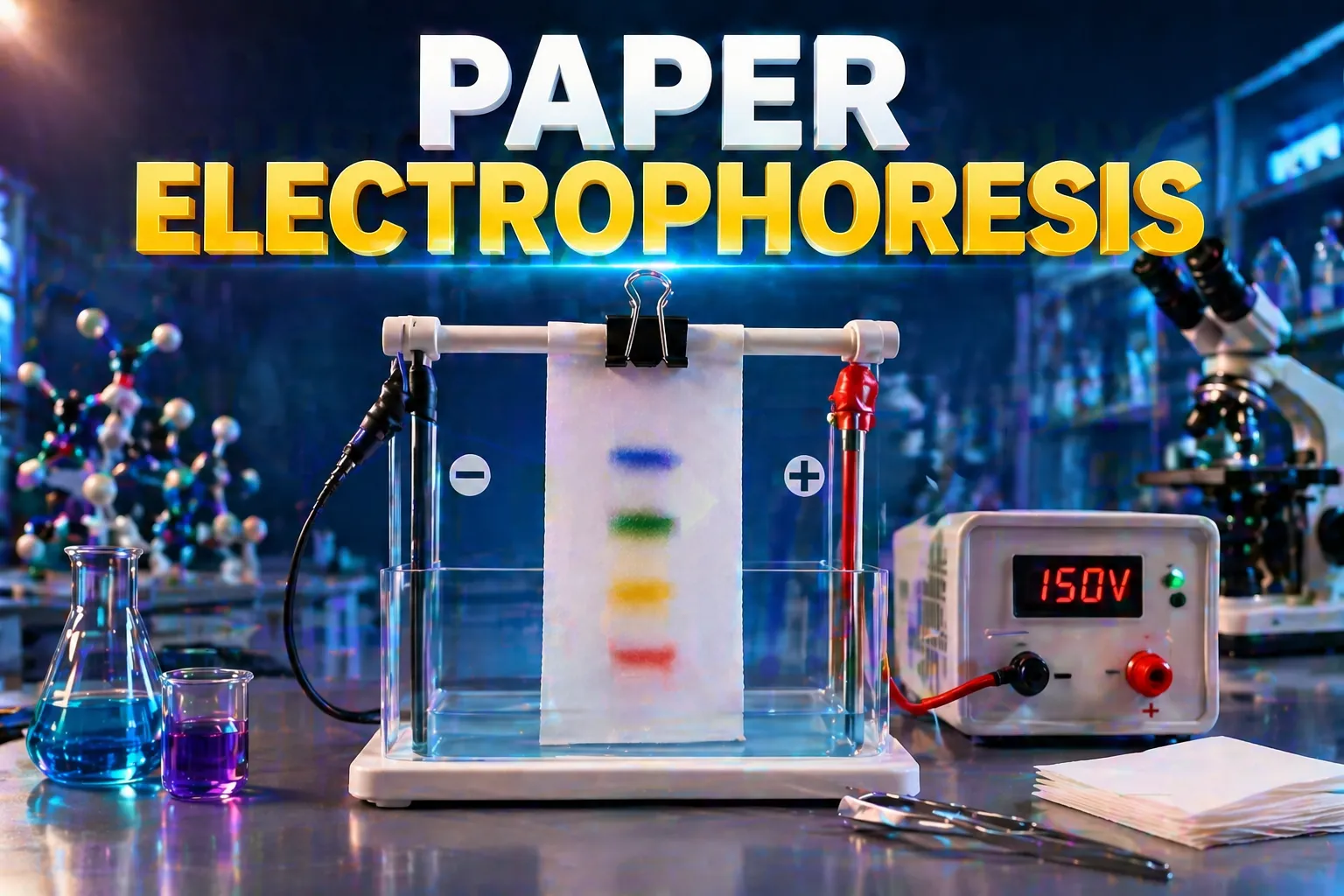
Introduction to Paper Electrophoresis
- Paper electrophoresis is one of the earliest forms of electrophoretic techniques.
- It employs cellulose paper as the medium through which molecules migrate under an electric field.
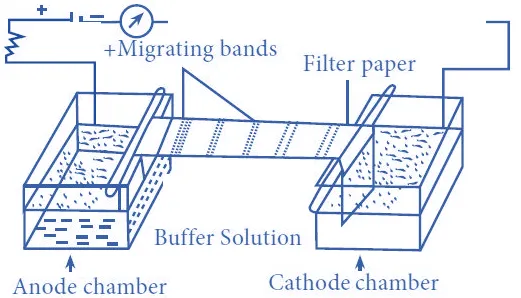
Principle of Paper Electrophoresis
- Molecules dissolve in a buffer solution and migrate through the porous structure of the paper based on their charge and size when an electric field is applied.
Advertisements
Methodology of Paper Electrophoresis
-
Preparation of the Paper:
- Cut the filter paper strip to the desired size and soak it in a buffer solution to maintain stable pH conditions.
-
Sample Application:
- Apply a small, precise spot of the sample at a designated point on the paper to minimize spreading and maintain resolution.
-
Electrophoresis Chamber Setup:
- Position the paper in a chamber containing a buffer solution.
- Ensure both ends of the paper strip are in contact with the buffer for proper conductivity.
- Place electrodes (anode and cathode) at opposite ends of the chamber.
-
Application of Electric Field:
- Connect the chamber to a power supply to establish an electric field across the paper.
- Charged molecules in the sample migrate toward the electrode with the opposite charge based on their charge-to-mass ratio.
-
Detection and Analysis:
- After electrophoresis, remove the paper and detect separated molecules using staining or other visualization methods.
- Analyze the migration distances to identify and characterize the sample components.
Types of Paper Electrophoresis
-
High Voltage Paper Electrophoresis:
- Voltage: Above 2000V.
- Duration: Faster separation due to higher voltage.
- Resolution: Better resolution with sharper bands.
- Applications: Ideal for rapid separations and smaller molecules.
-
Low Voltage Paper Electrophoresis:
- Voltage: Below 300V.
- Duration: Slower separation due to lower voltage.
- Resolution: Gentler process but may result in less sharp bands.
- Applications: Suitable for larger molecules or sensitive samples.
Advantages
- Simplicity: Easy to perform with minimal equipment.
- Cost-Effective: Inexpensive materials and setup.
- Portability: Suitable for field applications and educational purposes.
- Visualization: Clear band formation facilitates qualitative analysis.
- Versatility: Can separate a variety of small to moderately sized molecules.
Advertisements
Disadvantages
- Low Resolution: Limited ability to separate complex or closely related molecules.
- Quantitative Limitations: Primarily qualitative with limited accuracy for quantification.
- Reproducibility Issues: Variability due to manual handling and environmental factors.
- Sensitivity: Lower sensitivity compared to more advanced electrophoretic techniques.
- Sample Capacity: Limited sample loading capacity, restricting the analysis of large quantities.
Applications
- Amino Acid Separation: Differentiating amino acids based on charge and size.
- Clinical Diagnostics: Analyzing blood proteins and other biomarkers.
- Pharmaceutical Analysis: Quality control of drugs and active ingredients.
- Forensic Science: Identification of substances in forensic samples.
- Educational Demonstrations: Teaching fundamental electrophoretic principles in laboratories.
Click Here to Watch the Best Pharma Videos
Advertisements