

Introduction to Gel Electrophoresis
- Gel electrophoresis is a widely used technique that employs a gel matrix to facilitate the separation of macromolecules like DNA, RNA, and proteins.
- The gel acts as a sieve, enabling high-resolution separation based on size and charge.
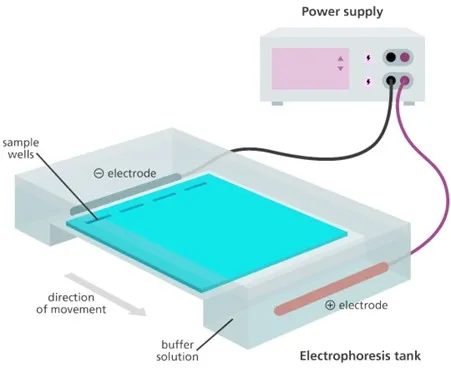
Principle of Gel Electrophoresis
- Molecules migrate through the porous gel matrix under an electric field, with smaller or more highly charged molecules moving faster than larger or less charged ones.
Advertisements
Methodology
- Gel Preparation: A gel matrix (commonly agarose for nucleic acids or polyacrylamide for proteins) is prepared and poured into a casting tray with a comb to create wells.
- Sample Loading: The sample mixtures are loaded into the wells.
- Buffer Setup: An appropriate running buffer is added to the electrophoresis chamber to facilitate ion conduction.
- Application of Electric Field: An electric current is applied, causing charged molecules to migrate through the gel.
- Visualization: After electrophoresis, the gel is stained with specific dyes (e.g., ethidium bromide for DNA) and visualized under UV light or other imaging systems.
Advantages
- High Resolution: Effective separation of closely related molecules.
- Versatility: Suitable for DNA, RNA, proteins, and other macromolecules.
- Quantitative Analysis: Allows for the estimation of molecular sizes and concentrations.
- Reproducibility: Consistent results with standardized protocols.
- Visualization: Clear band patterns facilitate identification and analysis.
Disadvantages
- Complexity: More steps and careful handling compared to simpler methods.
- Time-Consuming: Gel preparation and electrophoresis can be time-intensive.
- Cost: Reagents, gels, and equipment can be relatively expensive.
- Limited Throughput: Typically analyzes a limited number of samples simultaneously.
- Hazardous Dyes: Use of toxic stains like ethidium bromide requires safety precautions.
Advertisements
Applications
- Genetic Analysis: DNA fingerprinting, restriction fragment length polymorphism (RFLP) analysis.
- Protein Profiling: SDS-PAGE for protein separation and analysis.
- RNA Studies: Northern blotting and RNA expression analysis.
- Clinical Diagnostics: Identifying genetic disorders and infections.
- Molecular Cloning: Verification of DNA insertions and plasmid constructs.
Below is a tabulated differentiation between vertical and horizontal gel electrophoresis
| Parameter | Vertical Gel Electrophoresis | Horizontal Gel Electrophoresis |
| Orientation | Vertical | Horizontal |
| Gel Type | Typically polyacrylamide gels | Commonly agarose gels |
| Sample Wells | Created at the top using a comb during polymerization | Created using a comb in the gel mold after solidification |
| Equipment Design | Two glass plates held together with clips or a frame | Flat tray where agarose is poured and solidified |
| Applications | Protein separation, DNA sequencing | DNA and RNA fragment separation like restriction digests or PCR products |
| Handling | More cumbersome, risk of breaking glass or tearing gel | Easier to handle, manipulate, and transfer |
Advertisements