
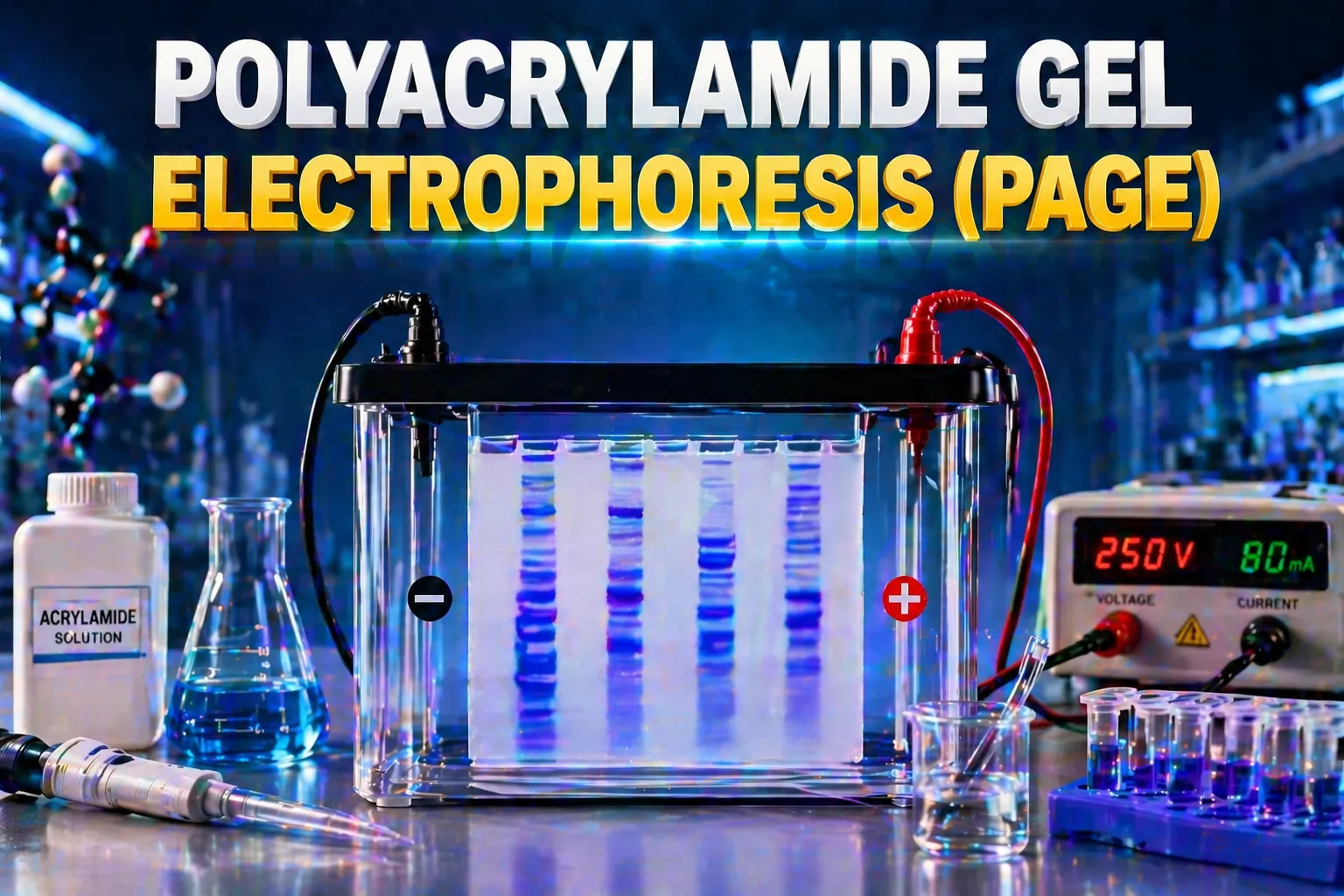
Polyacrylamide Gel Electrophoresis (PAGE) separates proteins by size and charge with high resolution in a polyacrylamide gel for analysis.
Polyacrylamide Gel Electrophoresis (PAGE)
- PAGE is a widely used technique for separating biomolecules, especially proteins and small nucleic acid fragments, based on their molecular weight.
Basic Principle
- Charged molecules migrate through a polyacrylamide gel matrix under an electric field.
- Smaller molecules move faster through the gel, while larger ones move more slowly, as migration is inversely proportional to molecular weight.
Advertisements
Procedure and Components
-
Gel Preparation:
- A solution of acrylamide and bis-acrylamide is mixed with a buffer.
- Polymerization is induced using ammonium persulfate (catalyst) and TEMED (stabilizer), forming a mesh-like gel matrix.
-
Loading Samples:
- Samples are loaded into wells created in the gel, along with a molecular weight marker (ladder) for size reference.
-
Electrophoresis:
- The gel is placed in an electrophoresis apparatus filled with running buffer.
- An electric field is applied, causing negatively charged molecules to migrate toward the anode.
-
Visualization:
- After separation, molecules are visualized using stains:
- Coomassie Blue for proteins.
- Ethidium Bromide for DNA.
- After separation, molecules are visualized using stains:
Variations of PAGE
-
SDS-PAGE:
- Uses Sodium Dodecyl Sulfate (SDS) to denature proteins and give them a uniform negative charge.
- Separation is purely based on molecular weight.
-
Native PAGE:
- No denaturing agents are used, so proteins retain their native structure and charge.
- Separation is based on both size and charge.
-
2D-PAGE:
- Combines isoelectric focusing (separation by isoelectric point) and SDS-PAGE (separation by molecular weight) for a detailed separation profile.
Advantages
- High Resolution: Capable of separating molecules with very similar sizes.
- Versatility: Suitable for proteins and nucleic acids; conditions can be tailored for various applications.
Advertisements
Disadvantages
- Toxicity: Acrylamide is a neurotoxic substance requiring careful handling.
- Fragility: Polyacrylamide gels are delicate and more difficult to handle compared to agarose gels.