
What Are Anthelmintic Agents?
- Anthelmintics (also called antihelminthic or vermifuge drugs) are medications used to eliminate parasitic worms (helminths) from the human or animal body.
Helminths (Parasitic Worms)
- Helminths are multicellular, worm-like organisms that cause various infections.
- They are classified into three major groups:
- Nematodes (Roundworms): e.g., Ascaris lumbricoides, Hookworms
- Cestodes (Tapeworms): e.g., Taenia saginata, Taenia solium
- Trematodes (Flukes): e.g., Schistosoma species
Mechanism of Action of Anthelmintic Drugs
- Anthelmintic drugs work by targeting specific biological processes in parasites, leading to:
- Immobilization (paralysis of the worm)
- Death (disrupting metabolism or structural integrity)
- Expulsion (elimination from the body)
- The exact mechanism depends on the type of drug and the helminth being treated.
Advertisements
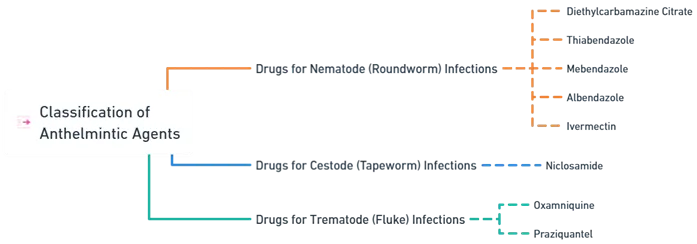
Classification of Anthelmintic Agents
-
Drugs for Nematode (Roundworm) Infections
- Diethylcarbamazine Citrate
- Thiabendazole
- Mebendazole
- Albendazole
- Ivermectin
-
Drugs for Cestode (Tapeworm) Infections
-
Drugs for Trematode (Fluke) Infections
Anthelmintic drugs play a vital role in controlling parasitic worm infections and improving overall health outcomes. The choice of drug depends on the type of helminth, severity of infection, and patient condition.