
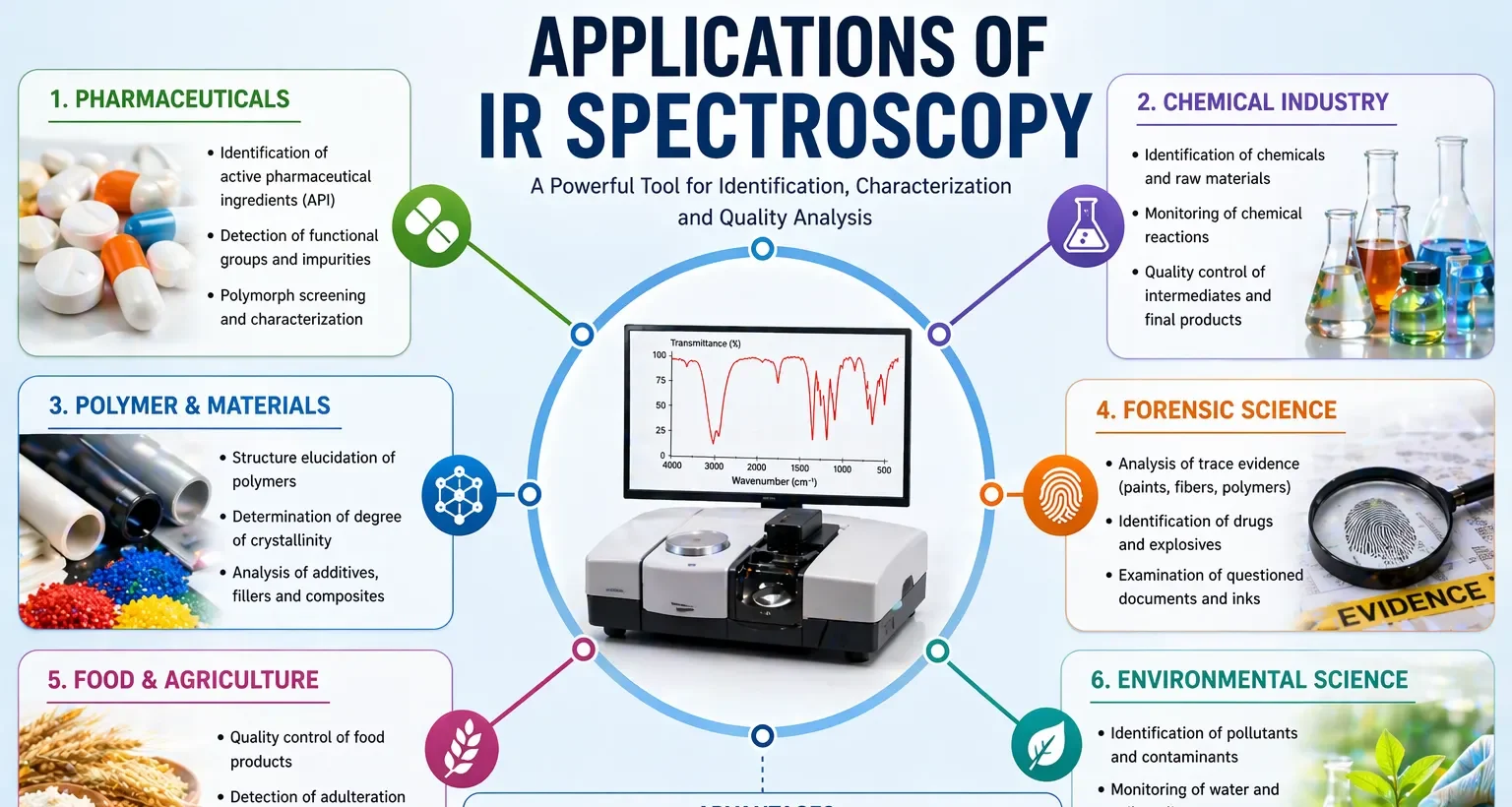
Applications of IR spectroscopy
Applications of IR spectroscopy include compound identification, purity testing, and functional group analysis.
-
Qualitative Analysis:
- Functional Group Identification: Detects groups like hydroxyl (-OH), carbonyl (C=O), and alkene (C=C).
- Compound Characterization: Confirms synthesis or isolation using the unique “fingerprint” region.
-
Quantitative Analysis:
- Measures species concentration through IR absorption, especially effective with ATR-FTIR techniques.
-
Polymer Analysis:
- Determines copolymer compositions, crystallinity, and other polymer characteristics.
-
Study of Hydrogen Bonding:
- Investigates hydrogen bond strength and nature in solvents or complex systems.
-
Gas Analysis:
- Identifies and quantifies gases for environmental and industrial applications.
-
Pharmaceutical Industry:
- Ensures quality control, drug purity, and identifies counterfeit medications.
-
Food and Agriculture:
- Detects adulteration, and measures fat, water, and other food components.
-
Forensic Analysis:
- Identifies drugs, toxins, or residues in samples; analyzes materials like paint chips and fibers from crime scenes.
-
Petrochemical Industry:
- Characterizes hydrocarbons, analyzes mixtures, and studies fuels and lubricants.
-
Catalysis:
- Examines surface adsorbed species on catalysts using techniques like DRIFT spectroscopy.
-
Environmental Monitoring:
- Detects and quantifies pollutants in air, water, and soil.
-
Biomedical Applications:
- Analyzes protein-ligand interactions, protein structures, lipid profiles, and tissue imaging.
-
Cultural Heritage and Art:
- Studies materials in artworks, historical artifacts, and archaeological samples.
Click Here to Watch the Best Pharma Videos
Advertisements