
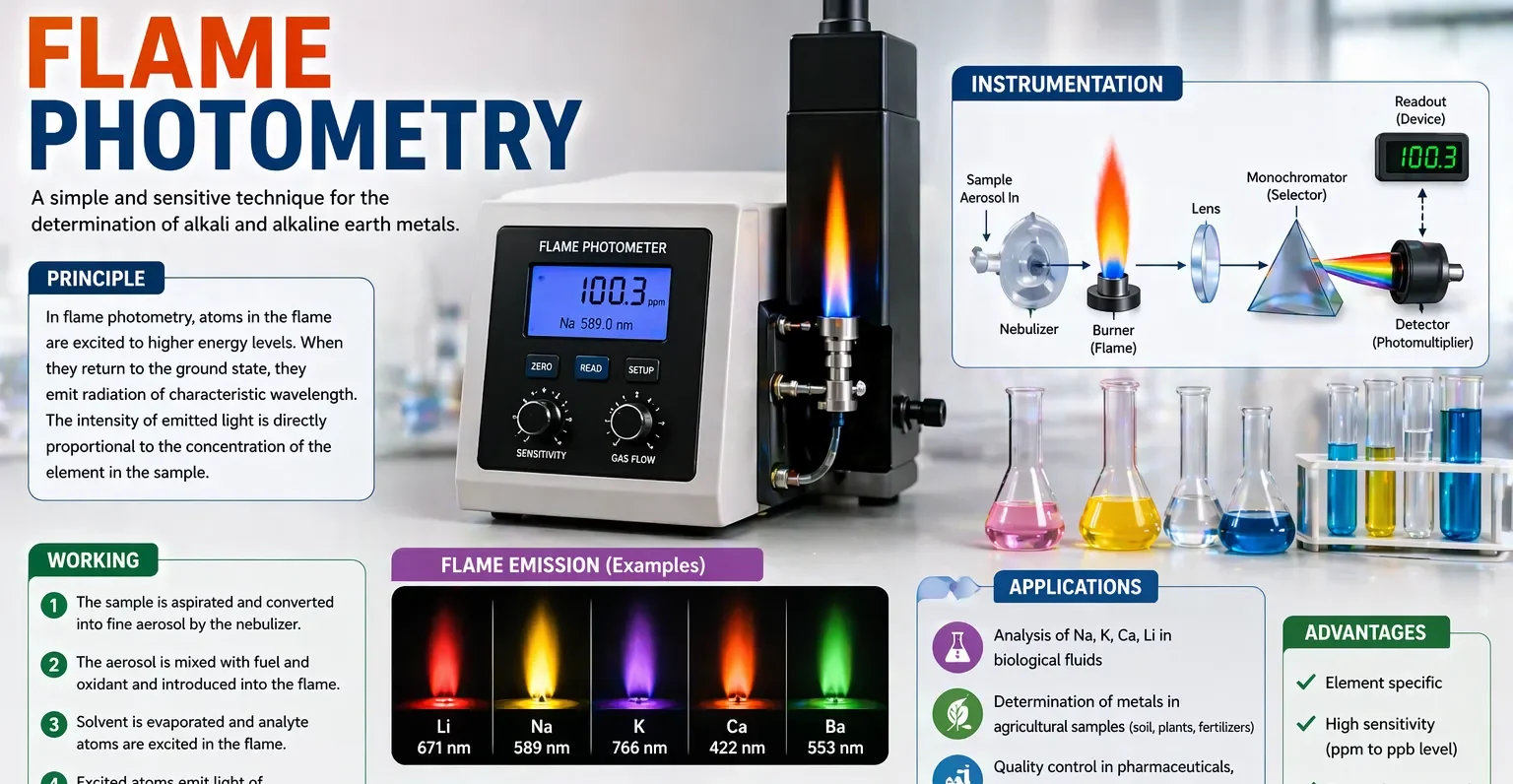
Definition of Flame Photometry:
- Flame photometry, or flame atomic emission spectrometry (FAES), is used to determine alkali and alkaline earth metals by analyzing the light emitted when a sample is introduced into a flame.
Principle:
- Excitation: Metal atoms in the flame get vaporized and excited to higher energy levels.
- Emission: On returning to the ground state, they emit light at specific wavelengths unique to the element.
Theoretical Basis:
- Boltzmann’s Distribution: Relates the ratio of atoms in ground vs. excited states at a given temperature.
-
- $\frac{\Delta N}{N_2} = \frac{g_1}{g_2} e^{-\Delta E / kT}$
-
- Bohr’s Theory: Describes energy transitions:
-
- $\Delta E = E_2 – E_1 = h\nu$
-
Advertisements
Procedure of Flame Photometry:
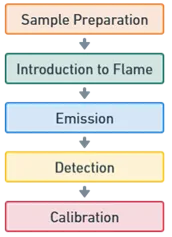
- Sample Preparation: Dissolve the sample in water or a suitable solvent.
- Introduction to Flame: Atomized sample produces light emissions.
- Emission: Excited atoms emit characteristic radiation.
- Detection: A monochromator isolates the wavelength of interest; a photodetector measures intensity.
- Calibration: Emission intensity is compared against a standard calibration curve for quantification.
Flame Colors of Common Elements:
| Element | Flame Color |
| Lithium (Li) | Crimson/Red |
| Sodium (Na) | Bright Yellow |
| Potassium (K) | Lilac/Purple |
| Calcium (Ca) | Orange-Red |
| Strontium (Sr) | Crimson/Red |
| Barium (Ba) | Apple Green |
| Copper (Cu) | Blue-Green |
Advantages of Flame Photometry:
- Simple and cost-effective.
- High sensitivity for alkali and alkaline earth metals.
Advertisements
Limitations:
- Limited to elements that can atomize and emit in the visible/UV spectrum.
- Results can be affected by flame interferences.