
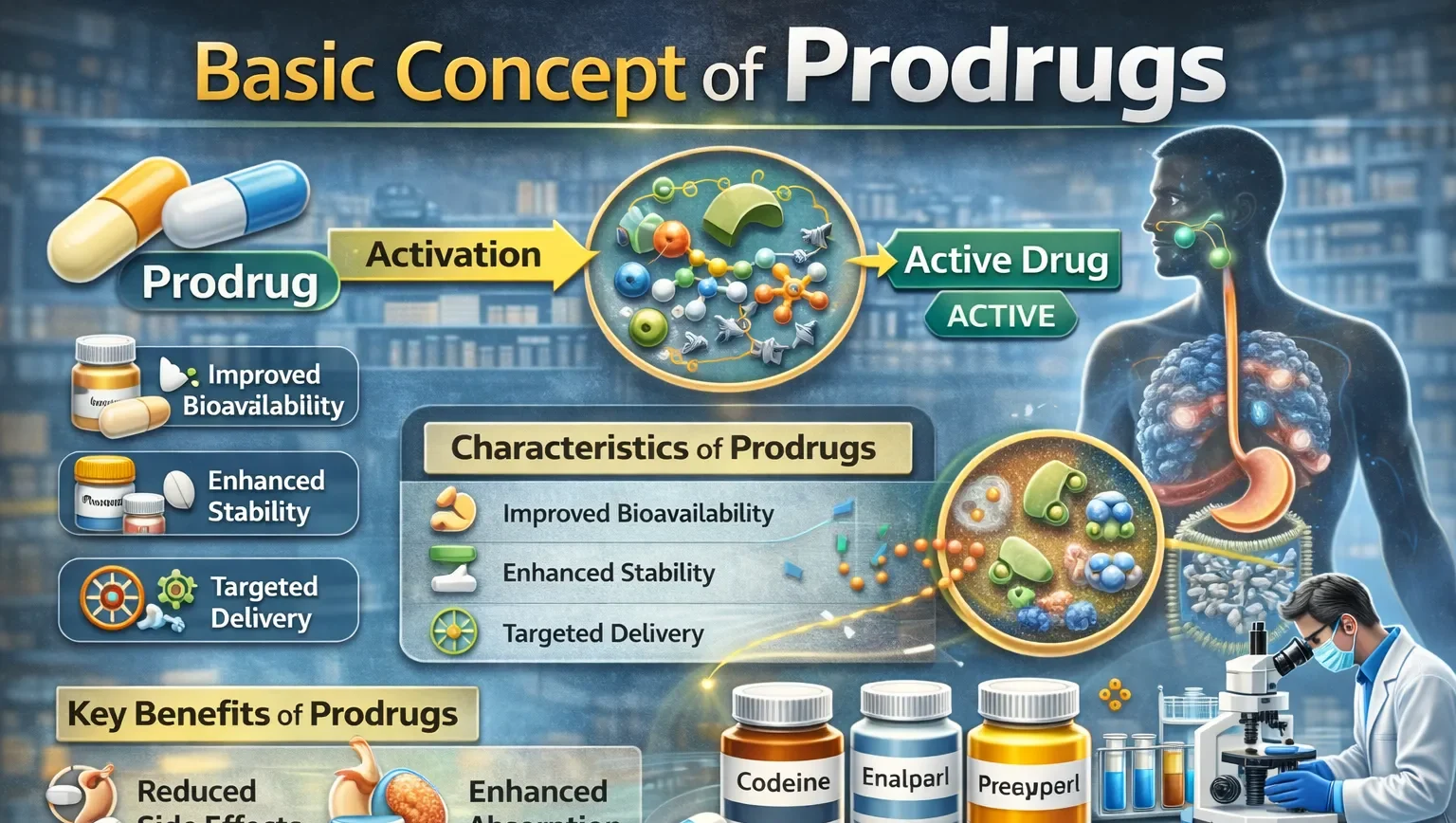
Basic Concept of Prodrugs explains inactive drug forms that convert into active drugs in the body to improve absorption and bioavailability.
Basic Concept of Prodrugs
- Prodrugs are inactive or less active precursors that convert into active drugs in the body, addressing issues like poor bioavailability, short half-life, or high toxicity.
Ideal Properties of Prodrugs
- Biologically inactive or less active: Minimizes side effects before activation.
- Efficient conversion: Easily metabolized into the active drug.
- Targeted delivery: Reduces off-target effects.
- Improved pharmacokinetics: Enhances drug absorption and metabolism.
- Non-toxic and non-immunogenic: Safe for use.
Advertisements
Introduction to Prodrugs
- Prodrugs are biologically inactive compounds that undergo metabolic conversion in the body to release the active drug.
- They are designed to improve solubility, stability, absorption, distribution, metabolism, and elimination while maintaining therapeutic efficacy.
Objectives of Prodrug Development
- Improved solubility and absorption: Enhances bioavailability of poorly soluble drugs.
- Enhanced drug delivery: Targets specific tissues, reducing side effects.
- Reduced toxicity and side effects: Minimizes adverse effects until activation.
- Bypassing first-pass metabolism: Increases systemic drug availability.
- Prolonged duration of action: Provides sustained therapeutic effects.
Classification of Prodrugs

Advertisements
-
Bioprecursor Prodrugs:
- Converted into the active drug via metabolic processes.
- Type I: Modified via oxidation/reduction (e.g., Codeine → Morphine).
- Type II: Structural rearrangement (e.g., Fosphenytoin → Phenytoin).
- Type III: Combination of modifications (e.g., Prontosil → Sulfanilamide).
- Converted into the active drug via metabolic processes.
-
Carrier-Linked Prodrugs:
- Active drug is linked to a carrier, removed enzymatically.
- Type A: Direct chemical bond (e.g., Aspirin → Salicylic acid).
- Type B: Spacer group is cleaved (e.g., Valacyclovir → Acyclovir).
- Type C: Carrier has therapeutic activity (e.g., 5-FU + Leucovorin).
- Active drug is linked to a carrier, removed enzymatically.
Applications of Prodrugs
- Improved solubility and absorption: Fosamprenavir enhances oral bioavailability.
- Enhanced drug delivery: Capecitabine targets tumors.
- Reduced toxicity and side effects: Prednisolone phosphate minimizes GI irritation.
- Bypassing first-pass metabolism: Lisdexamfetamine avoids liver metabolism.
- Prolonged duration of action: Latanoprost provides sustained glaucoma treatment.
- Improved patient compliance: Oseltamivir phosphate has better taste and stability.
- Overcoming drug resistance: Tenofovir alafenamide achieves higher intracellular drug levels.
Click Here to Watch the Best Pharma Videos
Advertisements