
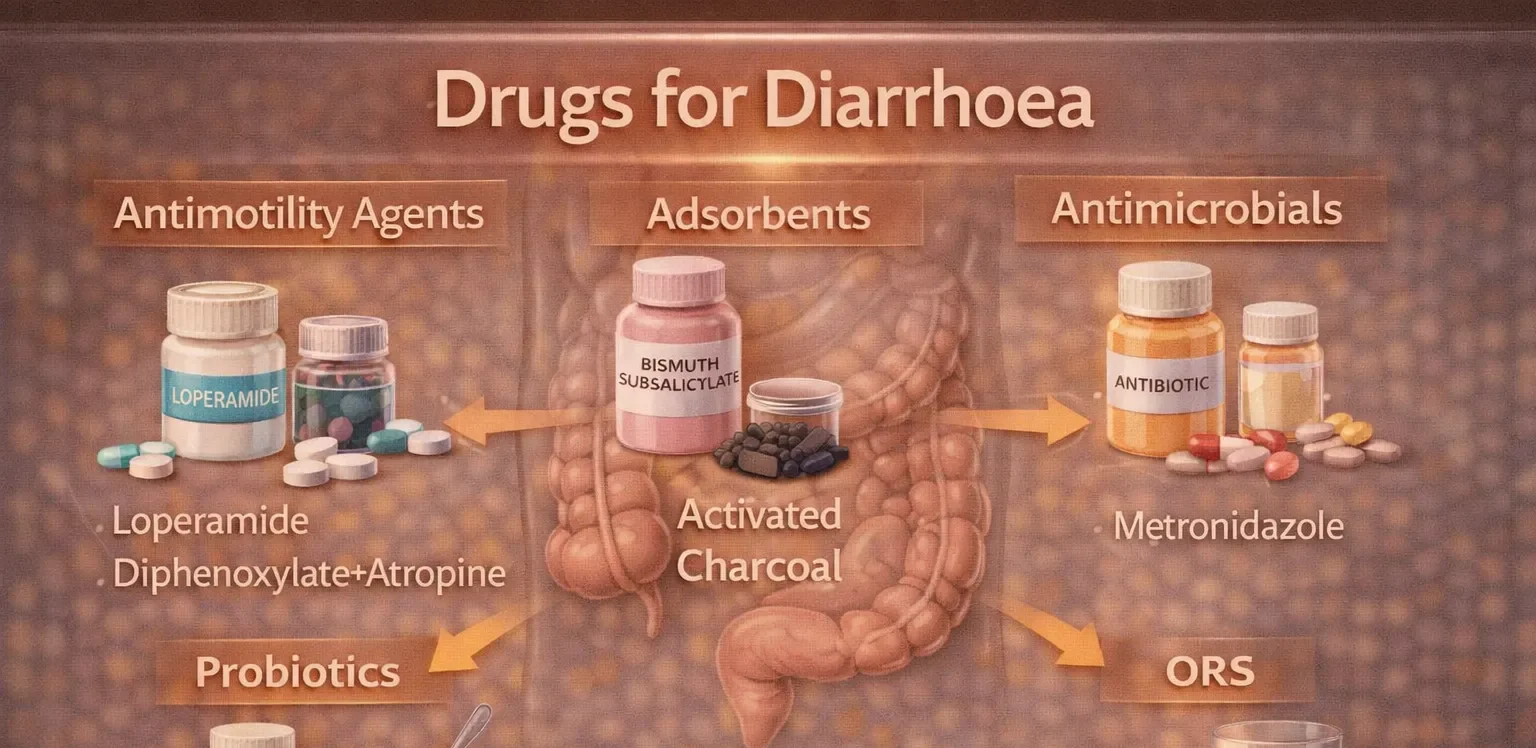
Drugs for Diarrhoea include antidiarrheal agents that reduce intestinal motility and fluid loss to control symptoms.
Drugs for Diarrhoea
Diarrhoea = frequent, loose or watery stools due to increased intestinal motility or secretion.
Classes of Antidiarrheal Agents

-
Adsorbents
- Examples: Kaolin, Activated charcoal
- Mechanism: Adsorb toxins and water → bulk up stool
- Use: Mild diarrhoea
-
Antimotility Agents
- Examples: Loperamide, Diphenoxylate
- Mechanism: Opioid receptor agonists → slow gut motility, increase absorption
- Use: Traveler’s diarrhoea, chronic diarrhoea
- Caution: Not to be used in infectious diarrhoea (can worsen infection)
-
Antisecretory Agents
- Examples: Racecadotril
- Mechanism: Enkephalinase inhibitor → ↓ intestinal secretion
- Use: Acute diarrhoea in children and adults
-
Antibiotics (for Infectious Diarrhoea)
- Examples:
- Metronidazole: Giardia, Amoebiasis
- Ciprofloxacin: Traveler’s diarrhoea (bacterial)
- Use: Only when infection is confirmed or suspected
- Examples: