
Factors Affecting Vibrations in Infrared Spectroscopy
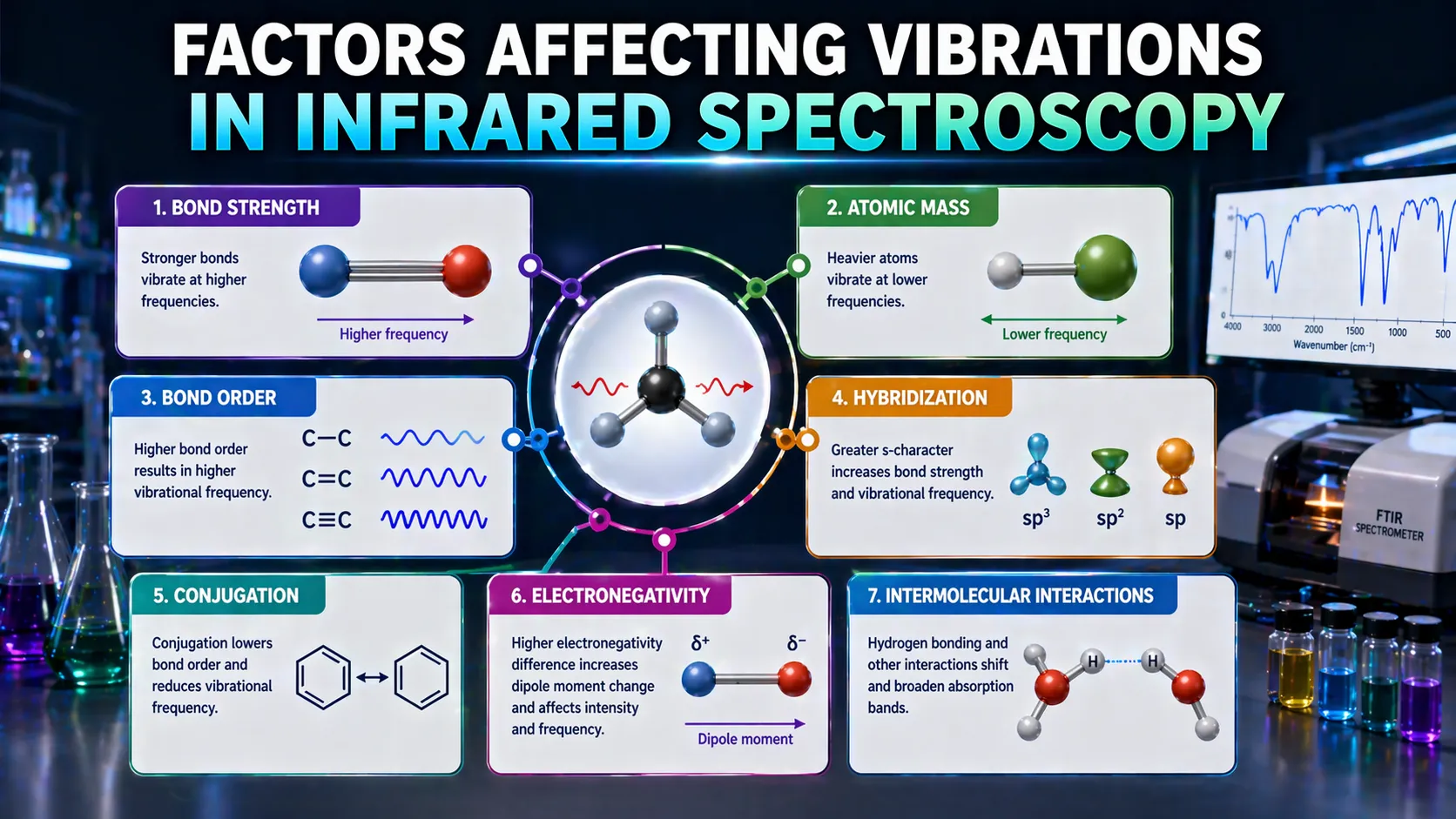
Factors Affecting Vibrations in Infrared Spectroscopy include bond strength, mass, and molecular structure.
-
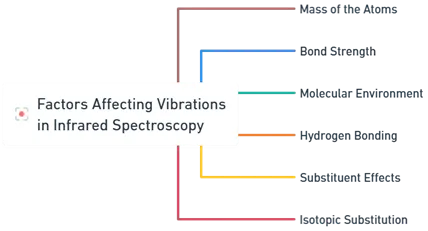
Mass of the Atoms
- Influence: Heavier atoms vibrate at lower frequencies compared to lighter atoms.
- Hooke’s Law:
-
- $\nu = \frac{1}{2\pi c}\sqrt{\frac{k}{\mu}}$
- ν = frequency of vibration
- c = speed of light
- k = force constant (bond strength)
- μ = reduced mass of the two atoms
-
Advertisements
-
Bond Strength
- Stronger Bonds: Higher force constants, leading to higher vibrational frequencies.
- Order of Frequencies:
- Single bonds < Double bonds < Triple bonds
Advertisements
-
Molecular Environment
- Electron Delocalization: Conjugation can lower the frequency of carbonyl groups.
- Ring Strain: In cyclic compounds, ring strain can affect bond angles and frequencies.
-
Hydrogen Bonding
- Effect: Hydrogen bonding can shift vibrational frequencies to lower values (red shift) and broaden absorption bands.
- Intramolecular vs. Intermolecular: Both types can impact the IR spectrum.
-
Substituent Effects
- Electron Donating Groups: Can increase electron density, affecting bond strength and frequencies.
- Electron Withdrawing Groups: Can decrease electron density, altering vibrational frequencies.
-
Isotopic Substitution
- Isotopes: Replacing an atom with its isotope changes the reduced mass (μ\muμ) and hence the vibrational frequency.
- Applications: Used to study reaction mechanisms and molecular structures.
Click Here to Watch the Best Pharma Videos
Advertisements