
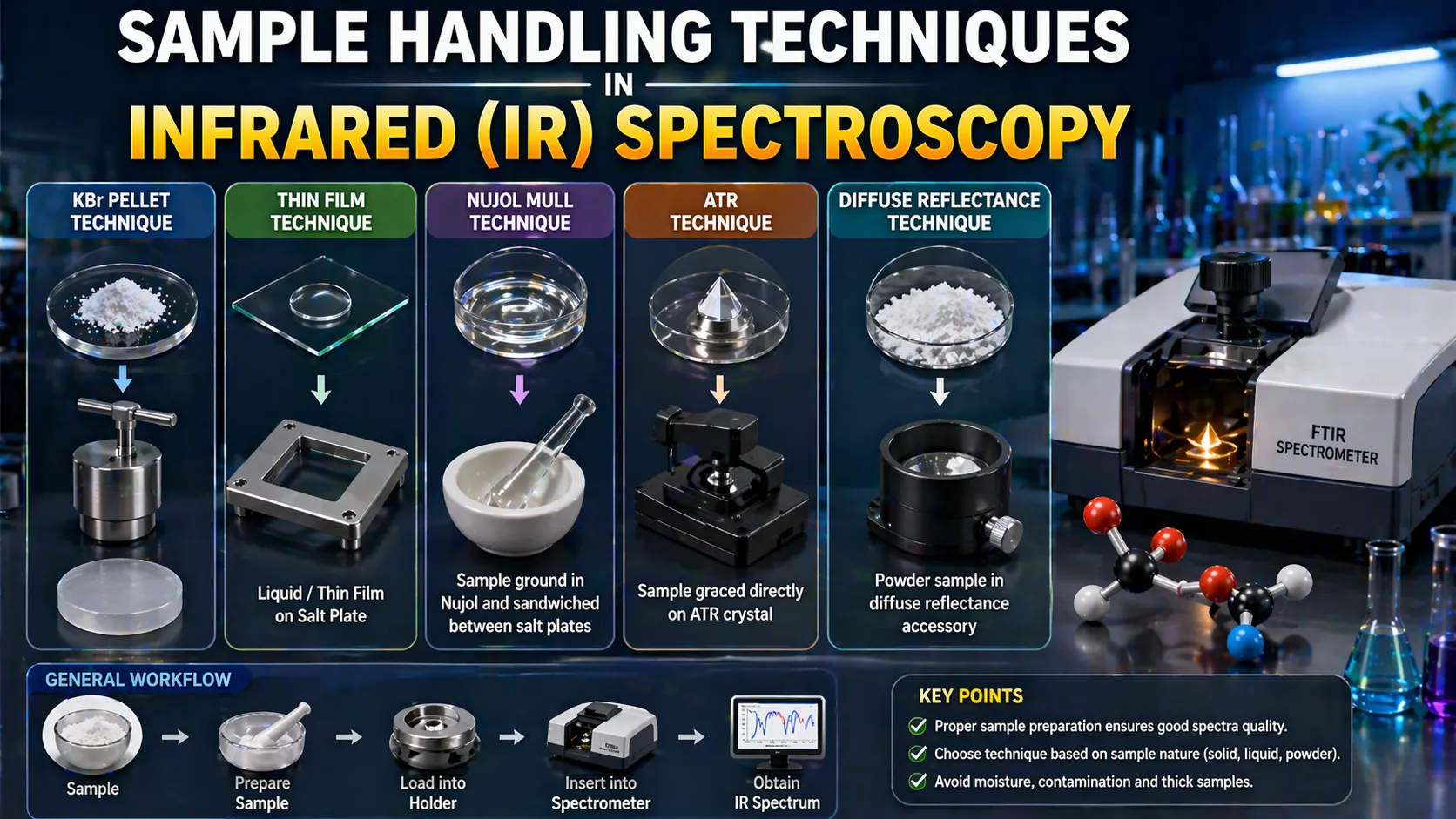
Sample Handling Techniques in Infrared (IR) Spectroscopy cover methods for preparing solids, liquids, and gases.
Sample Handling Techniques in Infrared (IR) Spectroscopy
- Proper sample preparation is essential for obtaining accurate IR spectra.
- Techniques vary based on the sample’s physical state: solid, liquid, gas, or solution.

Advertisements
-
Solid Sampling:
-
KBr Pellet Technique:
- Solid is ground with potassium bromide (transparent to IR) and pressed into a pellet.
-
Mull Technique:
- Solid is mixed with mineral oil to form a mull, then spread between NaCl salt plates.
-
Diffuse Reflectance (DRIFT):
- Used for solids unsuitable for other methods. The sample is mixed with a reflective medium, and the reflected IR radiation is analyzed.
-
-
Liquid Sampling:
-
Thin Film:
- A thin liquid film is placed between NaCl plates for analysis, suitable for non-corrosive liquids.
-
Solution Technique:
- Sample dissolved in an IR-transparent solvent and analyzed in a liquid cell or between salt plates.
-
-
Gas Sampling:
-
Gas Cells:
- Special cells with salt windows and variable path lengths are used. The gas is sealed in the cell for analysis.
-
-
Solution Sampling:
-
Salt Plates:
- A drop of solution is placed between plates. After solvent evaporation, the remaining solute is analyzed.
-
Liquid Cells:
- Two salt plates, separated by a thin spacer, form a liquid cell. The solution is added for spectrum measurement.
-