
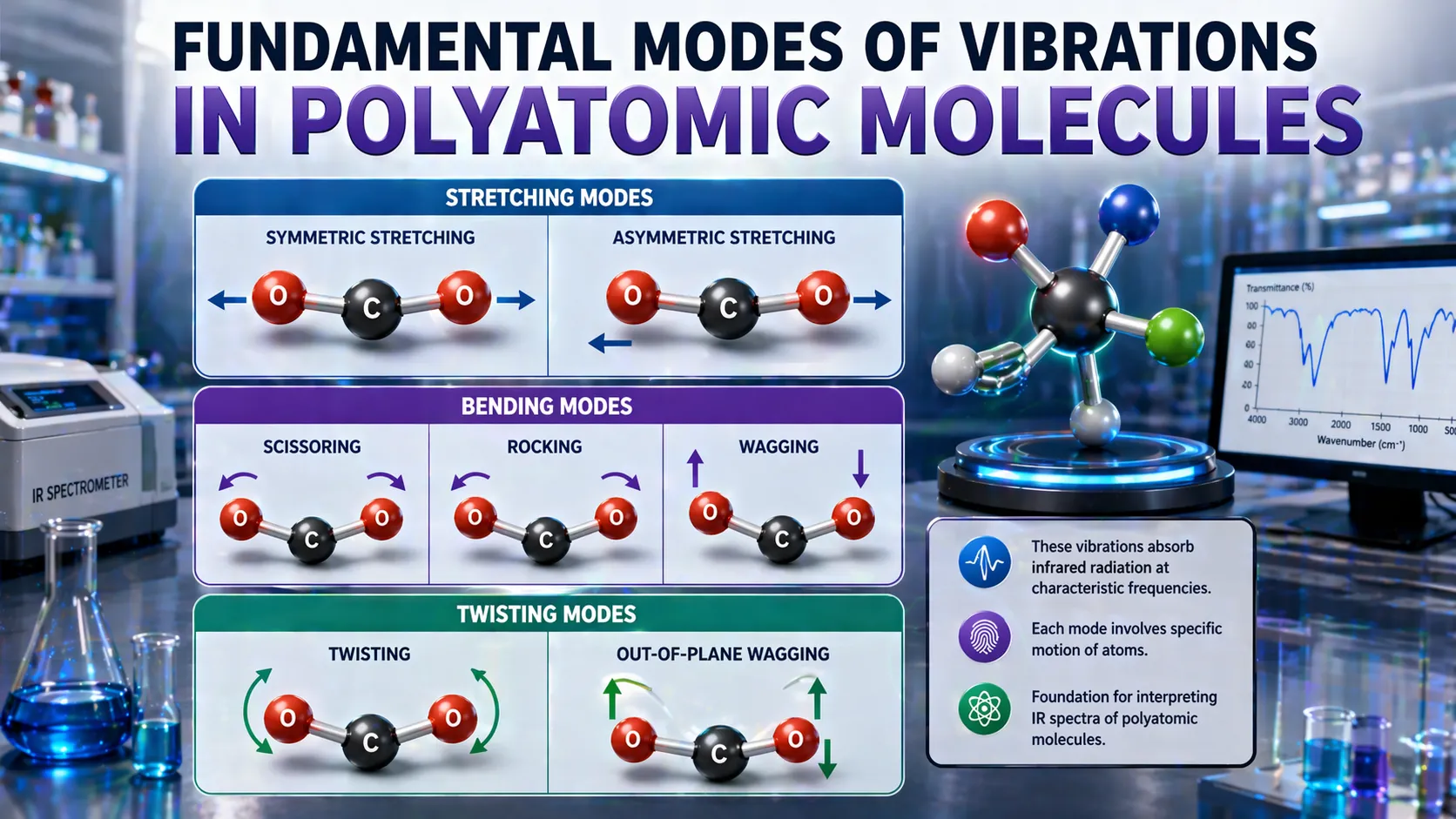
Fundamental Modes of Vibrations in Polyatomic Molecules
Fundamental Modes of Vibrations in Polyatomic Molecules explain bond stretching and bending in molecular analysis.
Molecular Vibrations
- In polyatomic molecules, atoms are not stationary but vibrate around their equilibrium positions.
- These vibrations can be described as periodic motions and are quantized, meaning they occur at specific energy levels.
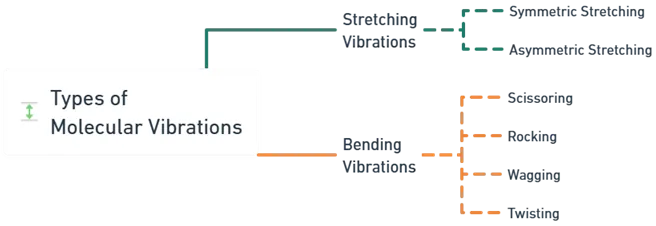
- The two main types of molecular vibrations are:
Advertisements
-
Stretching Vibrations:
- Involve changes in the bond length between atoms.
- Symmetric Stretching: Bonds expand and contract simultaneously in the same direction.
- Asymmetric Stretching: One bond shortens while another lengthens.
- Involve changes in the bond length between atoms.
-
Bending Vibrations:
- Involve changes in the bond angle between atoms.
- Scissoring: Two atoms move toward and away from each other.
- Rocking: Atoms move in the same direction, rocking back and forth.
- Wagging: Atoms move up and down out of the plane.
- Twisting: One atom moves up while another moves down, causing a twist.
- Involve changes in the bond angle between atoms.
Degrees of Freedom
- Translational Degrees: Movement of the entire molecule in space (three degrees).
- Rotational Degrees: Rotation of the molecule around its axes (three degrees for nonlinear, two for linear molecules).
- Vibrational Degrees: Calculated using the formula:
- Nonlinear Molecules: 3N−63N – 63N−6
- Linear Molecules: 3N−53N – 53N−5
- Where NNN is the number of atoms in the molecule.
Click Here to Watch the Best Pharma Videos
Advertisements