
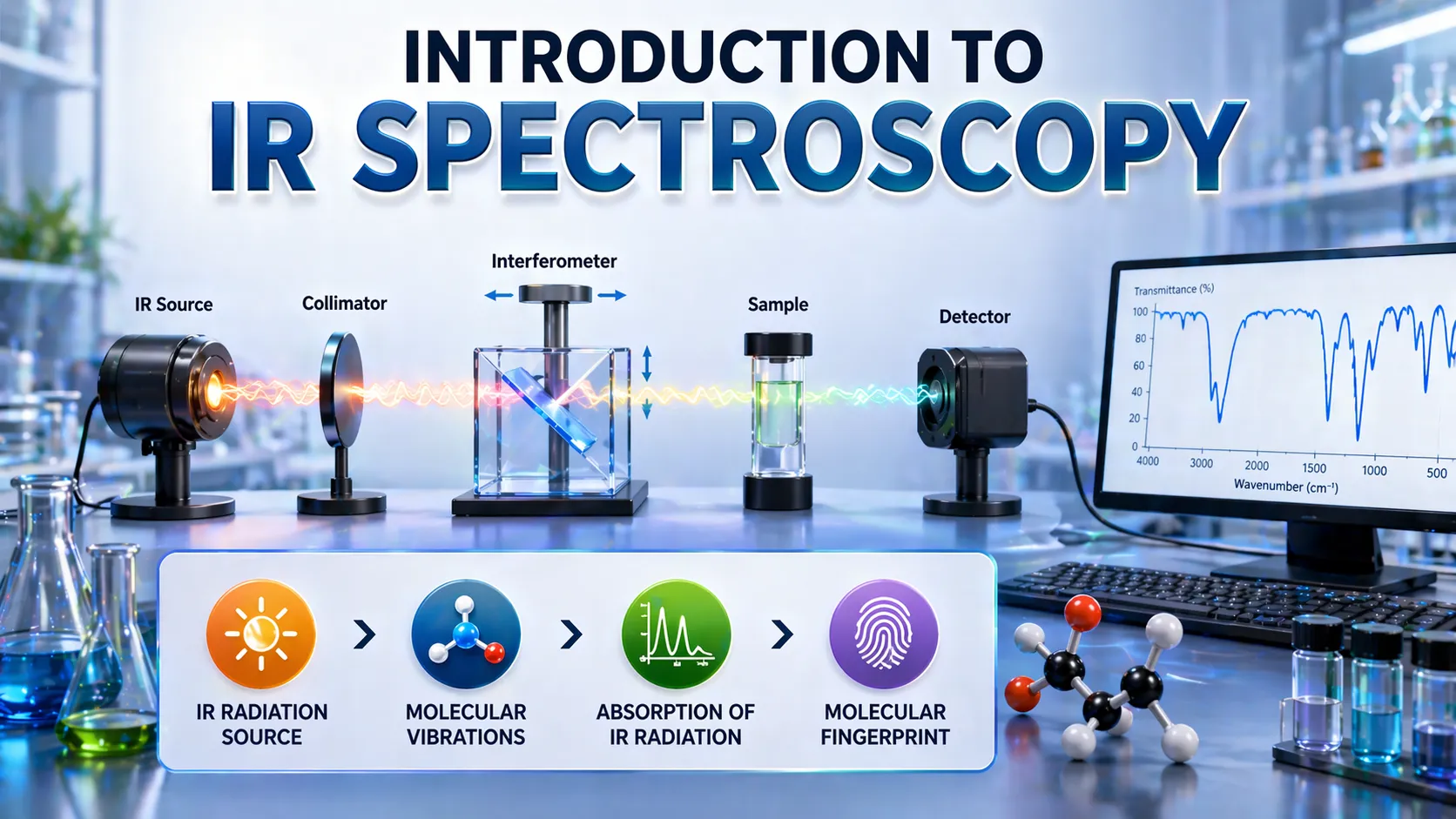
Introduction to IR Spectroscopy
Introduction to IR Spectroscopy explains how infrared light identifies functional groups and molecular bonds in compounds.
Principle:
- Infrared (IR) spectroscopy involves the interaction of IR light with molecules, leading to vibrations within molecular bonds.
How it Works:
-
Absorption:
- Molecules absorb specific IR frequencies, causing vibrational transitions in bonds (e.g., stretching or bending).
-
Spectrum Generation:
- Remaining radiation passes to a detector, generating a spectrum of intensity vs. frequency, revealing absorbed regions indicative of chemical bonds.
-
Fingerprinting:
- Each molecule has a unique IR absorption pattern, with bonds like C-H, N-H, and O-H showing distinct absorptions.
Pharmaceutical Applications:
- Identification: Verifies the chemical composition, ensuring purity and consistency.
- Quantitative Analysis: Measures the amount of a specific compound in a sample.
- Formulation Analysis: Ensures correct ingredients and detects impurities in drug formulations.
- Physical State: Identifies whether a drug is crystalline or amorphous.
Advertisements