
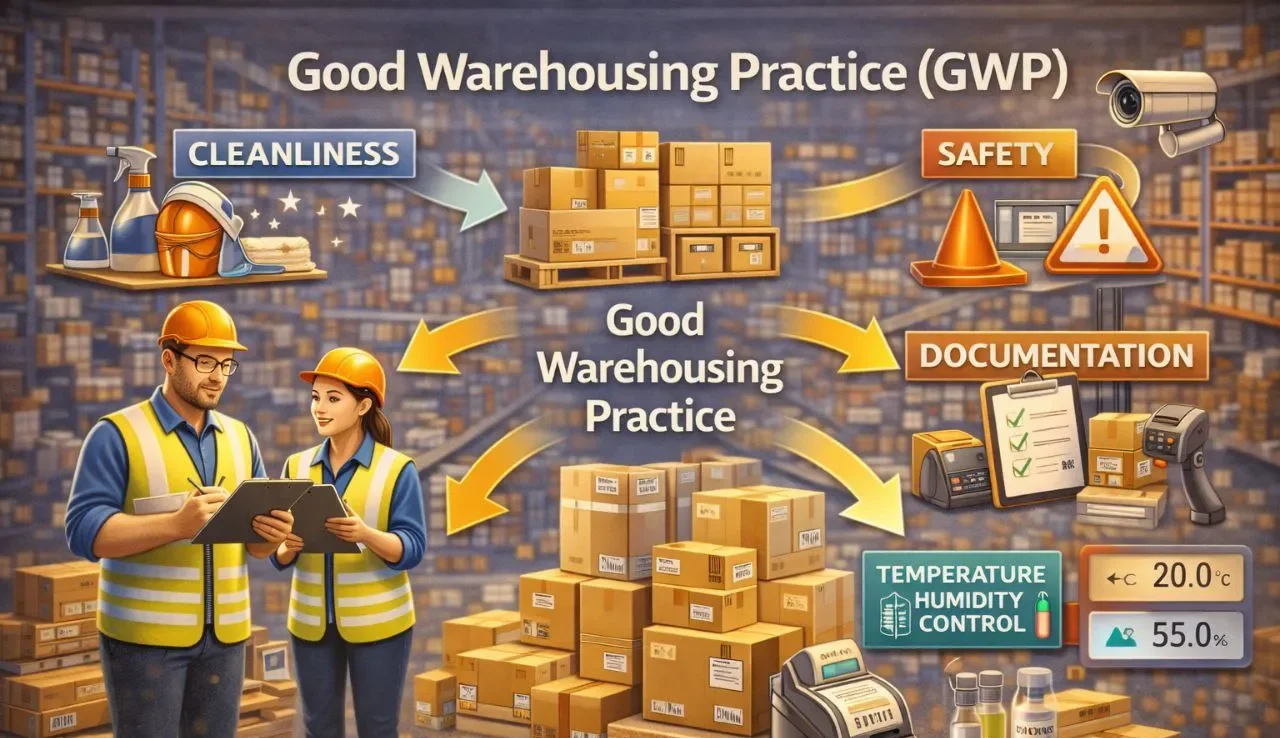
Good Warehousing Practice (GWP) explains guidelines for safe storage handling and distribution of pharmaceutical products.
Definition of Good Warehousing Practice (GWP):
- Good Warehousing Practice (GWP) involves standardized procedures and practices ensuring that products (raw materials, packaging materials, intermediates, finished products) are received, stored, handled, labeled, and dispatched safely, accurately, and in compliance with regulatory standards.
Purpose & Importance of GWP:
- Maintains product quality, potency, purity, efficacy, and safety.
- Minimizes risk of contamination, cross-contamination, deterioration, or spoilage.
- Ensures compliance with regulatory standards (FDA, WHO, GMP).
- Facilitates traceability, accountability, and recall management.
- Improves operational efficiency and inventory control.
Advertisements
Key Principles of Good Warehousing Practices
-
Proper Facility Design & Environmental Controls
- Warehouses must be clean, well-ventilated, and equipped with temperature and humidity controls.
- Segregated areas for raw materials, finished goods, rejected items, and quarantined stock.
- Adequate security measures to prevent unauthorized access.
-
Temperature & Humidity Control
- Temperature-controlled storage (e.g., 2°C to 8°C for biologics and vaccines, 15°C to 25°C for general medicines).
- Humidity control to prevent degradation of hygroscopic materials.
-
Stock Segregation & Labeling
- Clear labeling and segregation of materials:
- Quarantined stock: Materials waiting for quality clearance.
- Approved stock: Ready for use in manufacturing.
- Rejected stock: Non-compliant materials to be disposed of or returned.
- Returned goods: Evaluated before reintegration into stock.
- Clear labeling and segregation of materials:
-
Inventory Control & FIFO/FEFO System
- First-In, First-Out (FIFO): Ensures older stock is used first.
- First-Expired, First-Out (FEFO): Ensures products nearing expiration are used first.
-
Cleaning & Maintenance
- Regular cleaning and pest control.
- Maintenance of HVAC (Heating, Ventilation, and Air Conditioning)
- Proper waste disposal for damaged or expired goods.
-
Documentation & Record-Keeping
- Stock movement records (entry, storage, and dispatch).
- Storage conditions monitoring logs.
- Deviation and incident reports.
-
Security & Safety Measures
- Restricted access to sensitive storage areas.
- Fire protection systems.
- Proper handling of hazardous materials.
-
Cold Chain Management
- Specialized refrigerated storage for vaccines, insulin, and biological products.
- Data loggers and alarms for continuous monitoring of cold storage.