
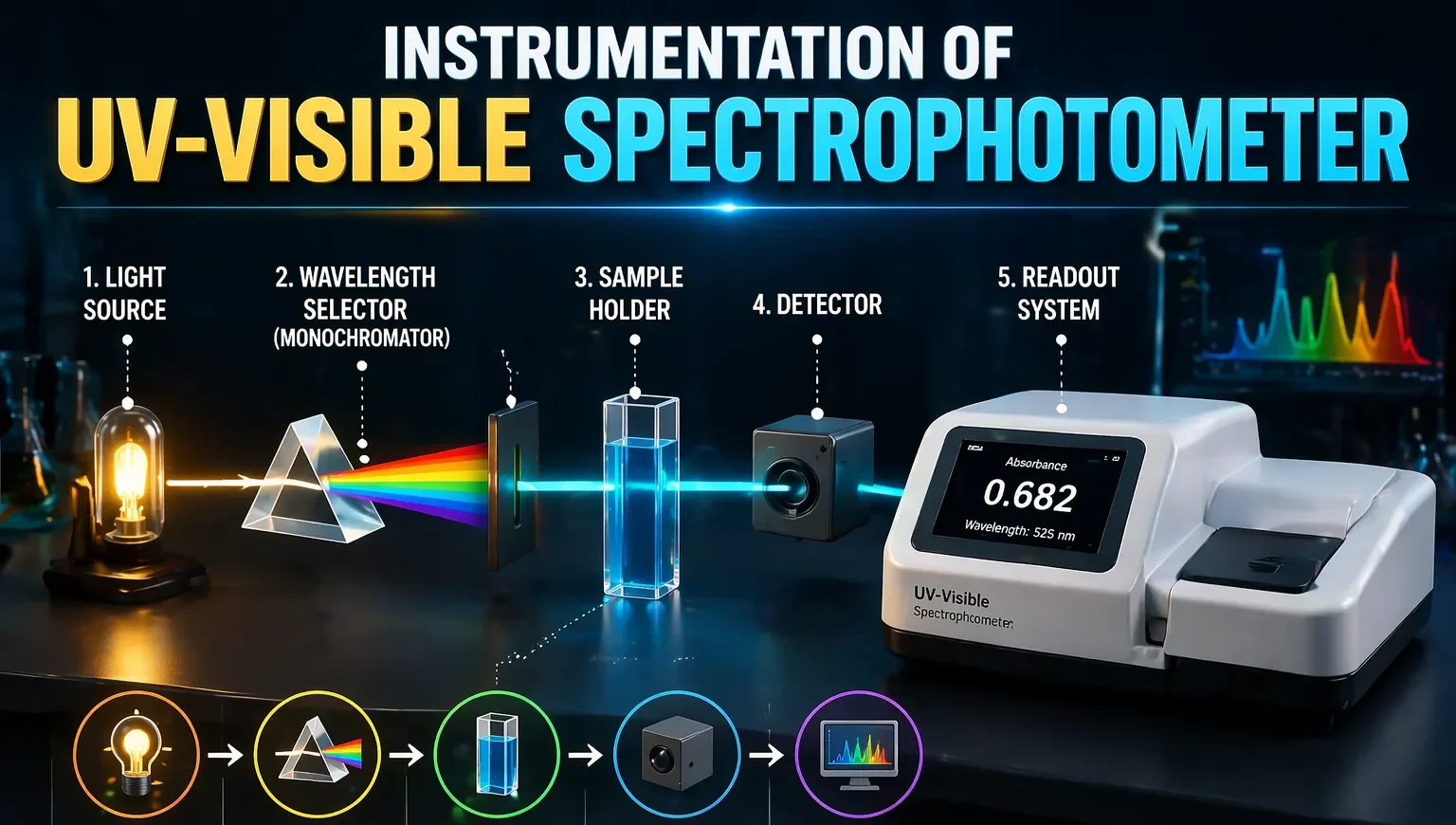
Instrumentation of UV-Visible Spectrophotometer covers components and setup for measuring light absorption of samples.
Instrumentation of UV-Visible Spectrophotometer
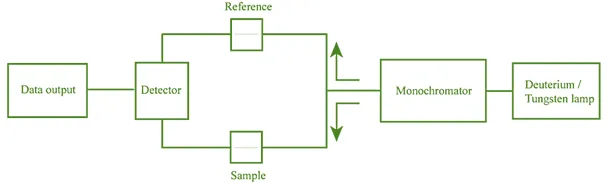
- A UV-Visible spectrophotometer measures light intensity in the UV and visible spectrum after it passes through a sample.
- The instrument’s key components include:
Advertisements
-
Sources of Radiation
- Radiation sources emit light, which interacts with the sample:
- Deuterium Lamp: Emits UV radiation (190–380 nm) using deuterium gas. Provides a continuous UV spectrum, ideal for spectroscopy.
- Tungsten/Halogen Lamp: Emits visible to near-infrared light (350–2500 nm). Tungsten filament ensures stability, halogen gas increases lamp life.
- Radiation sources emit light, which interacts with the sample:
-
Wavelength Selectors
- Monochromators isolate specific wavelengths from the light source:
- Prisms: Disperse light based on refractive indices. Made of quartz/glass, they separate wavelengths effectively but are less common today.
- Diffraction Gratings: Separate light by interference patterns. They offer high resolution, handle intense light, and are versatile, making them the most common in modern spectrometers.
- Monochromators isolate specific wavelengths from the light source:
-
Sample Cells (Cuvettes)
- Hold the sample for measurement:
- Materials:
- Quartz: Transparent in UV and visible regions (190–800 nm).
- Glass: For visible region measurements.
- Plastic: Disposable; ideal for routine use but less precise.
- Design: Rectangular with standardized path lengths (commonly 1 cm) for accurate quantitative measurements.
- Maintenance: Clean thoroughly to prevent contamination. Handle quartz cuvettes carefully to avoid scratches.
- Materials:
- Hold the sample for measurement:
-
Detectors
- Convert transmitted light into measurable electrical signals:
- Phototube: Releases electrons via the photoelectric effect to generate a current proportional to light intensity.
- Photomultiplier Tube (PMT): Amplifies the signal using a series of dynodes, making it highly sensitive.
- Photovoltaic Cell: Converts light into a direct current using semiconductor materials.
- Silicon Photodiode: Converts light to current/voltage with high sensitivity and fast response, often used in reverse bias for enhanced performance.
- Convert transmitted light into measurable electrical signals: