
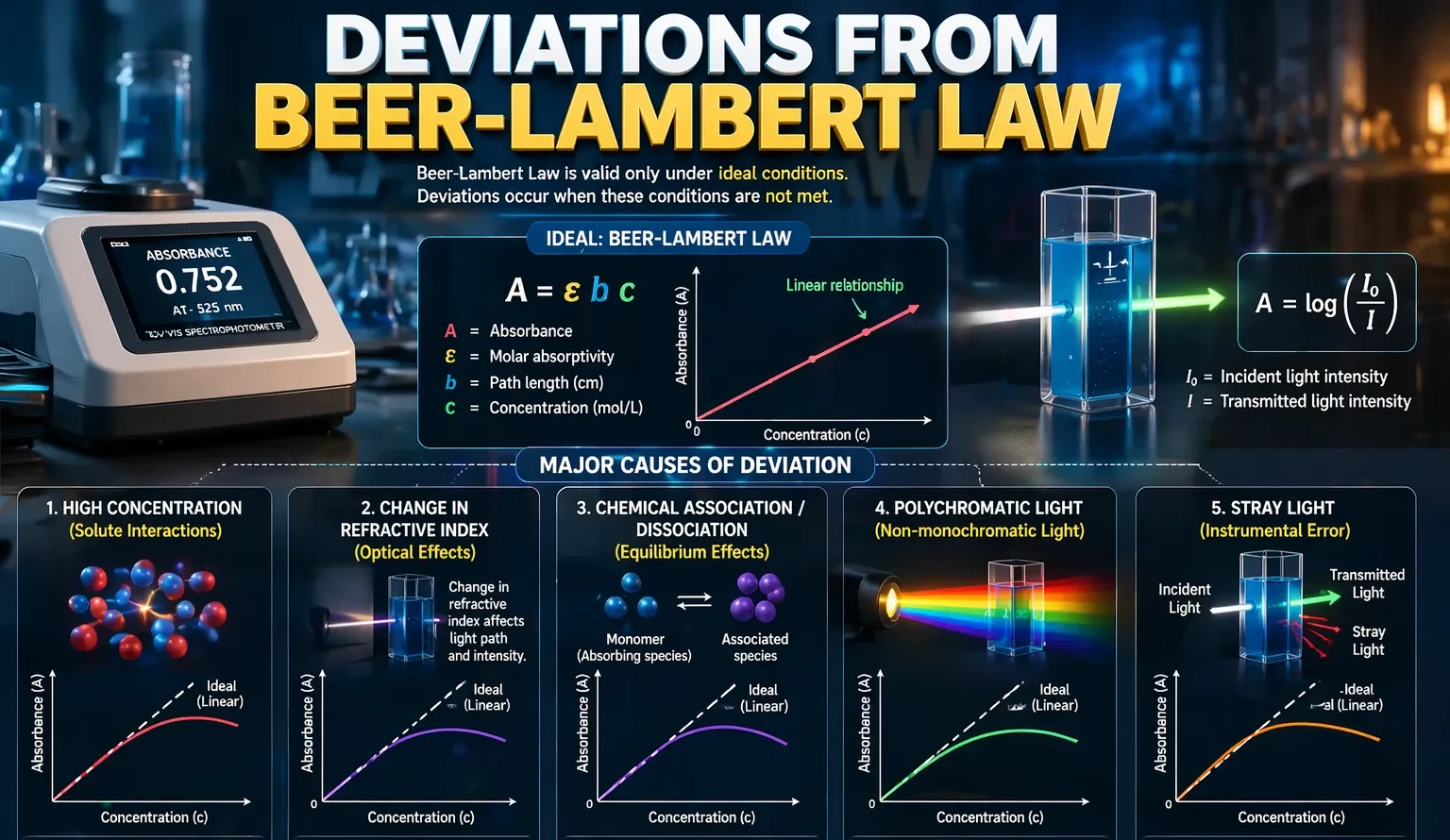
Deviations from Beer-Lambert Law occur due to high concentrations, chemical interactions, or instrument limitations.
Deviations from Beer-Lambert Law
Situations where Beer-Lambert Law may not hold include:
Advertisements
-
Chemical Deviations:
- Association/Dissociation: At high concentrations, molecules may associate or dissociate, altering the absorbing species.
- Reactions with Solvent: Chemical interactions between solute and solvent can change the nature of the absorber.
-
Instrumental Deviations:
- Stray Light: Light outside the selected bandwidth can cause overestimated absorbance.
- Polychromatic Radiation: Non-monochromatic light may lead to errors, especially for samples with sharp absorption peaks.
-
Physical Deviations:
- High Concentrations: Changes in refractive index can affect absorption at very high solute concentrations.
- Temperature/Solvent Effects: Variations in solvent or temperature can alter peak shape and position.
- Light Scattering: Particles or droplets scatter light, distorting absorbance readings.