
Beer’s Law and Beer-Lambert Law
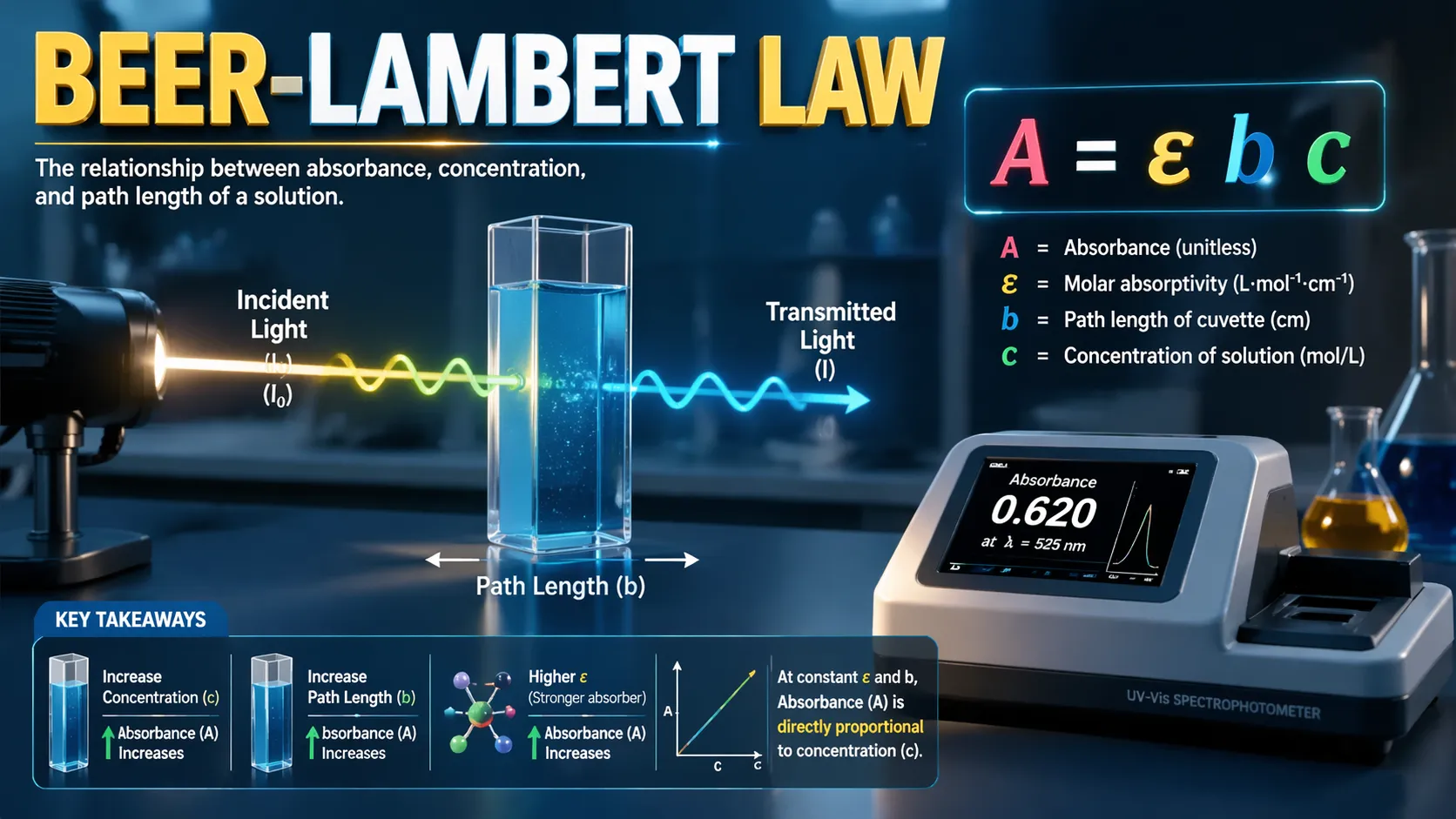
- Beer’s Law: Beer’s Law, also known as Beer-Lambert Law, relates the absorption of light to the properties of the material through which the light is traveling.
Mathematical Expression:
$A = \varepsilon \cdot c \cdot l$
- Where
- A = Absorbance (no units)
- ε = Molar absorptivity or extinction coefficient (L·mol⁻¹·cm⁻¹)
- c = Concentration of the absorbing species (mol·L⁻¹)
- l = Path length of the sample cell (cm)
Advertisements
Lambert’s Law:
- Lambert’s Law states that absorbance is directly proportional to the path length of the sample cell.
Combined Beer-Lambert Law:
- Combines both Beer’s and Lambert’s laws to provide a comprehensive relationship between absorbance, concentration, and path length.
Derivation
Starting Point:
- The law is derived from the principles that:
- Each molecule has a probability of absorbing light proportional to its concentration.
- The absorbance is cumulative over the path length.
Advertisements
Derivation Steps:
-
Transmission and Absorbance:
-
- $I = I_0 \cdot e^{-\alpha l}$
- The intensity of light decreases exponentially as it passes through an absorbing medium:
- where α is the absorption coefficient.
-
-
Logarithmic Relationship:
-
- $\ln\left(\frac{I_0}{I}\right) = \alpha l$
- Taking the natural logarithm:
-
-
Introducing Molar Absorptivity:
-
- $\alpha = \varepsilon c$
- Where c is concentration.
-
-
Final Form:
-
- $A = \varepsilon c l$
- Substitute α\alphaα into the equation:
-
Key Assumptions:
- The system is homogeneous.
- The absorbers do not interact with each other.
- The incident light is monochromatic and collimated.
Graph Description:
Advertisements
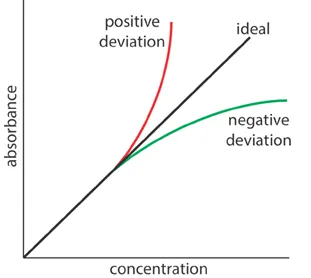
- If you were to plot absorbance (A) on the vertical axis (y-axis) against concentration (c) on the horizontal axis (x-axis) for a system that follows the Beer-Lambert law perfectly, you’d expect a straight line passing through the origin.
- The slope of this line would be equal to c × ε × l.