
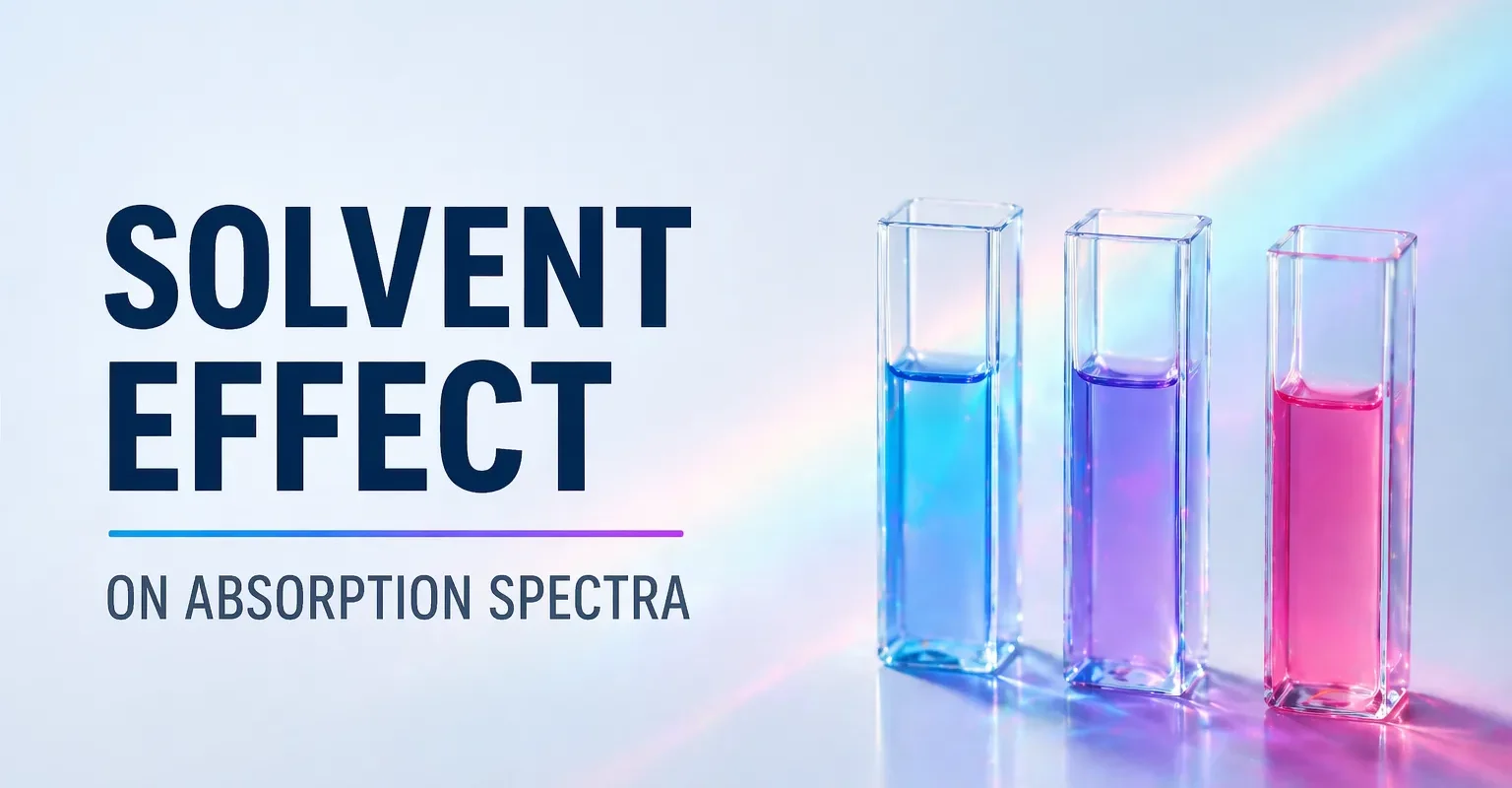
Solvent Effect on Absorption Spectra shows how solvents alter light absorption and spectral properties of compounds.
Solvent Effect on Absorption Spectra
- The solvent effect refers to how solvents influence the position (wavelength) and intensity of absorption bands in a solute’s UV-Vis spectrum.
Key Factors Influencing Solvent Effects:
-
Polarity:
- Polar Solvents: Stabilize polar excited states, causing a bathochromic shift (red shift).
- Non-Polar Solvents: Provide less stabilization, potentially leading to a hypsochromic shift (blue shift).
-
Hydrogen Bonding:
- Solvents capable of hydrogen bonding interact with solutes, altering their electronic environment and absorption properties.
-
Refractive Index:
- Affects the intensity and occasionally the position of absorption bands.
-
Viscosity:
- Influences non-radiative decay processes, impacting absorbance intensity.
Advertisements
Solvatochromism:
- The change in a compound’s absorption spectrum with solvent polarity.
- Positive Solvatochromism: Absorption shifts to longer wavelengths in more polar solvents.
- Negative Solvatochromism: Absorption shifts to shorter wavelengths in more polar solvents.
Examples:
- Dyes: Exhibit solvatochromism, useful as solvent polarity indicators.
- Flavonoids: Show varied absorption in different solvents, aiding structural studies.
Advertisements
Applications:
- Chemical Analysis: Measuring solvent polarity.
- Biochemistry: Exploring protein and nucleic acid environments.
- Material Science: Designing materials with specific optical properties.
Below is a table of some common solvents used in UV-Visible spectroscopy and their approximate UV cutoff (i.e., the wavelength below which the solvent starts to show significant absorption):
| Solvent | λmax (nm) |
| Hexane | 360 |
| Dichloromethane | 363 |
| Ethanol | 372 |
| Methanol | 375 |
| Acetonitrile | 378 |
| Water | 380 |
Click Here to Watch the Best Pharma Videos
Advertisements