
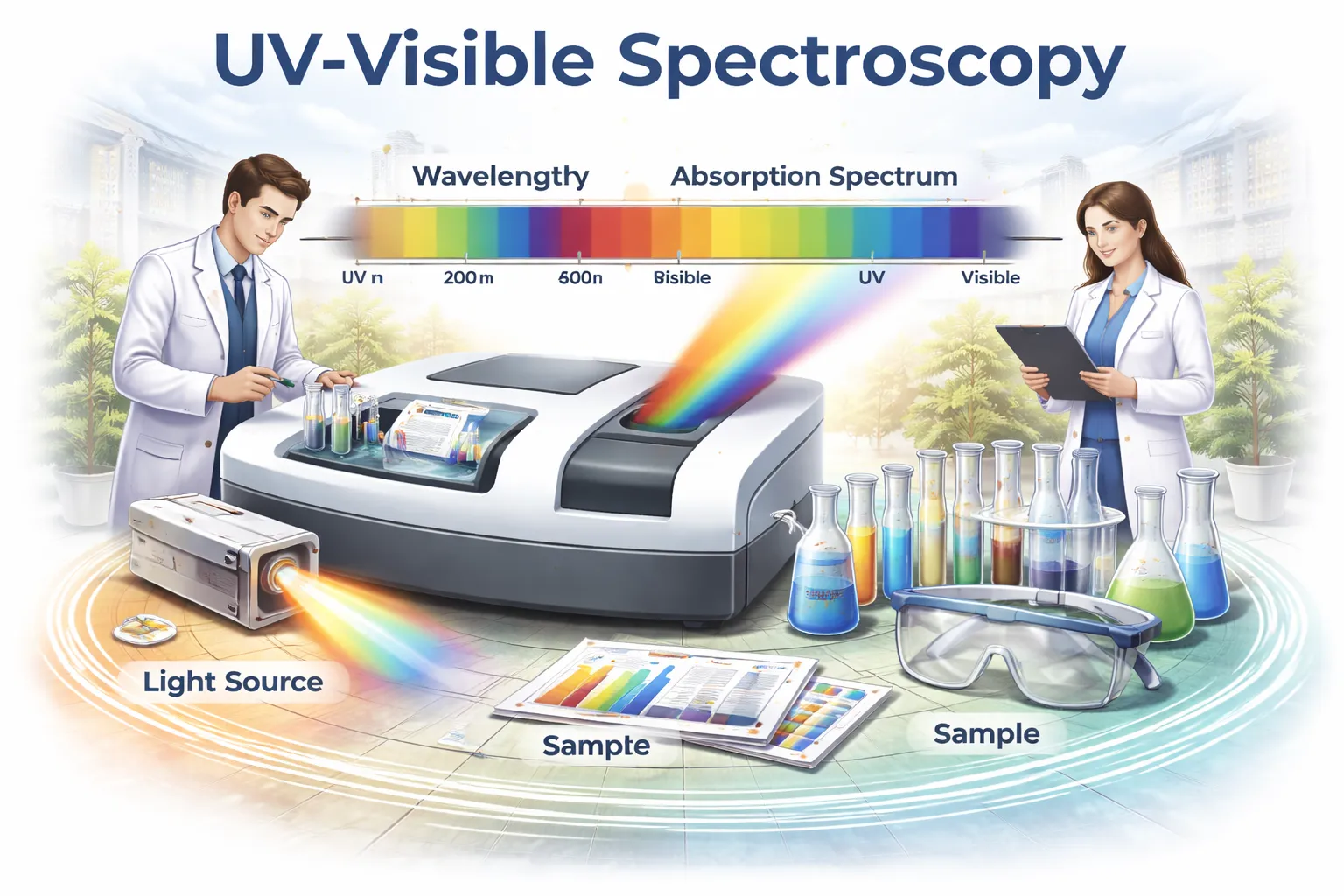
Overview of UV-Visible Spectroscopy
- UV-Visible spectroscopy is a technique used to measure the absorption of light in the ultraviolet (200-400 nm) and visible (400-700 nm) regions of the electromagnetic spectrum by a sample.
- This method provides valuable information about the electronic structure of molecules, particularly the presence of chromophores and their environment. It is widely utilized in:
- Quantitative analysis
- Identifying compounds
- Studying reaction kinetics
- Determining molecular concentrations
Advertisements
Basic Principle
- When a molecule absorbs light, its electrons are excited from a lower energy orbital to a higher energy orbital.
- The energy difference between these orbitals corresponds to the energy of the absorbed photon, which is inversely proportional to its wavelength.
- By measuring the absorbance at specific wavelengths, various properties of the sample can be inferred.