
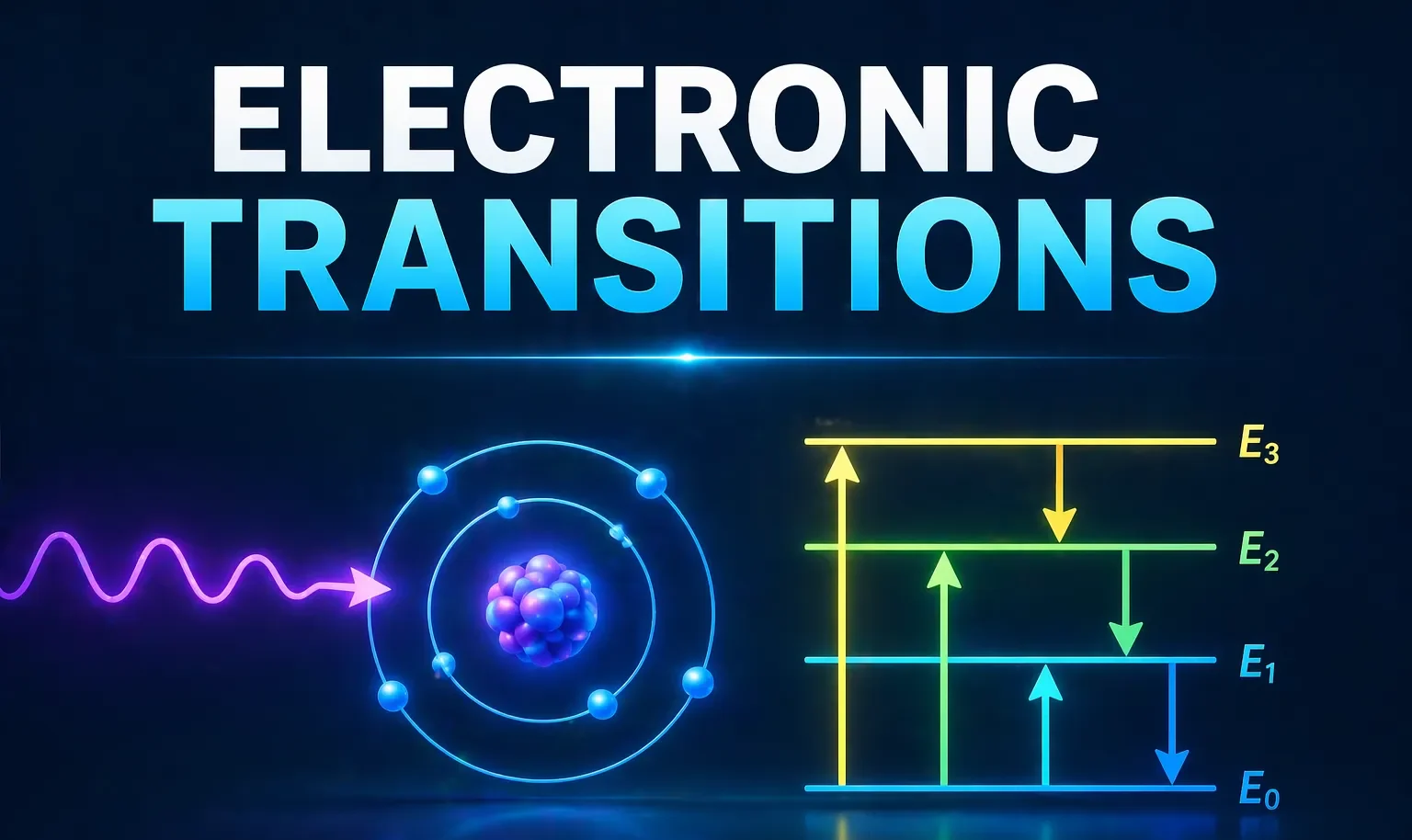
Definition of Electronic transitions
- Electronic transitions refer to the movement of electrons between different energy levels within a molecule upon absorption of light.
- In UV-Visible spectroscopy, these transitions typically include:
-
π → π*:
- Electrons in pi bonds (π bonds) are excited to anti-bonding pi-star (π*) orbitals.
-
n → π*:
- Non-bonding electrons (n electrons), often lone pairs on heteroatoms like oxygen or nitrogen, are excited to anti-bonding pi-star (π*) orbitals.
-
σ → σ*:
- Electrons in sigma bonds (σ bonds) are excited to anti-bonding sigma-star (σ*) orbitals.
- These transitions generally require higher energies (shorter wavelengths) compared to π → π* or n → π* transitions.
Energy Levels
-
Ground State:
- The lower energy state of the molecule, where electrons are in their stable, unexcited state.
-
Excited State:
- The higher energy state reached after electrons absorb energy and move to higher orbitals.
Advertisements
Selection Rules
Not all electronic transitions are permitted. The likelihood of a transition depends on certain selection rules:
-
Allowed Transitions:
- Transitions that typically involve a change in dipole moment, e.g., π → π* and n → π*.
-
Forbidden Transitions:
- Transitions that do not involve a change in dipole moment; for example, those occurring between orbitals of the same symmetry. These transitions are less likely or weaker in intensity.
Click Here to Watch the Best Pharma Videos
Advertisements