
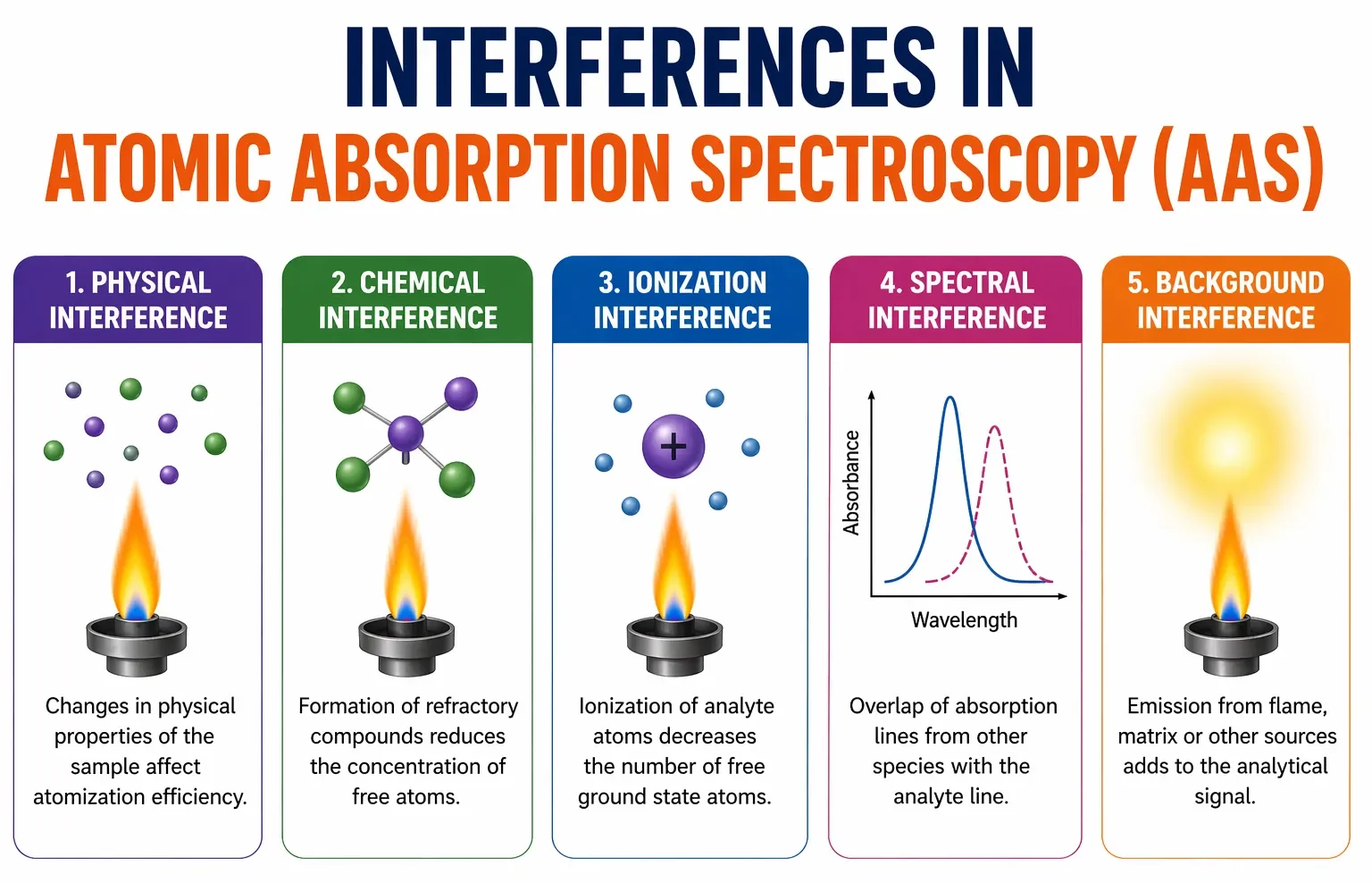
Interferences in Atomic Absorption Spectroscopy (AAS) include spectral and chemical effects reducing accuracy.
Interferences in Atomic Absorption Spectroscopy (AAS)
Interferences in AAS can impact the accuracy and reliability of measurements. They are categorized into three types:
-
Spectral Interferences:
- Cause: Occur when another species absorbs light at the same or nearby wavelength as the analyte.
- Examples: Overlapping absorption lines or stray light from the source.
-
Chemical Interferences:
- Cause: Changes in the analyte’s chemical form, preventing atomization, or reactions with other species in the sample.
- Examples:
- Matrix elements causing precipitation or complexation of the analyte.
- Flame characteristics (oxidizing/reducing) affecting analyte atomization.
-
Physical Interferences:
- Cause: Sample matrix properties affecting atomization efficiency or light transmission.
- Examples:
- Viscosity, refractive index, and surface tension impacting nebulization or mist formation.
- Dust or particulates scattering light.
Proper strategies to address these interferences are essential to ensure accurate analysis.
Advertisements