
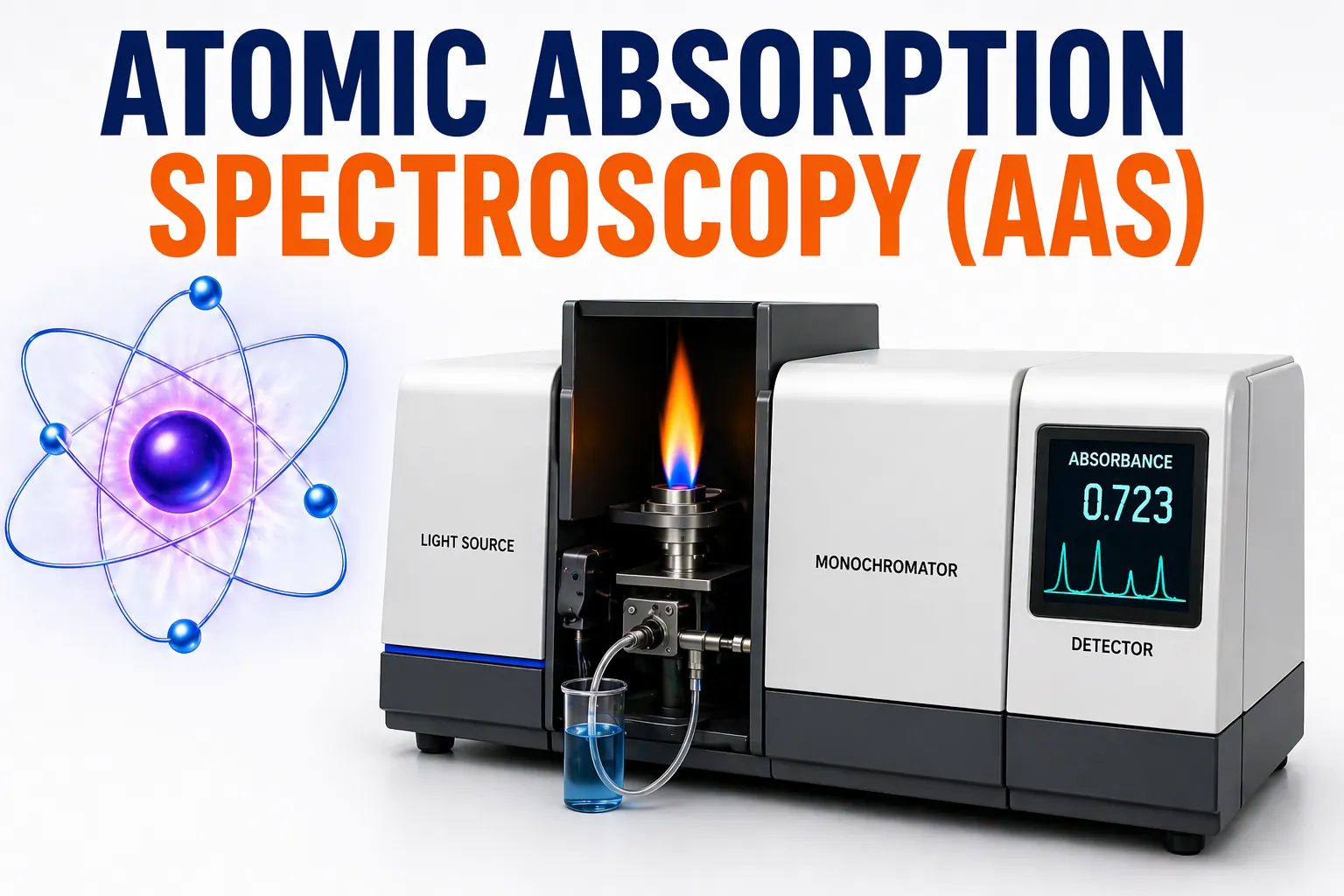
Introduction to Atomic Absorption Spectroscopy (AAS)
- Atomic Absorption Spectroscopy (AAS) is a quantitative analytical technique that measures the concentrations of elements by detecting the absorption of optical radiation (light) by free atoms in the gaseous state.
- AAS is widely used for the analysis of metals in various samples due to its specificity, sensitivity, and relatively simple instrumentation.
Principle
- In AAS, a sample is atomized, and the ground-state atoms absorb light of specific wavelengths emitted by a light source.
- The amount of light absorbed is proportional to the concentration of the element in the sample.
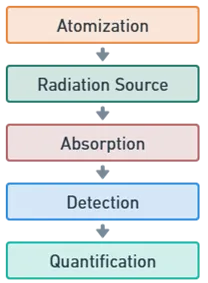
Process Steps
Advertisements
- Atomization: The sample is introduced into a flame or graphite furnace where it is vaporized and converted into free atoms.
- Radiation Source: A light source emitting the characteristic wavelength of the element of interest passes through the atomized sample.
- Absorption: Ground-state atoms absorb specific wavelengths, reducing the intensity of the transmitted light.
- Detection: The decrease in light intensity is measured by a detector.
- Quantification: Using Beer-Lambert Law, the concentration of the element is determined.
Key Equations of Atomic Absorption Spectroscopy (AAS)
Beer-Lambert Law in AAS:
$A = \log\left(\frac{I_0}{I}\right) = \varepsilon c l$
Advertisements
- Where:
- A = Absorbance
- I0 = Incident light intensity
- I = Transmitted light intensity
- ϵ = Molar absorptivity
- c = Concentration of the analyte
- l = Path length (usually constant in AAS)