
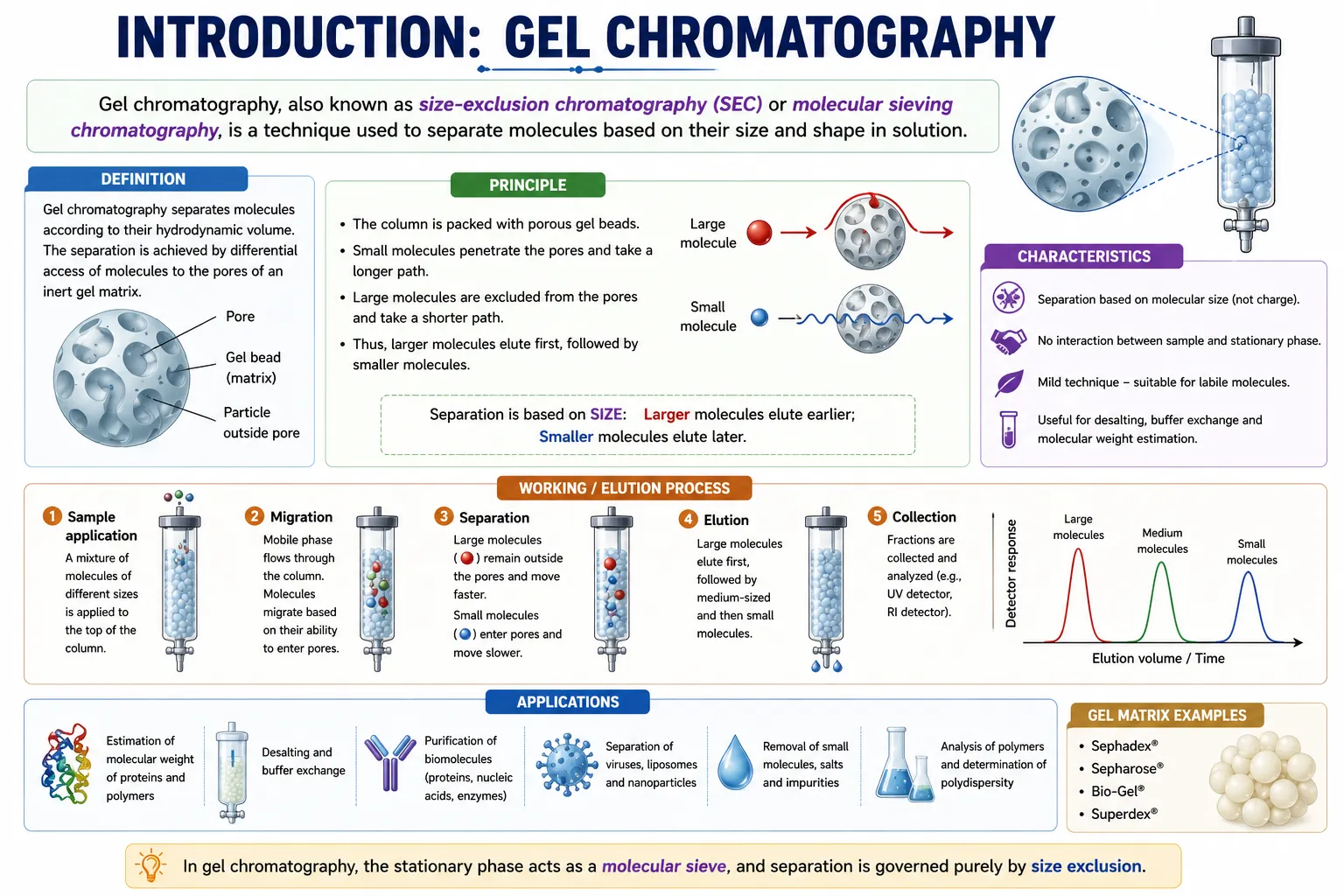
Introduction: Gel Chromatography explains separation of molecules based on size using a porous gel matrix.
Introduction: Gel Chromatography
- Gel Chromatography, also known as Size Exclusion Chromatography (SEC), is a technique that separates molecules based on size.
- It is widely used in the pharmaceutical industry for analyzing and purifying biomolecules such as proteins, peptides, nucleic acids, and polysaccharides.
- Column Composition: Packed with porous beads made of materials like agarose, dextran, or polyacrylamide.
- Separation Mechanism: Smaller molecules enter the bead pores, eluting slower; larger molecules bypass the pores and elute faster.
Advertisements
Principle
- Gel Chromatography operates on the size exclusion principle, where separation depends on a molecule’s size or hydrodynamic volume:
- Large Molecules: Cannot enter the pores, elute quickly.
- Intermediate Molecules: Partially enter pores, elute at intermediate times.
- Small Molecules: Enter most or all pores, elute last.
- Separation is based on molecular size in solution, not intrinsic size.
Classification of Gel Chromatography
- Based on Material and Use:
- Gel Filtration Chromatography (GFC): For aqueous samples; uses hydrophilic gels (e.g., dextran, agarose); applied in protein purification.
- Gel Permeation Chromatography (GPC): For synthetic polymers in organic solvents; uses hydrophobic beads (e.g., polystyrene).
- Based on Pore Size:
- Micro-Porous: For low molecular weight compounds.
- Meso-Porous: For medium molecular weight compounds.
- Macro-Porous: For high molecular weight compounds.
- Based on Usage:
- Analytical Chromatography: Analyzes molecular weight, size, and purity.
- Preparative Chromatography: Purifies and collects specific molecules in large quantities.
Advantages:
- Mild Conditions: Works under non-denaturing conditions, preserving the biological activity of sensitive molecules like enzymes or proteins.
- Versatility: Can be used for a wide range of molecules from small ions to large proteins or nucleic acids.
- High Resolution: Can effectively separate molecules with minor size differences.
- Desalting Capability: Efficient in removing small molecules like salts from larger ones in a sample.
Advertisements
Disadvantages:
- Limited Range: Each column has a specific molecular weight range. Molecules outside this range might not be separated efficiently.
- Bead Degradation: Over time, or under harsh conditions, the beads can degrade or shrink.
- Limited Chemical Compatibility: Some gels can be incompatible with certain solvents or conditions.
- Sample Recovery: Sometimes, the sample might interact non-specifically with the matrix, leading to reduced recovery.