
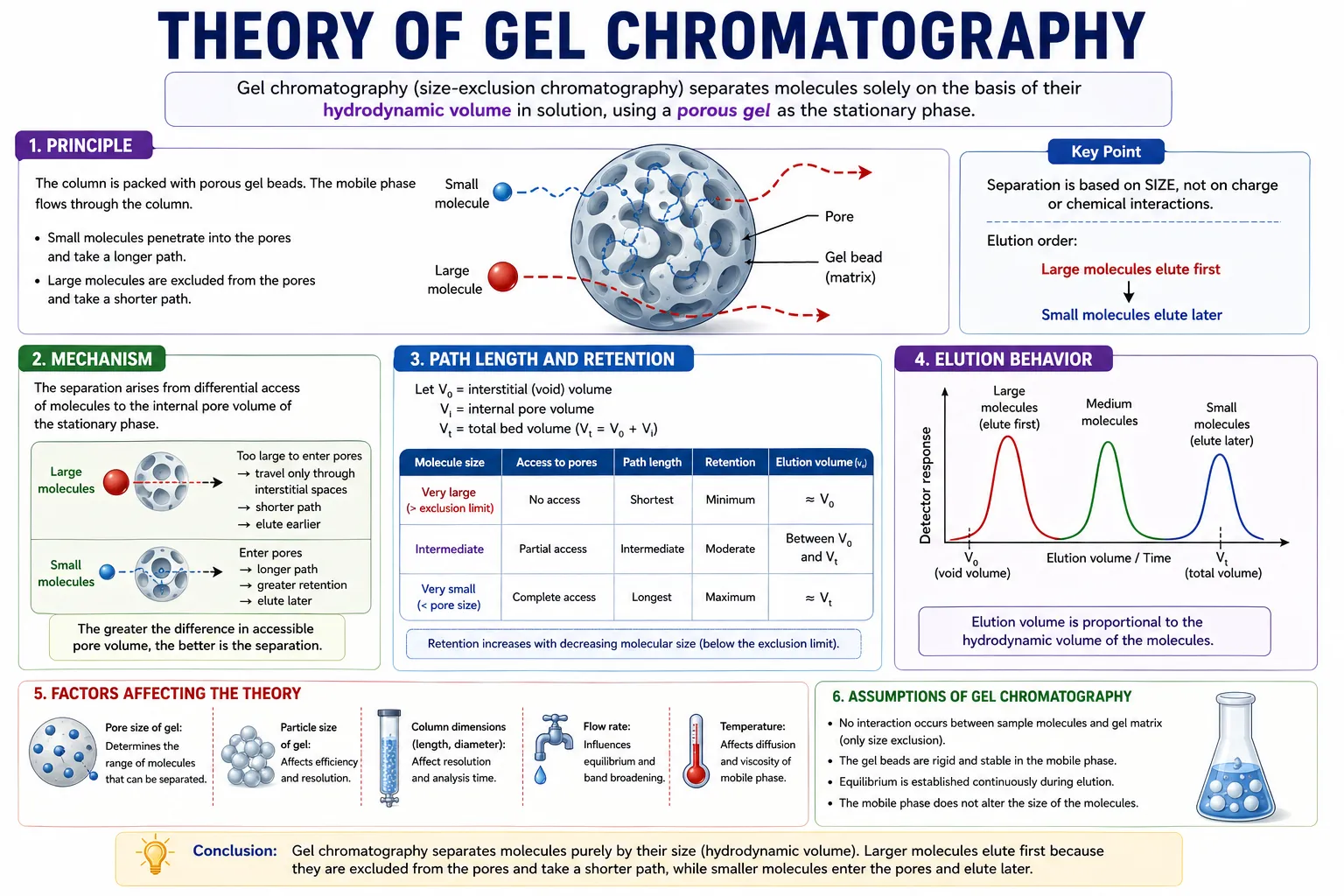
Theory of Gel Chromatography describes separation based on molecular size as smaller molecules enter gel pores.
Mechanism of Separation
- The separation mechanism is based on the size (hydrodynamic volume) of molecules relative to the pore sizes of the gel beads in the stationary phase.
-
Exclusion:
- Molecules: Larger than the largest pores.
- Behavior: Excluded from entering the beads.
- Elution: Pass straight through, eluting first.
-
Partial Penetration:
- Molecules: Smaller than the largest pores but larger than the smallest.
- Behavior: Enter some pores partially.
- Elution: Delayed compared to excluded molecules.
-
Total Penetration:
- Molecules: Small enough to enter all pores.
- Behavior: Spend the most time within the column.
- Elution: Pass through the column last.
Advertisements
Elution Volume
- Definition: The volume at which a molecule elutes from the column.
- Relation to Size:
- Larger Molecules: Smaller elution volume (elute first).
- Smaller Molecules: Larger elution volume (elute last).
Partition Coefficient (Kav)
- Definition: Describes the behavior of a molecule in the column.
- Calculation:
$K_{av} = \frac{V_e – V_0}{V_t – V_0}$
Advertisements
-
- Ve: Elution volume of the molecule.
- V0: Column void volume (volume outside the pores).
- Vt: Total column volume.
Relation to Molecular Size:
- A calibration curve is created by plotting Kav values of standards with known molecular weights.
- The molecular weight of unknown molecules is determined using their elution volumes and corresponding Kav values.
Click Here to Watch the Best Pharma Videos
Advertisements