
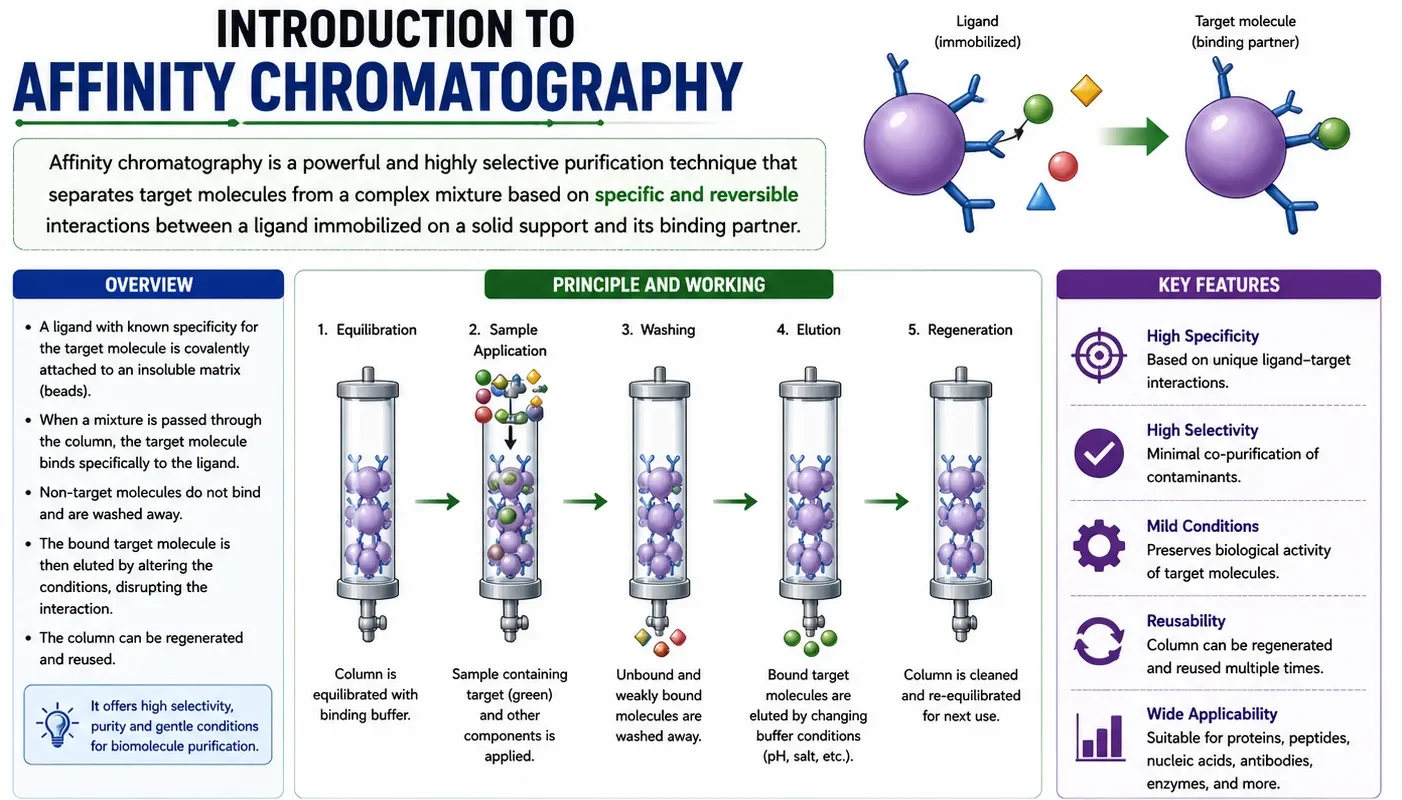
Introduction of Affinity Chromatography
Introduction of Affinity Chromatography explains separation of biomolecules based on specific binding interactions.
Introduction
- Affinity Chromatography is a liquid chromatography technique that separates molecules based on specific and reversible interactions between a molecule in a mixture and a counter-molecule bound to a stationary phase.
- It is extensively used in biochemistry and pharmaceuticals to purify and concentrate specific molecules from complex mixtures, such as isolating a protein from a cell lysate.

Advertisements
Principle
- Affinity chromatography relies on the selective and reversible binding of a target molecule (ligand) to a complementary molecule (counter-ligand) immobilized on the stationary phase.
- Key interactions include:
- Enzyme-Substrate
- Antigen-Antibody
- Receptor-Ligand
During the process:
- Binding: The target molecule binds to the immobilized ligand.
- Non-binding: Molecules with weak or no affinity pass through.
- Elution: The target molecule is released by altering conditions (e.g., pH, ionic strength) or introducing a competing ligand.
Advertisements
Advantages
- High Specificity: Selective interaction ensures high specificity for the target molecule.
- High Purity: Achieves significant purity in a single step.
- Versatility: Broad applicability with various immobilized ligands.
- Scalability: Suitable for both small-scale and industrial-scale processes.
Disadvantages
- Ligand Leakage: Ligands may leach from the column, leading to contamination.
- Time-Consuming: Binding equilibrium can slow down the process.
- Expense: High costs associated with ligands and setup.
- Non-specific Binding: Can lead to co-purification of undesired molecules.
Click Here to Watch the Best Pharma Videos
Advertisements